

TreeTake Network
Recognising environmental degradation as a structural driver of global geopolitical instability, the United Kingdom government has unleashed a massive international financing strategy. Foreign Secretary Ed Miliband announced the funding deployment at the United Nations General Assembly, where he brought together foreign ministers from multiple nations to address climate and nature-related security threats. The state-backed initiative establishes that ecological collapse and extreme weather anomalies are no longer merely environmental challenges, but are core national security hazards that directly threaten domestic food security, macro-economic infrastructure, and global sovereign stability.
The Multilateral Allocations and Strategic Targets
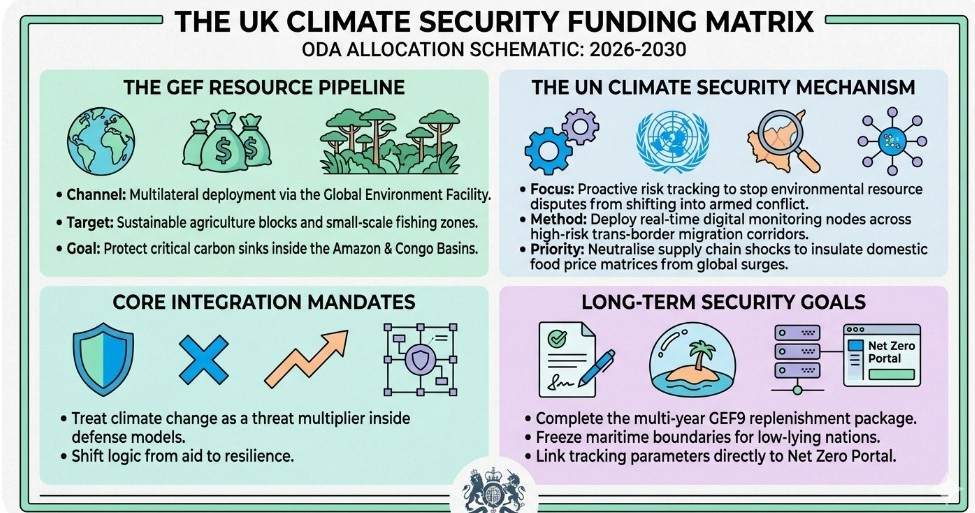
The state financing package channels resources through established multilateral frameworks to target primary carbon sinks and high-risk demographic basins. The vast majority of the allocation is directed as new funding from Official Development Assistance budgets to support the Global Environment Facility during its four-year replenishment window spanning from 2026 to 2030. The primary operational objective involves financing sustainable agricultural practices, reinforcing artisanal fishing frameworks, and protecting vulnerable populations across Africa, Asia, and Latin America from catastrophic droughts, desertification, and landscape concretion.
A highly specialised slice of the allocation involves a direct capital injection to the United Nations Climate Security Mechanism. This joint task force focuses on identifying, tracking, and defusing ecological stress points before resource scarcity transitions into violent conflict and involuntary human migration patterns. By shoring up biological systems in the Amazon and Congo basins, the strategic investment aims to build localised economic resilience, preventing cascading trans-border shocks from disrupting international trade pipelines and inflating the cost of basic consumer goods inside the domestic market.
The Security Directive and Institutional Re-Alignment
The UK delegation used its high-level plenary sessions at the United Nations to advocate for an absolute realignment of traditional defence planning models. Foreign Secretary Ed Miliband issued a stark directive to global delegates, warning that the immediate realities of landscape degradation demand a fundamental transformation in how modern states calculate risk. Miliband stated that the countries fit for the future will be those that see climate and nature as intrinsic to economic and national security, noting that nations must anticipate risks and invest in resilience before crises hit. He emphasised that the international community cannot afford to treat ecological collapse as an isolated environmental sector, but must instead integrate climate shocks directly into national defence strategies, intelligence networks, and strategic military planning.
This call for structural integration has been strongly supported by climate transition advisors and international trade specialists who argue that traditional political frameworks remain severely behind the operational realities tracked by the defence community. Commenting on the sideline negotiations of the UN summit, the UK Minister for Climate Transition, Katie White, confirmed that the military has been at the forefront of this planning for a long time because they have always seen that climate change is a threat multiplier. She pointed out that while defence analysts have long integrated resource disruption into active threat assessments, the broader political arena has failed to match that pace, making immediate financial mobilisation an absolute requirement to secure fragile supply paths ahead of global climate summits.
The Geo-Political Imperative and Economic Insulation
The financial commitment highlights a growing policy consensus that local market insulation is entirely impossible without comprehensive global environmental stabilisation. Under the current international security architecture, sudden disruptions to primary food production regions or vital maritime transit routes travel rapidly through interconnected global supply chains and volatile financial markets, transforming a localised drought or sea-level rise into an immediate domestic inflation spike.
By embedding climate and nature security at the absolute centre of foreign policy decision-making, the initiative seeks to establish a permanent framework for proactive environmental risk mitigation. Moving past reactive humanitarian aid structures, the multi-million-pound strategy prioritises early-stage infrastructure reinforcement, the deployment of automated ecological monitoring telemetry, and the legal recognition of maritime zones for low-lying nations facing existential threats from sea-level rise, thereby constructing an unyielding systemic shield to protect subcontinental development grids from future environmental shocks.



Leave a comment