

TreeTake Network
In a major structural push to transition subcontinental conservation from traditional methods into technology-driven administration, the Union Ministry of Environment, Forest and Climate Change has launched a comprehensive national initiative. Formally inaugurated in the capital, the Capacity Enhancement for Effective Forest Management Project establishes an expansive institutional framework to systematically upgrade the technical capabilities, operational logistics, and field-level planning arrays of frontline forestry personnel across the country. The bilateral project addresses changing forest dynamics, accelerating climate shocks, and the growing field responsibilities assigned to low-ranking terrain guards.
The Bilateral Financing and Nationwide Structural Blueprint
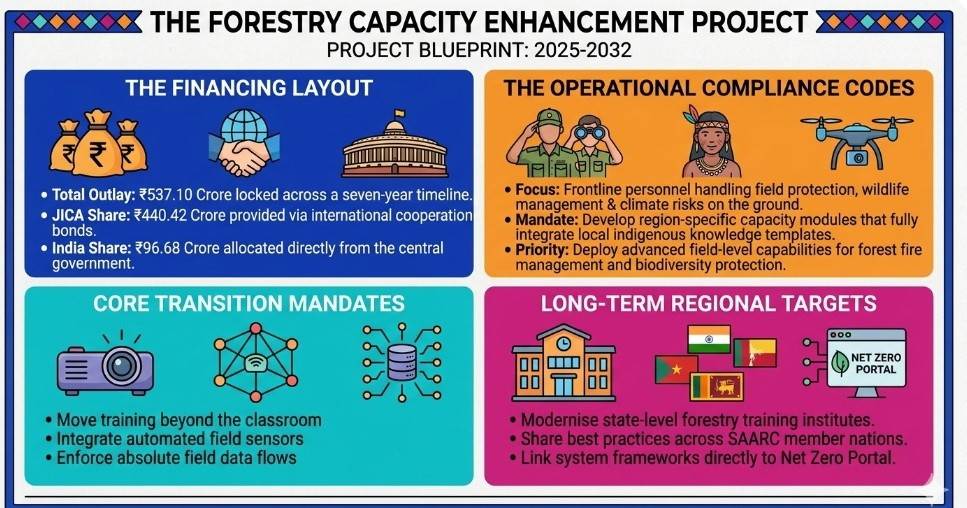
The seven-year project spans from the 2025–26 financial phase through 2031–32 and encompasses all states across the country, prioritising newly participating provinces while maintaining continuous institutional funding loops for zones established under previous forestry partnerships. The total material commitment for the multi-year project rests at 537.10 crore rupees. The financial layout relies heavily on international development cooperation, with the Japan International Cooperation Agency supplying a principal contribution of 440.42 crore rupees, while the Government of India provides a matching state treasury share of 96.68 crore rupees.
The primary administrative objective focuses on strengthening research and development frameworks to translate laboratory research outcomes into practical, field-ready training modules for frontline personnel. According to project briefings cleared by Additional Director General of Forests (Wildlife) Ramesh Pandey, the resources will be directly utilised to modernise central training institutes, upgrade state-level forestry schools, and finance targeted pilot applications on the ground. The strategic framework focuses heavily on developing region-specific capacity-building modules that integrate localised indigenous knowledge with emerging geospatial technologies, ensuring that field guards are equipped to handle terrain-specific landscape fragmentation.
The Administrative Mandate and Field Integration Metrics
Union Minister for Environment, Forest and Climate Change Bhupender Yadav emphasised that modern environmental challenges require expanding training beyond traditional classrooms. Commenting on the structural layout of the initiative, Bhupender Yadav stated that the launch of this project marks an important milestone in India's partnership with Japan in the forestry sector, noting that forests play a crucial role in climate action, biodiversity conservation, and supporting local livelihoods. He highlighted that forest fires represent a significant global challenge, and added that this project will strengthen technical capabilities for fire management by combining advanced scientific methods with indigenous knowledge.
This emphasis on local integration is structurally supported by senior forestry planners who point out that frontline guards require immediate access to automated warning systems rather than delayed bureaucratic briefs. The primary focus of the training curriculum involves decentralising data access, ensuring that field guards can independently parse remote-sensing data lines and implement active habitat restoration loops. By shifting the logic of forestry training from static classroom lectures to real-time field-level applications, the project seeks to establish an unyielding defensive grid to insulate the country's primary biodiversity reservoirs from climate-driven degradation.
Institutional Cooperation and Trans-Border Knowledge Sharing
The framework upgrades training academies and aims to share best practices with SAARC and other developing nations. Replacing paper registries, the seven-year plan integrates high-resolution tracking sensors, automated fire-detection systems, and digitised logs to ensure operational accountability across all state forest divisions.



Leave a comment