

The circular economy frameworks governing subcontinental industrial waste management have faced an intensive system breakdown. A comprehensive resource audit report compiled by the Central Electricity Authority has rejected multiple optimistic state compliance summaries, confirming a critical drop in fly-ash recycling indices across heavy coal-fired generation stations. The statutory evaluation marks an immediate collapse of the unalterable green-accounting narrative surrounding regional infrastructure management, revealing that hundreds of thousands of tonnes of hazardous industrial byproduct are bypassing brick manufacturing networks to be dumped illegally in open-air common lands. TreeTake presents a detailed operational report on this industrial gridlock, exploring the specific logistical bottlenecks, the economic friction voiced by small-scale brick cooperatives, and the urgent judicial demands for independent environmental compensation assessments.
The Audit Rejections and Accumulated Waste Packages
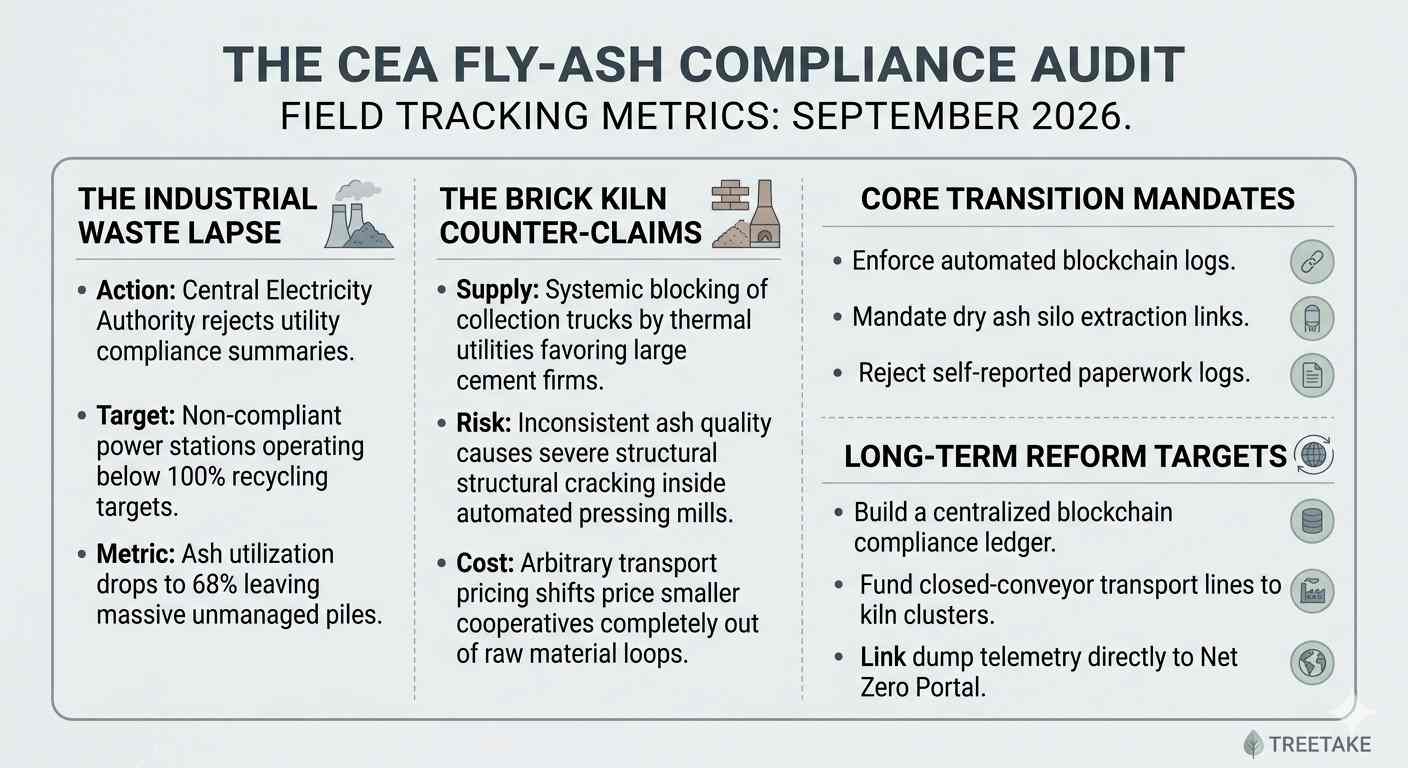
The baseline parameters governing the processing of coal-combustion residues underwent an immediate, data-driven transformation as federal resource investigators finalised their review of thermal utility performance logs. The field audit, which tracks data across major industrial zones, revealed a staggering reduction in the off-take quantities processed by regional construction material sectors. While the Union Ministry of Environment, Forest and Climate Change has long mandated a strict one hundred per cent fly-ash utilisation target for all coal-based power infrastructure, the actual recycling metrics have plummeted to an average of sixty-eight per cent across several high-capacity generation circles.
The core of the environmental friction turns on the severe breakdown of localised transport networks and dry fly-ash extraction systems. Auditors verified that four prominent thermal power generation stations located within high-density generation circles had systematically falsified their commercial recycling ledgers, listing massive quantities of waste as "utilised" when the material was simply shifted to unlined ash ponds or un-notified low-lying fields. "We are tracking a deeply disturbing pattern where thermal utilities reduce statutory disposal targets to mere paper entries while allowing thousands of tonnes of hazardous particulates to accumulate in open-air dumps," stated a senior technical director attached to the Central Electricity Authority during an emergency operational briefing. He emphasised that the audit has outright rejected attempts by utility boards to pad their environmental registers retroactively. "The records confirm that the small-scale brick manufacturing clusters were completely priced out of the raw material supply loops due to arbitrary transportation pricing shifts, meaning that public resource allocations were cleared without ground-level logistical validation."
Industrial Resistance and Small-Scale Cooperative Lapses
The enforcement bottleneck is heavily aggravated by a structural conflict between large energy conglomerates and the decentralised brick-kiln cooperatives that dominate subcontinental manufacturing borders. Under existing environmental policy frameworks, thermal plants are statutorily required to provide dry fly-ash completely free of cost to localised brick makers located within a three-hundred-kilometre radius. However, facility managers argue that while these supply rules look seamless on paper, local developers cannot execute high-speed material extraction during peak energy demand cycles due to inadequate silo infrastructure and continuous vehicle congestion.
This corporate industry narrative has faced firm resistance from cooperative leaders, who point out that thermal plants routinely prioritise large-scale commercial cement corporations over local brick makers, leaving smaller units without reliable access to raw material matrices. "The enforcement of these rigid utilisation targets represents an impossible, non-insurable operational burden for small brick cooperatives because the thermal utilities systematically block our collection trucks while demanding unofficial clearance fees," argued a regional secretary representing a prominent fly-ash brick manufacturers association. He stressed that technical constraints prevent immediate substitution across older kiln setups. "We are facing severe mechanical vulnerabilities, as inconsistent ash quality frequently causes structural cracking inside our automated pressing mills. Withholding necessary operational funds from local manufacturers while the state administration fails to guarantee an equitable, transparent supply of industrial residue will completely dismantle the regional building material supply chain."
Severe Atmospheric Degradation and Public Health Vulnerabilities
The continuous accumulation of unmanaged fly ash introduces a catastrophic threat to the region's protected ecosystems and peri-urban populations, functioning as a severe airborne pollutant during dry windy seasons. The systematic piling of fine silica, heavy metal residues, and unburnt carbon particles has created extensive dust zones around thermal clusters, leading to an immediate collapse in localised air quality parameters and severe contamination of surrounding agricultural topsoils.
"The rapid expansion of these unlined ash dumping grounds has triggered an extensive, unfixable collapse in our ambient environmental health registers," noted Dr Ashutosh Tripathi, a senior geospatial analyst specialising in subcontinental landscape dynamics, during an environmental evaluation session. He highlighted that the airborne dust has led to widespread crop degradation and spiked respiratory illness counts across rural settlements bordering the industrial zones. "The administration is focusing entirely on token green metrics, celebrating minor cement plant allocations while ignoring the massive volume of loose ash blowing across our fields. By suffocating the surrounding soil layers and entering local groundwater aquifers through unlined pond configurations, this ash crisis is driving a localised ecological collapse that no amount of cosmetic urban greening can ever resolve."
Strategic Pathways to Resource Security
Dismantling the systemic failures gridlocking industrial waste utilisation requires a total transformation of subcontinental catchment planning and ecological governance. First, the Ministry of Power must legally mandate the integration of high-resolution, unalterable digital weighing telemetry across all thermal ash silos, transferring all dispatch inputs to a centralised, blockchain-backed National Digital Traceability System that automatically flags unauthorised dumping operations. Second, local development bodies must be statutorily banned from approving new coal-fired expansions until a complete, multi-season independent environmental audit verifies that existing residue loads are fully absorbed by regional infrastructure networks. Finally, the central government must introduce a unified, fast-track fiscal ledger that links project funds directly to verified tree survival rates and aquifer health metrics around ash ponds, forcing utilities to finance automated, closed-conveyor transport lines to cooperative brick zones, thereby engineering absolute long-term accountability into the foundational tier of subcontinental development.



Leave a comment