

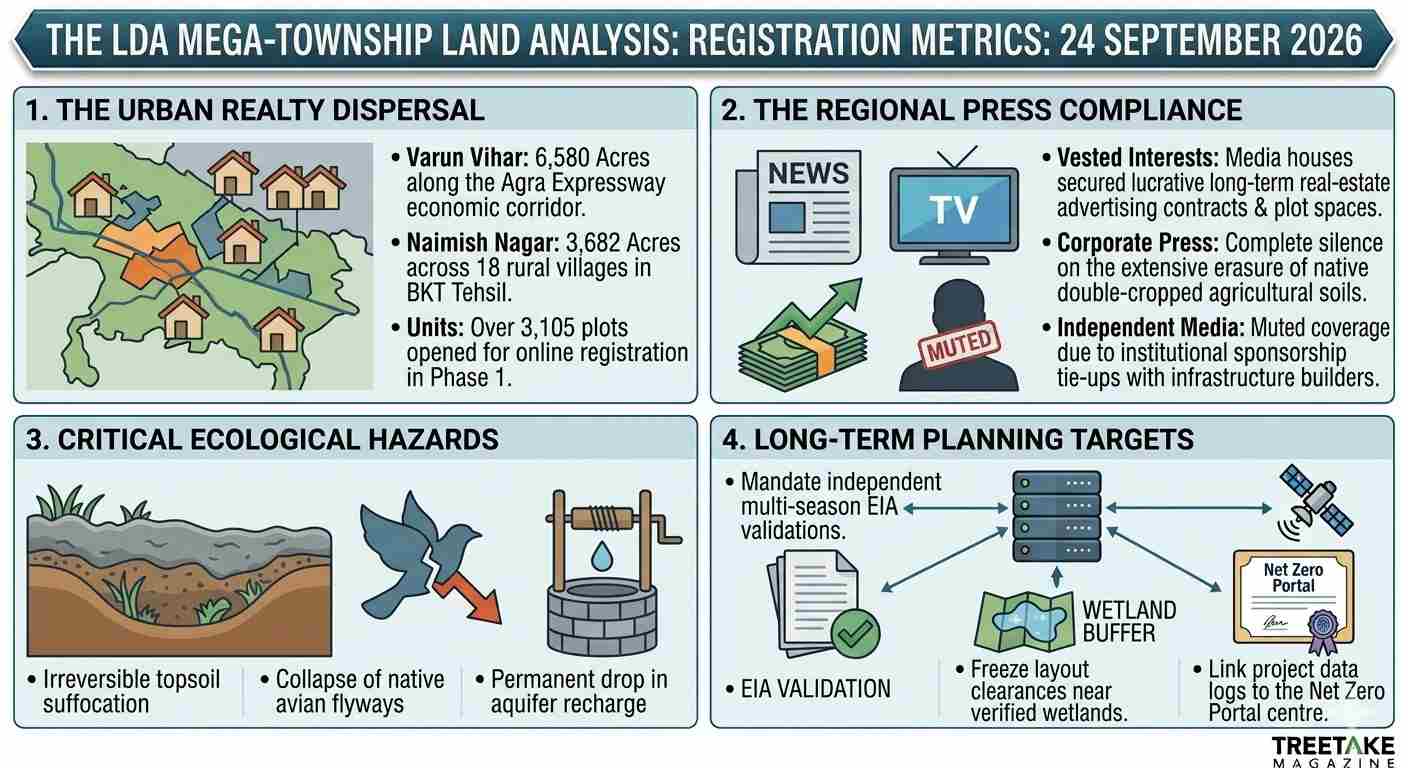
The architectural expansion of Uttar Pradesh’s capital district achieved its primary administrative milestone today, unleashing a structural shift that environmental economists warn could permanently break regional climate resilience. The Lucknow Development Authority has officially opened online registration for its dual flagship residential projects—the Varun Vihar Yojna spanning across the Agra Expressway zone and the Naimish Nagar Yojna carving into the Bakshi Ka Talab sector. This massive state-backed intervention will convert thousands of hectares of highly productive, double-cropped agricultural terrain and critical wetland buffers into a concrete smart-city infrastructure grid. TreeTake delivers a critical frontline report on this launch, exposing the systematic corporate and independent media silence surrounding the destruction of these vital carbon sinks, the permanent degradation of the regional topsoil matrix, and the severe habitat fragmentation threatening indigenous avian populations.
The Launch Mandate and the Corporate Media Blackout
The operational parameters governing the spatial layout of northern Lucknow underwent a permanent, state-backed modification on Thursday, 24 September 2026, as the Lucknow Development Authority formally activated its digital portals for plot allotments. The simultaneous roll-out stands as an unprecedented urban expansion, with the Varun Vihar layout encompassing 6,580 acres along high-speed economic transit lines and the Naimish Nagar scheme consuming 3,682 acres of contiguous rural landscape. While administrative bureaus celebrated the launch as a milestone for the State Capital Region framework, field telemetry maps confirm that the immediate physical clearing of these massive boundaries has initiated the systematic erasure of critical regional ecological buffers.
A deeply disturbing dimension of this mega-township deployment is the complete, coordinated absence of critical evaluation across mainstream communication channels. Both large corporate media houses and prominent independent digital platforms have completely ignored the severe ecological costs of the land conversion, focusing entirely on publishing promotional real-estate supplements and investment advertisements. Field analysts point out that this widespread editorial compliance stems directly from vested financial interests, as regional media conglomerates, broadcast networks, and local independent publishing outfits have secured lucrative long-term advertising contracts, media sponsorships, and prime commercial plot allocations within the newly launched township layouts. By prioritising these corporate revenue streams, the regional press has effectively muted public access to independent data-verified environmental impact reviews, leaving the permanent concretion of the district's primary carbon sinks entirely unscrutinized.
The Irreversible Loss of Multi-Cropped Alluvial Soils
The environmental cost of this media-insulated spatial spill is heavily compounded by the permanent erasure of the most productive agricultural tracts in the central plains. Unlike arid waste zones or barren municipal lands, the terrain targeted across the Bakshi Ka Talab tehsil consists of highly fertile, multi-cropped alluvial soils that have sustained complex rural agricultural economies and regional crop rotations for generations. The conversion of these double-cropped fields into asphalt roads and concrete foundations represents a permanent loss of regional food security assets and localised topsoil networks.
The physical clearing of these agricultural fields has drawn sharp warnings from soil scientists who emphasise that non-permeable paving disrupts the foundational tier of subcontinental hydrology. "The irreversible paving over of thousands of hectares of prime, multi-cropped agricultural land across eighteen contiguous villages represents a short-sighted destruction of our foundational ecological security," stated Dr Ashutosh Tripathi, a senior soil scientist specialising in subcontinental landscape indices, during an emergency catchment evaluation session on Thursday, 24 September 2026. He emphasised that the localised topsoil layers, which take thousands of years to accumulate their dense nutrient structures, are being systematically scraped away by heavy earth-moving equipment within days. "When you replace highly porous, active agricultural soils with non-permeable concrete slabs, you are not merely changing a land use category on a municipal ledger. You are permanently suffocating the natural biological activity of the earth and creating an unyielding block that prevents rainfall from recharging our deep regional aquifers, forcing the entire district into structural water scarcity."
Official Sustainability Claims and Developer Discursive Frameworks
The Lucknow Development Authority maintains that modern public housing designs successfully engineer sustainability into their core frameworks. Authority representatives argue that rapid population growth and shifting manufacturing zones present immense logistical monitoring hurdles, and assert that major enforcement sweeps proceed subject to resource availability. They claim that aggressive infrastructure projects like the CG City expansion are necessary to accommodate the rapid migration of populations into the state capital, and claim that all major works proceed subject to environmental clearance reviews.
The state planning wing fiercely rejects allegations of data manipulation, claiming that the municipal administration remains fully committed to sustainable modernisation. "We are balancing the massive, inevitable residential demands of a fast-growing state capital with responsible environmental planning, and our layouts incorporate modern green infrastructure that sets a new national standard," announced Anoop Kumar Misra, a senior urban planning director within the authority's engineering wing, during a technical briefing on the project's master roads system on Thursday, 24 September 2026. He emphasised that the mega-townships are legally structured to allocate large spaces to dedicated ecological zones. "The Varun Vihar layout explicitly designates over 980 acres exclusively for green belts, public parks, and preserved water bodies, while Naimish Nagar incorporates modern solid waste management facilities and centralised sewage treatment plants, ensuring that urban development does not compromise regional groundwater purity."
Severe Habitat Fragmentation and Avian Population Collapse
This official narrative has faced sharp opposition from independent environmental litigators and local citizen conservation networks, who argue that artificial green belts inside a high-density concrete township cannot replace the complex ecosystem services of natural land. The continuous clearance of high-density scrub networks, native tree clusters, and seasonal pools has completely dismantled the micro-habitats that support vulnerable regional wildlife, leading to an immediate collapse in localized ecological diversity.
"The rapid concretion of these contiguous rural zones has triggered an extensive, unfixable collapse in our regional biodiversity registers," noted Shanal Khullar, a field coordinator attached to a prominent subcontinental wildlife conservation foundation, during an environmental evaluation session on Thursday, 24 September 2026. She highlighted that the ongoing destruction of tall grasses, indigenous acacia patches, and seasonal pools has led to a dramatic drop in nesting counts for resident waterbirds and local raptor species across the northern peri-urban belt. "The administration is hiding behind superficial green labels, creating manicured public parks while simultaneously clearing the complex wild scrub networks that actually sustain our native fauna. By forcing wild species out of their natural foraging ranges into increasingly hostile urban fragments, we are actively driving a localised extinction event that no amount of cosmetic urban landscaping can ever resolve."
The legal dimensions of the conflict highlight a structural failure to enforce existing environmental safeguards against well-connected economic actors. "The statutory frameworks governing wetland protection in Uttar Pradesh are highly comprehensive on paper, but their enforcement is completely gridlocked by institutional lethargy and political pressure," noted Vibhor Gauba, a senior environmental advocate practising before the National Green Tribunal, during a legal review of infrastructure projects on Thursday, 24 September 2026. He warned that the administrative practice of delaying final notifications allows developers to establish irreversible ground realities that courts struggle to dismantle retroactively. "When local bodies delay the final notification of checked wetlands, they are actively creating a twilight zone that developers exploit to concrete over natural basins. We need immediate judicial intervention to hold municipal officers personally accountable under environmental protection acts for failing to protect these designated carbon sinks."
Strategic Pathways to Urban Sustainability
Dismantling the systemic environmental risks gridlocking local urban expansion requires an immediate overhaul of development approval protocols. First, the State Environment Department must legally mandate the integration of high-resolution, unalterable satellite telemetry to freeze the land-use baselines of all high-priority peri-urban water systems, rendering any unauthorised modifications by construction crews a non-bailable criminal offence. Second, local development bodies must be statutorily banned from entering the public registration phase until a complete, multi-season Environmental Impact Assessment is hosted on public-access servers for a minimum of sixty days, ensuring transparent data verification. Finally, the central government must introduce a unified, blockchain-backed National Digital Traceability System for urban infrastructure projects, forcing developers to submit to independent, annual ecological audits that link project funds directly to verified tree survival rates and aquifer health metrics, thereby engineering absolute long-term accountability into the foundational tier of subcontinental development.


.jpg?resize=120%2C90&ssl=1)



Leave a comment