

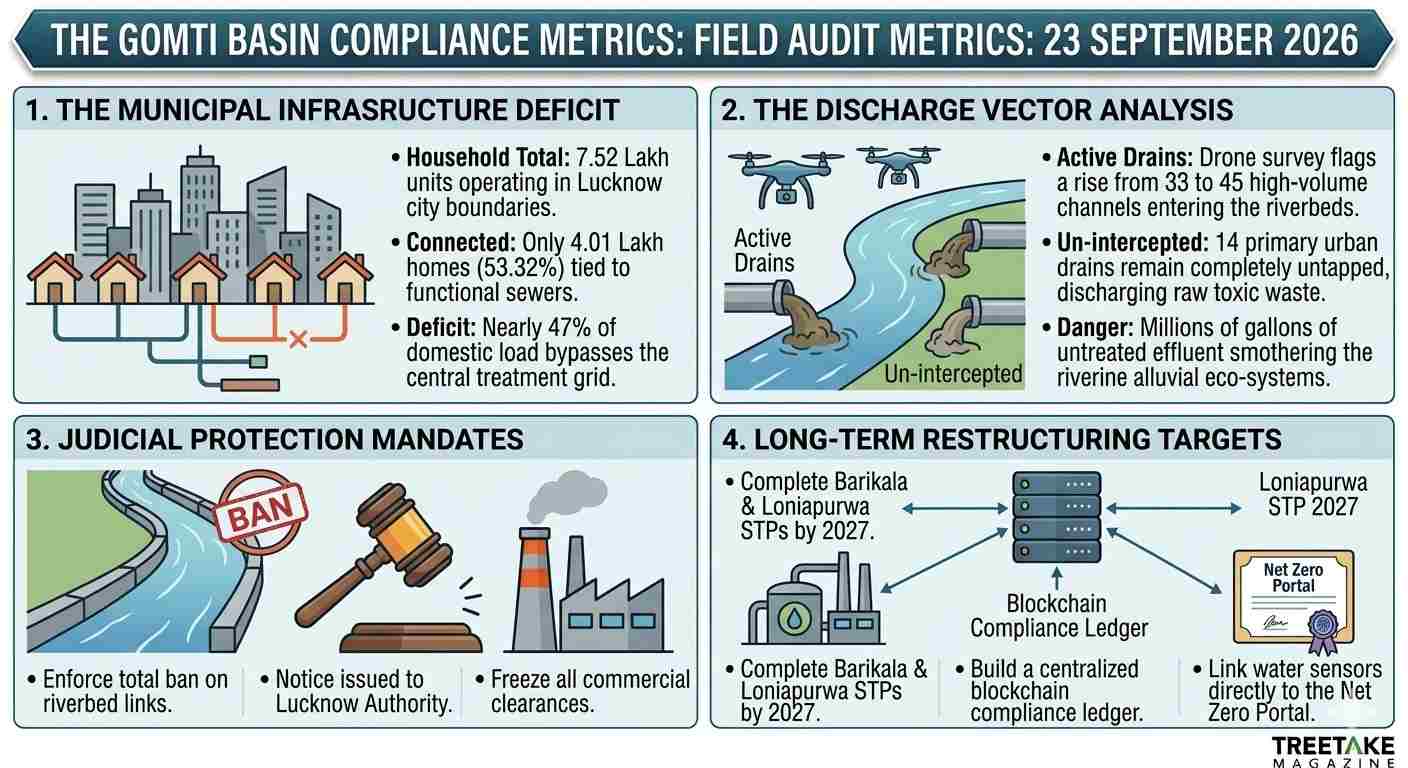
The institutional accountability loops regulating the protection of subcontinental river basins have faced an intensive technical review. According to the latest data audits compiled under the federal river rejuvenation monitoring programmes, the critical infrastructure grids designed to prevent untreated urban effluents from entering the Ganga main stem and its primary alluvial tributaries, including Lucknow’s Gomti River, continue to operate under severe structural deficits. TreeTake presents a detailed operational brief on this riverine crisis, examining the massive volume of unintercepted drainage vectors, the failure of municipal connectivity targets, and the urgent judicial interventions preventing unauthorised infrastructure expansions on fragile floodplains.
Untapped Sewage Discharges and Infrastructure Deficits
The operational parameters governing water resource conservation across Uttar Pradesh faced a significant technical challenge on Wednesday, 23 September 2026, as field telemetry logs confirmed that extensive columns of untreated municipal wastewater continue to bypass regional treatment facilities. The infrastructure review revealed that out of the massive quantity of daily sewage and industrial waste generated within major urban clusters, a highly disproportionate volume is routed directly into natural riverbeds through open, unintercepted drainage systems. The field findings indicate that the long-term failure to complete core sewerage connections leaves extensive urban boundaries entirely dependent on broken, obsolete municipal handling lines.
The crisis is particularly visible along the thirty-kilometre urban stretch of the Gomti River flowing through Lucknow, where recent extensive drone mapping surveys conducted by state engineering wings verified the presence of forty-five active, high-volume pollution drains discharging directly into the river channel. While the state administration has completed a series of high-capacity sewage treatment plants under the central Namami Gange framework—including a thirty-nine million litres per day facility—the ground-level infrastructure remains severely bottlenecked. Out of the 7.52 lakh total households residing within the capital municipal boundary, only 4.01 lakh domestic units are actively connected to the centralised sewer network, leaving nearly forty-seven per cent of the urban population reliant on unregulated septic tanks or open channels that dump raw toxic loads directly into the riverine ecosystem daily.
Judicial Bans and Floodplain Enforcement Clearances
The regulatory gridlock has drawn severe legal interventions from the National Green Tribunal, which has issued absolute interim restrictions to prevent infrastructure groups from encroaching upon fragile river boundaries. The principal bench in New Delhi has targeted the construction of heavy four-lane transport grids, commercial high-rise blocks, and extensive concrete embankments built by local development authorities directly over the active riverbeds and low-lying floodplains of the Gomti basin. The tribunal has firmly ruled that all municipal works must proceed in strict compliance with the statutory River Ganga Rejuvenation, Protection and Management Authorities Order, which legally isolates active channels from commercial exploitation pipelines.
This rigid judicial stance has faced defensive arguments from municipal development planners who maintain that expanding public utility links requires altering local river margins to accommodate rapid urban population migrations. Regional engineering bodies assert that modern riverfront layouts incorporate necessary flood protection walls that far exceed minimal safety targets. "The court can monitor implementation to prevent pollution, but overriding our long-term structural development projects based on volatile floodplain data lines introduces immense logistical planning uncertainties," argued a senior regional municipal official on Wednesday, 23 September 2026, defending the authority's infrastructure layouts. He stressed that the administration is working to execute progressive modernisation steps to intercept the remaining unmapped drains. "We are balancing the massive connectivity demands of a fast-growing state capital with responsible environmental planning, and our teams are working to finish the critical Barikala and Loniapurwa treatment installations by 2027 to satisfy the tribunal's newest water quality benchmarks."
Strategic Paths to Catchment Protection
Dismantling the systemic failures gridlocking subcontinental water governance requires a complete rewrite of regional environmental planning protocols. First, the Ministry of Jal Shakti must strip municipal corporations of the authority to self-report water quality data, transferring all monitoring inputs to a centralised, blockchain-backed National Digital Traceability System linked directly to automated, continuous water quality sensors at every active urban drain mouth. Second, local development bodies must be statutorily banned from issuing commercial building clearances within a five-kilometre radius of a verified floodplain, ensuring that natural hydrological shock absorbers are legally insulated from concretion. Finally, the central government must introduce a unified, fast-track fiscal ledger that holds state pollution control officers personally liable under environmental protection acts for failing to connect households to functional treatment grids, guaranteeing that long-term riverine sustainability is engineered directly into the foundational tier of subcontinental urban planning.



Leave a comment