

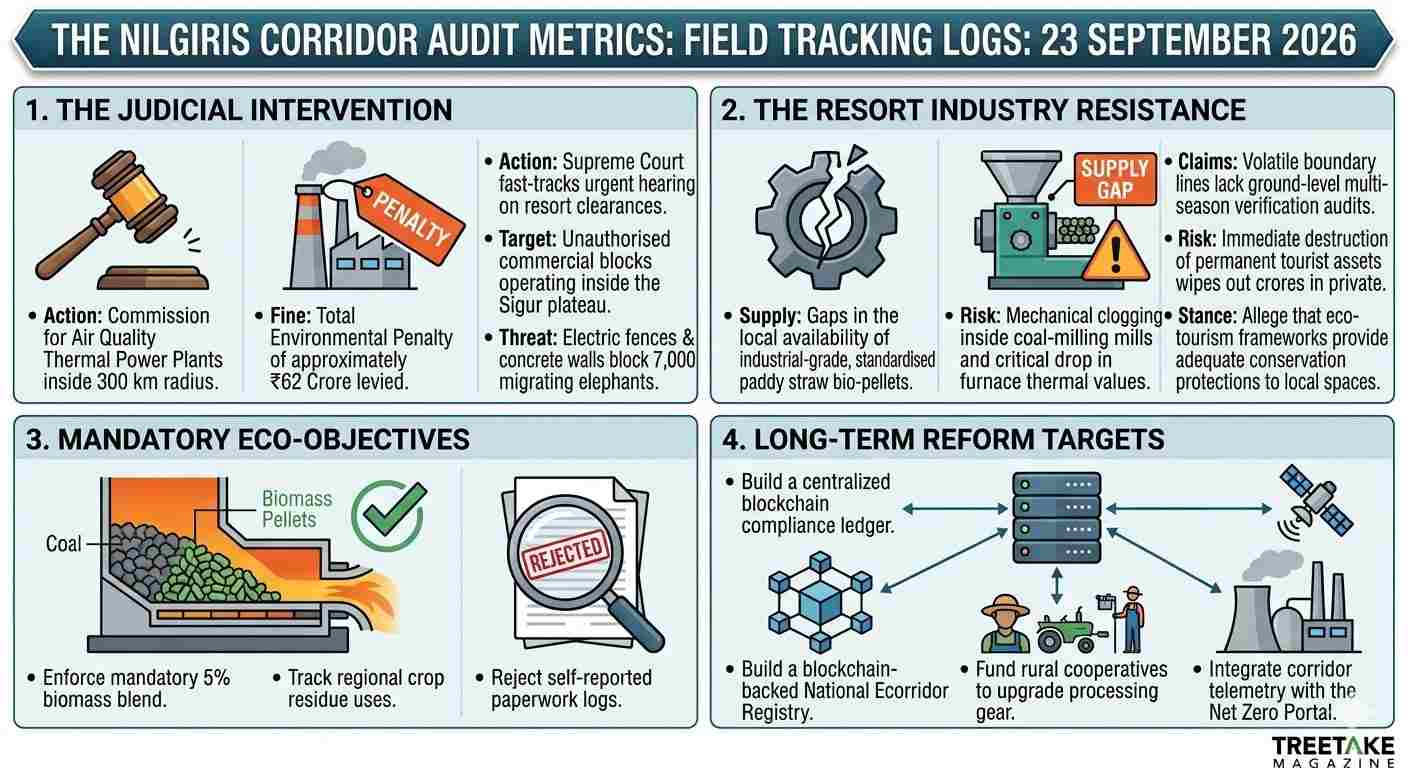
The architectural integrity of the subcontinent's premier elephant migration network faces a definitive statutory test before the highest court. Responding to extensive satellite telemetry logs and field enforcement sweeps executed across the sensitive Segur plateau, the Supreme Court of India has listed an urgent hearing to review widespread commercial encroachment within designated wildlife pathways. The judicial intervention targets dozens of high-profile luxury resorts and private commercial developments that have systematically built concrete infrastructure layouts directly over ancient elephant pathways, gridlocking the seasonal movements of the largest contiguous Asian elephant (Elephas maximus) population. TreeTake presents a detailed operational report on this landmark conservation battle, exploring the legal mechanisms governing corridor notifications, the economic resistance voiced by the hospitality sector, and the urgent deployment of unalterable boundary mapping frameworks to prevent long-term genetic isolation.
The Judicial Intervention and Spatial Encroachment Metrics
The operational parameters regulating large mammal protection across the Western Ghats underwent an immediate, high-stakes escalation on Wednesday, 23 September 2026, as the Supreme Court of India fast-tracked a special bench listing to arbitrate the enforcement of demolition notices issued against unauthorised commercial structures in the Nilgiris district. The judicial review follows a comprehensive compliance audit submitted by the state-appointed expert committee, which conducted intensive spatial mapping across the critical Sigur elephant corridor. The field findings revealed that despite explicit statutory bans and repeated conservation warnings, multiple luxury hospitality groups had systematically expanded their commercial building footprints inside the designated eco-sensitive zone.
The Sigur corridor functions as a vital, irreplaceable ecological bridge connecting the Western and Eastern Ghats, enabling over seven thousand elephants to migrate seasonally between the Mudumalai, Bandipur, and Wayanad sanctuary complexes in search of forage and water. However, field telemetry confirmed that private developers have built extensive electric fencing, heavy concrete boundary walls, and sprawling resort villas directly across these historical movement tracks. This artificial fragmentation forces elephant herds out of their natural migratory buffers into surrounding human-dominated agricultural settlements and village pasture lands, driving a catastrophic spike in human-wildlife encounters, crop-raiding incidents, and retaliatory wildlife mortalities along the fringe sectors.
Official Conservation Mandates and Commercial Pushback
The apex court’s aggressive stance has drawn immediate, defensive arguments from regional hospitality federations and private landholders who assert that the sweeping demolition orders violate basic commercial rights and ignore local economic realities. Resort owners argue that their properties operate under valid municipal licences and that the state forest department has systematically altered corridor boundary lines without conducting transparent, ground-level multi-season ecological audits. They maintain that the sudden enforcement of absolute infrastructure bans will wipe out hundreds of crores in tourism investments and destroy localised employment loops.
"The enforcement of these blanket demolition structures represents an unfair, non-insurable economic shock to the regional hospitality sector because the corridor boundaries remain administratively volatile," argued a senior executive representing the Nilgiris Luxury Resort Owners Association on Wednesday, 23 September 2026. He stressed that modern eco-tourism setups incorporate adequate conservation safeguards that far exceed minimal municipal codes. "We are balancing the massive, inevitable economic demands of a fast-growing tourism sector with responsible environmental planning, and our layouts are purposefully designed to maintain open corridors. Penalising legitimate businesses by ordering the immediate destruction of permanent structures based on contested satellite parameters will completely dismantle the public-private partnership models that sustain regional forest conservation efforts."
This commercial industry narrative has faced firm resistance from federal conservation architects and legal advocates, who emphasise that resource sovereignty and species preservation cannot be compromised to protect commercial exploitation pipelines. Watchdog groups maintain that the Right of Passage for elephants is a fundamental extension of the Right to Life under the Constitution, rendering any commercial encroachment within notified pathways a non-negotiable violation. "The expert committee logs have verified over thirty-five commercial structures operating in flagrant violation of the initial corridor notifications, and the court has directed the regional administration to submit a comprehensive compliance log detailing closure actions," announced a senior legal advocate representing the wildlife conservation society during a press briefing outside the Supreme Court. He confirmed that field teams are deploying automated remote sensing to prevent any further structural non-compliance. "We have established an absolute enforcement baseline, and no corporate entity will be permitted to exploit economic scale parameters to block these ancient biological lines. The clearance of these blockades will proceed through unalterable judicial mandates regardless of political or commercial pressure."
The Academic Critique and Genetic Containment Concerns
The institutional stand-off has revived an intense, high-stakes academic debate among landscape ecologists and subcontinental population geneticists regarding the structural isolation of top-tier megafauna within fractured habitats. Independent data analysts point out that while traditional sanctuary models focused entirely on protecting stationary core areas, the long-term survival of wide-ranging species relies completely on preserving dynamic spatial connectivity.
"The deployment of fast-track judicial hearings to enforce elephant corridor clearances represents a critical transition toward data-driven environmental governance across the conservation sector," noted Dr Alok Ranjan, a senior conservation biologist specialising in subcontinental megafauna dynamics, during an institutional evaluation session on Wednesday, 23 September 2026. He highlighted that allowing concrete barriers to sever the Sigur plateau creates an irreversible genetic bottleneck. "When you isolate seven thousand elephants within small, disconnected pocket reserves, spatial saturation occurs rapidly, and inbreeding levels spike. The animals are not entering village crop fields because they are aggressive; they are entering them because their ancient, open migratory paths are physically blockaded by swimming pools and luxury villas. True sustainability requires that the judiciary legally insulate these corridors from all future commercial developments, transforming these pathways into unalterable national ecological assets."
Strategic Pathways to Corridor Continuity
Securing the long-term future of the Asian elephant requires moving beyond reactive legal battles toward integrated, community-backed landscape restoration frameworks. The Ministry of Environment must urgently establish a permanent, blockchain-backed National Eco-Corridor Registry, legally freezing the land-use baselines of all verified migration channels and rendering any unauthorised construction a non-bailable criminal offence. Second, regional forest departments must introduce community-led stewardship models, recruiting and training local tribal youths as specialised tracking guides to manage human-elephant encounters and secure immediate reporting of herd movements. Finally, the central government must introduce a unified, digital ledger for immediate crop and property compensation payments, utilising automated mobile banking to disburse market-rate financial restitution to affected farmers within forty-eight hours of a verified incident, thereby neutralising local hostility and fostering an environment of tolerant coexistence across the expanding conservation frontiers.



Leave a comment