

The administrative frameworks regulating seasonal air quality across the National Capital Region faced a major structural enforcement sweep today. Moving decisively ahead of the impending crop-residue burning cycle, the federal pollution monitor has cracked down heavily on multiple thermal power generation stations located within the vulnerable three-hundred-kilometre containment boundary of New Delhi. The statutory intervention addresses long-standing compliance delays, converting administrative targets into direct financial consequences for defaulting infrastructure conglomerates. TreeTake presents a comprehensive operational update on this industrial intervention, examining the strict biomass blend metrics, the operational friction voiced by energy developers, and the strategic rollout of real-time emission tracking networks to safeguard subcontinental air basins.
The Statutory Penalty Loop and Mandatory Biomass Blend Metrics
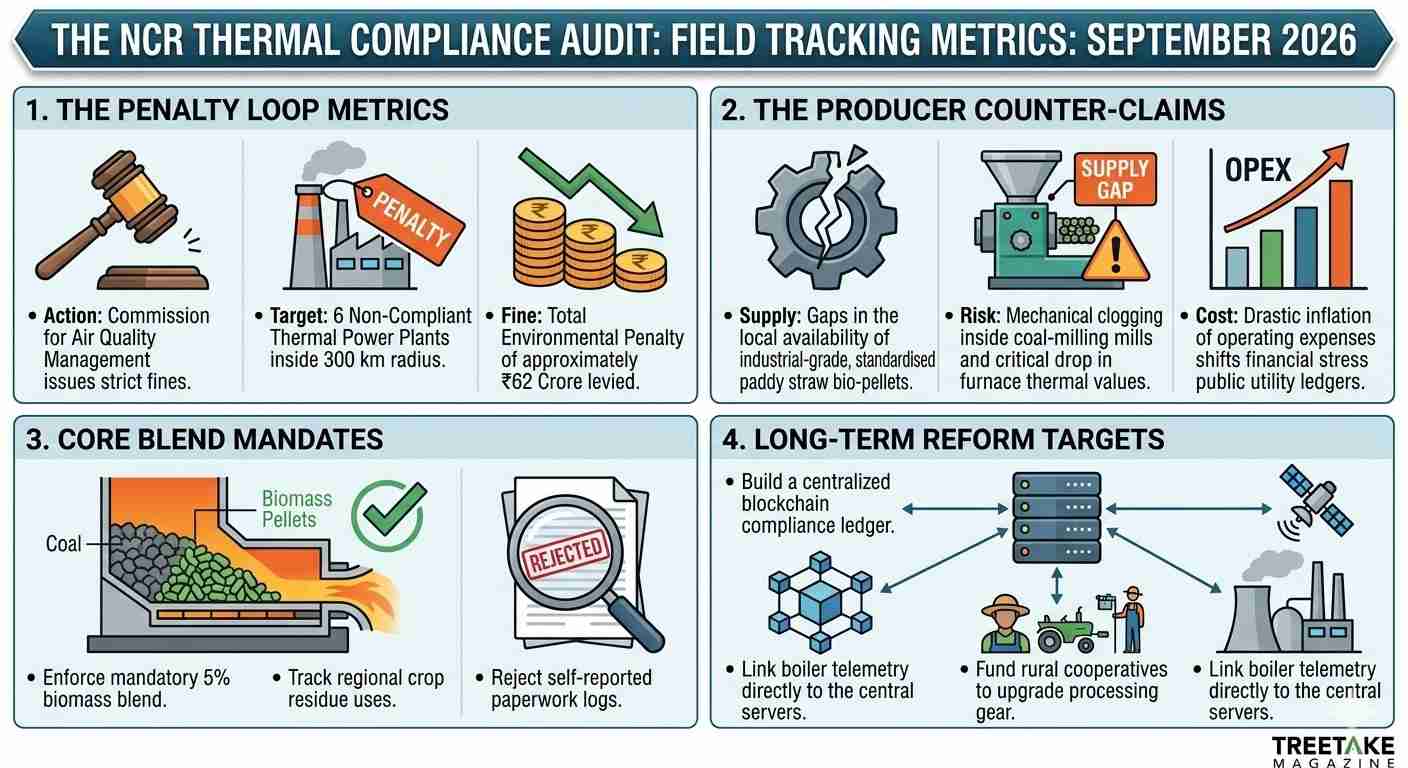
The operational parameters governing large-scale power infrastructure underwent an immediate, data-driven escalation on Wednesday, 23 September 2026, as the Commission for Air Quality Management (CAQM) finalised a series of extensive environmental compensation orders against defaulting coal-fired utilities. The regulatory crackdown, executed across key provincial generation circles, follows an exhaustive multi-month review of state-backed and private utility performance indicators. The field findings revealed that six major regional thermal stations had systematically failed to satisfy the central government's mandatory guidelines regulating the utilization of agricultural residues for cleaner co-firing operations.
The statutory directions mandate that all coal-based thermal utilities located near the capital territory must blend a minimum five per cent composition of compressed biomass pellets or paddy-straw briquettes within their baseline fuel input lines. This environmental policy is specifically engineered to create an immediate economic off-take market for the massive volume of agricultural stubble produced by farmers across Punjab, Haryana, and western Uttar Pradesh, thereby transforming a major airborne pollutant into a valuable low-carbon energy resource. However, field logging systems confirmed that multiple facilities operated significantly below the required levels. Acting on these unalterable data trends, the authority has imposed an aggregate environmental compensation penalty of approximately sixty-two crore rupees across six prominent installations, including the Rajiv Gandhi Thermal Power Plant managed by the Haryana power utility, the Guru Hargobind Thermal Power Plant in Punjab, and the Harduaganj Thermal Power Station situated in Uttar Pradesh.
Official Implementation Mandates and Energy Producer Resistance
The aggressive enforcement sweep has drawn immediate, defensive responses from regional infrastructure operators and state electricity boards, who claim that the penalties disregard severe structural gaps in the subcontinental biomass supply chain. Power plant managers argue that while co-firing targets look flawless on paper, local developers cannot secure a consistent, high-density flow of standardised paddy straw pellets from decentralised rural processing units. They maintain that the sudden imposition of heavy fiscal penalties will restrict vital working capital and disrupt the operational stability of regional power networks.
"The enforcement of these heavy environmental compensation structures represents an impossible, non-insurable operational burden for regional thermal stations because the raw material logistics remain completely unformalised," argued a senior operations executive representing a prominent state power generation corporation on Wednesday, 23 September 2026. He stressed that technical constraints prevent immediate compliance across older generation units. "We are facing severe mechanical vulnerabilities, as unrefined agricultural pellets frequently cause structural clogging inside our coal-milling machinery and degrade our furnace thermal values. Penalising infrastructure operators by withholding necessary project funds while the central administration fails to guarantee a reliable, industrial-grade supply of processed bio-pellets will severely compromise regional grid stability as winter energy demands peak."
This state industry narrative has faced firm resistance from federal pollution control architects, who emphasise that public health and resource preservation cannot be compromised to accommodate corporate operational delays. Regulators maintain that the current penal directives follow repeated warnings and multi-year transition windows that were systematically ignored by utility boards. "The total Environmental Compensation imposed across these six non-compliant thermal power plants amounts to around sixty-two crore rupees, and the commission has directed the concerned bodies to execute immediate deposits to satisfy our statutory enforcement codes," announced a senior technical representative attached to the Union Ministry of Environment, Forest and Climate Change during an official status presentation. The ministry confirmed that regional teams are executing strict verification sweeps to ensure full compliance. "We have established an absolute tracking baseline, and no utility will be permitted to exploit economic scale parameters to bypass our clean air directives. The recovery of these penalties will proceed directly through unalterable land revenue arrear channels if compliance deadlines are breached."
The Academic Critique and Carbon-Accounting Constraints
The institutional stand-off has revived an intense, high-stakes academic debate among environmental economists and subcontinental energy analysts regarding the structural integration of circular economy principles inside primary infrastructure. Independent data analysts point out that while traditional emission policies relied entirely on end-of-pipe filtration systems, the new biomass mandate seeks to regulate the foundational tier of raw material supply chains.
"The deployment of automated biomass co-firing fines represents a critical transition toward data-driven environmental governance across the energy sector," noted Dr Sunanda Sen, an urban infrastructure analyst specialising in subcontinental transport and generation ecology, during an interview on Wednesday, 23 September 2026. She observed that using independent tracking tools dismantles the old reliance on contractor-led self-compliance logs, which routinely hid zero-blending operations. "However, the next challenge for the commission is ensuring that the entire supply chain is digitally mapped from the farm field to the furnace stack. True sustainability requires that the money recovered from these environmental compensation penalties is channeled directly back into rural cooperative networks to finance high-speed pellet-making machinery, thereby turning a punitive regulatory mechanism into a self-sustaining green investment loop."
Strategic Pathways to Infrastructure Compliance
Sustaining the clean energy transformation requires moving beyond retrospective penal interventions toward integrated, multi-agency logistical support systems. The Ministry of Power must urgently establish automated regional Biomass Supply Hubs adjacent to high-capacity thermal stations, formalising long-term supply contracts with local farmer collectives to guarantee the delivery of standardised, moisture-controlled bio-pellets. Second, regional engineering circles must integrate real-time automated boiler telemetry linked directly to the commission's central server, allowing operators to adjust fuel blend values based on localised atmospheric changes dynamically. Finally, the central government must introduce a unified, blockchain-backed National Digital Traceability System for all agricultural waste utilisation projects, requiring power developers to submit to weekly independent technical audits to ensure full compliance before winter inversion conditions freeze the regional air quality index.



Leave a comment