

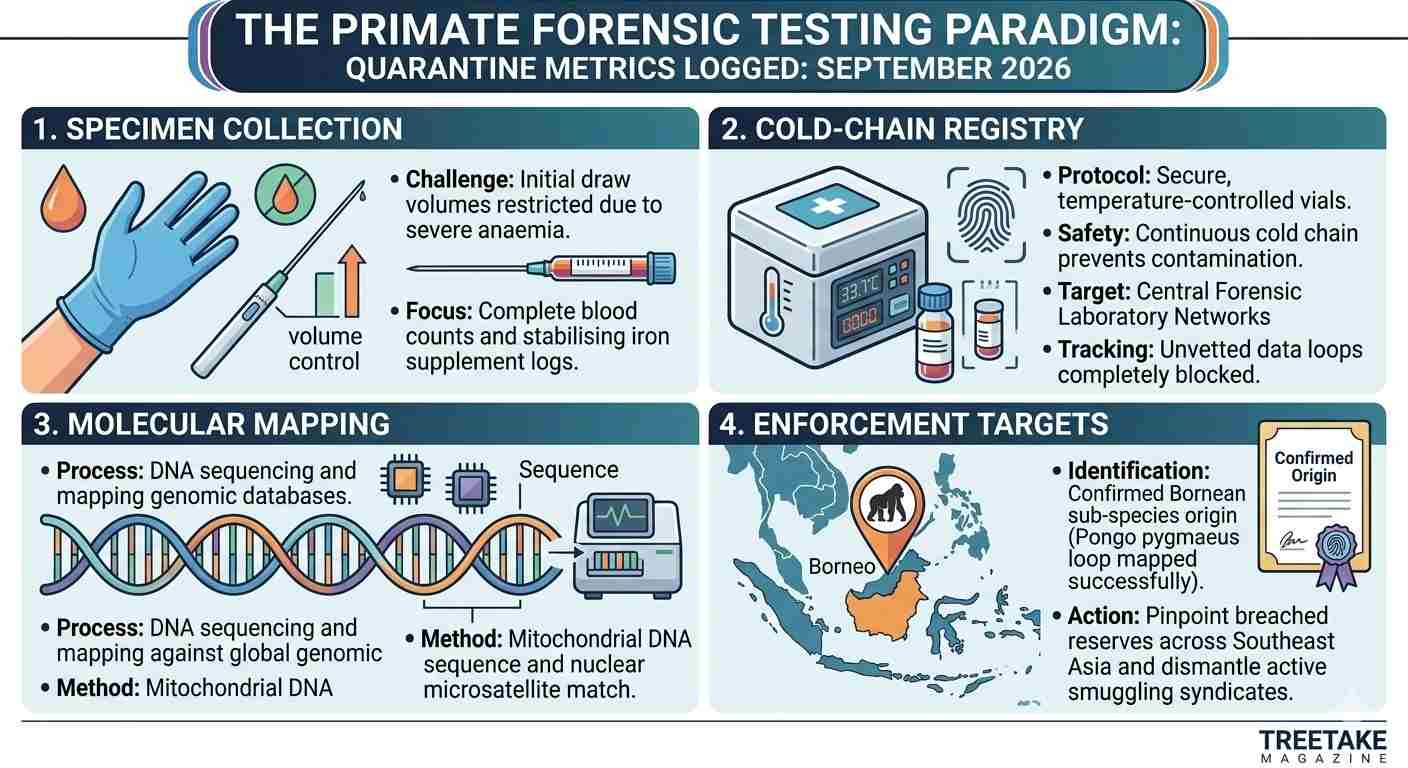
The high-stakes molecular phase tracking the international black-market trafficking of five infant orangutans rescued in coastal Odisha has officially yielded its foundational scientific datasets. Moving past the preliminary logistical delays forced by the animals' clinical vulnerabilities, geneticists have processed the initial blood and serum profiles to establish structural genomic identities for the recovering primates. TreeTake presents a detailed operational report on this forensic breakthrough, examining the exact sub-species allocations, the intensive haematological stabilisation routines managed by the state nursery panel, and the trans-border enforcement frameworks required to shut down multi-million rupee exotic wildlife smuggling corridors.
Mitochondrial Mappings and Geographic Point-Source Forensics
The technological tracking mechanisms deployed to dismantle trans-continental exotic wildlife supply chains achieved a permanent breakthrough on Wednesday, 23 September 2026, as forensic scientists completed the preliminary sequence alignments for the juvenile primates. The molecular extraction, conducted inside high-security cleanrooms to isolate uncontaminated genomic lines, focused on mapping mitochondrial DNA sequences and highly variable nuclear microsatellite markers against established global great ape repositories. This definitive analysis allows investigators to bypass the superficial anomalies of physical transit and identify the exact evolutionary boundaries of the confiscated fauna.
The final laboratory matrices have successfully differentiated the genetic coordinates of the five infants, definitively mapping their maternal lines to the critically endangered Bornean (Pongo pygmaeus) species rather than the neighbouring Sumatran (Pongo abelii) stocks. By resolving this specific subspecies classification, scientists have provided the Wildlife Crime Control Bureau and international tracking networks with absolute empirical proof of geographic extraction. The genetic data confirms that the infants were systematically poached from pristine rainforest pockets within the Indonesian or Malaysian borders of Borneo before being introduced into the maritime and overland smuggling networks that terminated in the Balasore forest division on Tuesday, 8 September 2026.
Haematological Stabilisation Metrics and Quarantine Protocols
The molecular validation has run concurrently with an intensive, highly restricted medical recovery programme overseen by the specialised technical care committee at the Nandankanan Zoological Park in Bhubaneswar. The initial collection of biological samples faced severe hurdles as frontline diagnostics revealed that three of the five juveniles were suffering from varying degrees of moderate to severe anaemia, meaning that veterinary panels had to tightly restrict initial blood draw volumes to prevent inducing hypovolemic shock or critical cortisol stress spikes in the fragile animals. Over the past week, the application of customised iron supplements and fluid therapies has successfully stabilised the haematological baselines across the entire nursery registry.
Day-to-day veterinary charts confirm that the acute monsoon fever spikes that previously disrupted the health logs have been completely suppressed, with all five juveniles registering stable, baseline rectal temperatures hovering consistently within the safe physiological band of 98 to 99 degrees Fahrenheit. Specialised curators continue to manage a rigorous hand-rearing framework, administering advanced milk formulas every two hours supplemented with fresh apple extracts, banana fluids, and soft steamed potatoes to rebuild depleted mineral matrices. To protect the emotionally fragile primates from maternal separation trauma and secondary viral pathogens, the directorate has maintained an absolute quarantine buffer, utilising background music therapy to suppress stereotypic pacing and barring all non-essential personnel from the nursery facility.
Expert Insights and Institutional Testimony
The integration of veterinary logs and administrative declarations provides an unyielding window into the operational realities of this international rescue. The technical care panel has emphasized that absolute clinical isolation remains the non-negotiable baseline for the animals' long-term psychological and physical survival during the thirty-day mandatory quarantine pipeline.
"The overall health condition of the orangutans seems to be stable, and the latest blood parameters indicate that their systems are responding positively to our intensive nutritional adjustments," stated Sanath Kumar N, Director of the Nandankanan Zoological Park, during a formal briefing at the veterinary centre on Wednesday, 16 September 2026. He confirmed that the initial diagnostic panel included comprehensive skeletal radiography to rule out any underlying structural abnormalities induced by illegal transit. "X-rays and blood samples of the animals were taken to ascertain their individual health condition and facilitate advanced testing. We are monitoring their responses around the clock to intercept any secondary complications."
This baseline health update is supported by senior forestry administrators who point out that genetic validation is the only bulletproof path to tracing active global poaching routes. "Conducting DNA tests is part of the process to ascertain the origin of the orangutan genetics, species classification, and their parents," announced Ganesh Ram Singhkhuntia, State Forest and Environment Minister, during an official policy review session on Thursday, 10 September 2026, where he underscored that the animals have no natural ecological footprint on the subcontinent. "It will also help the investigation into how the animals came to Odisha. They are not native to India, and we must find the exact syndicates responsible for this breach."
The forensic complexities of matching these exotic biological lines require accessing highly specialised, scarce international primate databases that are rarely maintained within regional diagnostic facilities. "An appropriate laboratory needs to have the standard DNA sample profile of orangutans for comparison," explained a senior Forest Department official close to the Special Task Force investigation on Wednesday, 16 September 2026, detailing the systemic constraints that initially delayed the molecular tracking pipeline. "Such laboratories are not very common, and we had to execute meticulous cold-chain controls to guarantee sample integrity before the mapping arrays could be safely initialised."
The focus must now transition to balancing immediate veterinary interventions with long-term clinical safety metrics to prevent irreversible developmental harm. "The members of the technical committee visited the high-risk care centre and collected samples for various tests, including a Complete Blood Count, to detect any latent infection in the body," reported Pradeep Mirase, Deputy Director of the Nandankanan Zoological Park, detailing the updated field parameters on Wednesday, 16 September 2026. He clarified that the veterinary board is utilising these continuous diagnostic updates to engineer an unyielding permanent management plan. "The findings would not only guide immediate treatment but also help experts decide the most suitable long-term living conditions and management plan for the rescued primates."
Strategic Paths to International Wildlife Security
Dismantling the multi-layered networks driving the international exotic pet trade demands a structural transition from slow, post-facto forensic analysis to real-time molecular enforcement at the borders. First, the Ministry of Environment, Forest and Climate Change must establish automated, high-security Wildlife Forensic Desks at all major international aerial and maritime ports, providing customs units with portable genetic testing blocks capable of verifying protected non-native species signatures within hours of interception. Second, India must aggressively advocate for an automated, cross-border digital ledger linked directly to Southeast Asian forestry databases, allowing instant verification of genetic origins and parentage tracking. Finally, the central government must implement strict statutory mandates that compel local courts to finalise exotic repatriation rulings within a maximum of forty-eight hours post-forensic confirmation, guaranteeing that endangered infants are returned to native sanctuary arrays before long-term captivity causes irreversible cognitive harm.



Leave a comment