

TreeTake Network
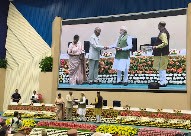
The baseline parameters governing international environmental diplomacy faced an aggressive structural realignment in the national capital today. Officially opening the National Green Tribunal's landmark international conference on "The Future of Environment and Climate Dynamics" at Vigyan Bhawan, New Delhi on Saturday, 19 September 2026, Prime Minister Narendra Modi issued a powerful structural indictment against the climate reporting mechanisms of Western economies. Addressing a high-level assembly of Supreme Court Justices, Chief Justices, and judicial representatives from 17 foreign nations, Modi brought forward hard empirical metrics to challenge the long-standing international narrative that routinely penalises developing economies for global warming. The Prime Minister explicitly rejected the Western practice of shifting climate accountability onto developing populations, pointing out that developed nations maintain a staggering six times higher per capita carbon emission level compared to India. By highlighting this massive disparity, Modi positioned the subcontinental green transition not as an act of global compliance, but as a sovereign balancing act that must aggressively safeguard domestic industrial progress. "Often the responsibility for carbon emissions is wrongly placed upon developing countries, whereas the reality has already been that India contributes less than half of the global average," Prime Minister Modi stated forcefully during his keynote address, directly confronting the historical inequities built into international regulatory frameworks. He added that developed nations have six times India's per capita carbon emissions, and New Delhi strongly highlights this fact on global platforms: “And I would say to every Indian: You too say this forcefully.” Modi underscored that India remains the only G-20 nation to have fulfilled its Paris Agreement commitments ahead of schedule, proving that localised execution can outpace Western public relations mandates.
The opening session, which was closely attended by Chief Justice of India Surya Kant, Union Environment Minister Bhupender Yadav, and NGT Chairperson Justice Prakash Shrivastava, directly targeted the growing friction between environmental activism and critical development infrastructure. A primary focus of the deliberations turned heavily on what the leadership termed as the counter-productive weaponisation of public interest litigation by external actors aiming to stall India’s sovereign clean energy independence. The Prime Minister voiced serious concerns over the pattern of legal interventions that systematically target India’s zero-emission nuclear energy generation pipeline. Modi stated that closure demands and legal battles frequently emerge "whenever he advances work on nuclear energy generation, those who preach most loudly about the environment actively oppose clean energy solutions by filing court cases to halt the government's nuclear initiatives." This pattern of litigation creates a severe operational contradiction, stalling the exact low-carbon baseload technologies required to permanently displace fossil fuels. Supporting this stance, Chief Justice Surya Kant called for a major transition in subcontinental environmental jurisprudence toward "eco-centric proportionality". Tracing the deep roots of India's conservation history, the Chief Justice noted that the gathering of jurists, scientists, and policy architects from nearly thirty nations underlined the global urgency of climate justice. "From the dawn of civilisation, India has held eternal reverence for Mother Nature," Chief Justice Surya Kant stated, describing the foundational legal texts as a moral covenant with past, present, and future generations. He firmly reminded the assembly that safeguarding nature is not merely an act of altruism but one of self-preservation, warning that "progress without preservation is but a mirage that vanishes in the desert of ecological ruin."
Resolving the deep global divisions gridlocking environmental governance requires moving beyond punitive domestic litigation toward clear, science-based legal metrics. The international legal community must formalise an independent carbon-accounting standard that factors historical cumulative emissions into all trade and carbon regulations, ensuring developed nations pay their fair share of the global transition deficit. Concurrently, domestic green tribunals must establish an expedited clearance track for zero-emission energy infrastructure like nuclear and smart-grid arrays, blocking frivolous litigations from halting national grid decarbonisation. Finally, the Ministry of Environment must link state infrastructure funds directly to localised climate metrics verified by India’s new Net Zero Portal and automated ISRO satellite data, replacing unverified state compliance self-reports with hard terrestrial science.
As the climate crisis accelerates subcontinental monsoon failure and triggers unprecedented urban heat anomalies, the frontline of environmental defence has shifted from legislative chambers to the courts. The National Green Tribunal’s international conference at Vigyan Bhawan marks a critical turning point in global climate governance. By utilising the stage to expose the six-fold emission disparity of developed economies, the Prime Minister has fundamentally shifted the focus of global climate diplomacy. TreeTake Magazine presents a comprehensive operational update on this legal mobilisation, tracking how the shift toward eco-centric proportionality could finally balance subcontinental infrastructure development with rigid, unyielding ecological preservation.



Leave a comment