

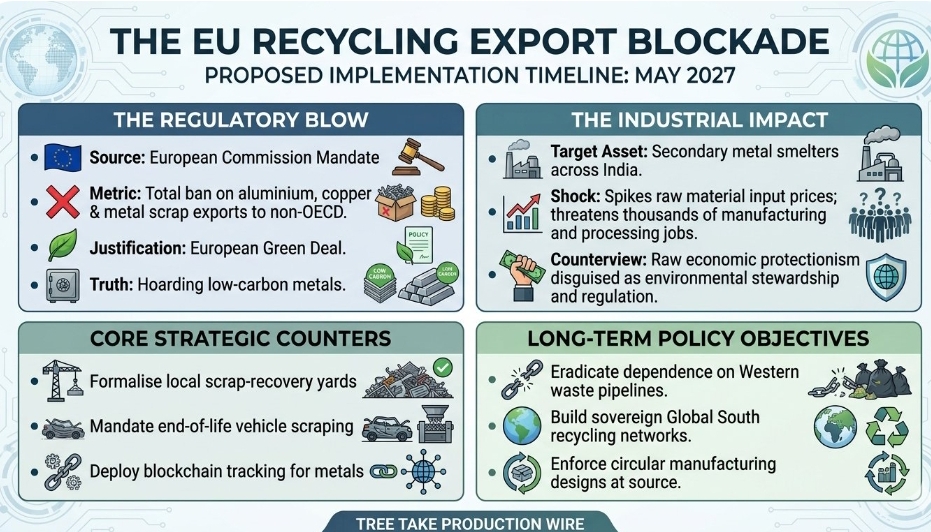
As the Union government aggressively targets a closed-loop circular economy, a massive regulatory threat from Western European markets is poised to disrupt subcontinental manufacturing infrastructure. Under a highly restrictive environmental trade proposal from the European Commission, India is on track to be completely barred from importing essential non-ferrous metal scraps, including aluminium and copper waste, from the European Union. TreeTake presents a critical operational brief on this impending trade blockade, examining the raw economic protectionism behind the EU's environmental arguments, the massive supply chain shock facing Indian recycling facilities, and the urgent necessity for domestic heavy industry self-reliance.
The European Commission’s Statutory Mandate
The baseline parameters governing how recyclable commodities move across the global market are facing a severe, structural intervention from European regulators. According to a formal statutory proposal finalised by the European Commission, India will be explicitly included among the non-OECD nations prohibited from importing metal waste and aluminium scrap directly from the economic bloc. This sweeping legislative measure is designed to take absolute effect in May 2027, marking a complete tightening of Europe's Waste Shipment Regulations across all twenty-seven member states.
The European Union frames the impending export ban as a necessary environmental intervention under the overarching European Green Deal. Brussels argues that keeping scrap metals within its borders reduces carbon leakage, saves energy in local smelting plants, and ensures that recyclable waste is not processed unscientifically in developing countries. However, trade analysts and Indian industrial groups have exposed a highly cynical counterview. They argue that under the guise of green policy, the EU is executing a naked protectionist strategy to corner global secondary raw materials, intentionally choking the manufacturing growth of fast-developing competitor nations like India while ensuring its own domestic automotive and construction sectors retain monopoly access to cheap, low-carbon recycled inputs.
Supply Chain Shocks and Industrial Repercussions
The immediate fallout for India’s recycling and manufacturing landscape is projected to be immense and deeply destabilising. India remains one of the world's largest importers of EU metal scrap, utilising hundreds of thousands of tonnes of imported aluminium and steel waste annually to feed its domestic secondary metallurgical units. This recycled metal forms the foundational raw material for producing automotive components, structural engineering frameworks, consumer electronics, and heavy machinery, providing a low-cost, energy-efficient alternative to the highly polluting mining and refining of primary bauxite and iron ore.
The sudden restriction has triggered a fierce institutional stand-off between international trade bodies and domestic recycling federations. "The proposed EU scrap metal export ban represents a direct, structural shock to India's circular economy targets," stated Sanjay Mehta, President of the Material Recycling Association of India (MRAI), during an emergency industry risk assessment. He emphasised that the sudden severing of European supply lines will force domestic smelting units to scramble for alternative, potentially lower-grade inputs, spiking raw material volatility and threatening thousands of industrial jobs. "We are looking at an artificial market distortion where high-quality recyclable commodities are being hoarded by developed nations. This completely undermines the spirit of global climate cooperation and penalises developing economies that have built robust, state-of-the-art recycling facilities over the past decade."
The Industrial Counterview and Global Friction
Economic friction has spilt into multilateral diplomatic forums, with Indian officials raising serious concerns about the weaponisation of environmental regulations to create unfair trade barriers. Indian metallurgical experts argue that local recycling yards have already achieved strict international environmental safety standards, rendering the EU's claims of preventing unscientific waste processing entirely obsolete.
"European climate policy is increasingly functioning as a sophisticated tool for industrial protectionism," noted Dr Rajeev Ananthan, a senior environmental economist specialising in subcontinental supply chains. "By preventing the export of metallic scrap to non-OECD countries like India, the European Union is effectively subsidising its own industrial transition at the direct expense of the Global South. This policy does not eliminate global carbon emissions; it merely forces developing nations to either expand primary mining or source lower-grade scrap from less regulated regions, which ultimately worsens global environmental degradation."
From the European perspective, however, the narrative remains rigidly anchored in domestic resource security and carbon neutrality metrics. EU policymakers maintain that scrap metal must be classified as a strategic asset rather than disposable waste. "If the European Union is to achieve its target of a climate-neutral continent by 2050, we must ensure that our precious, low-carbon raw materials remain within our industrial ecosystem," stated a senior trade attaché to the European Commission during a regulatory briefing. "Exporting our high-quality metallic waste to regions that do not enforce identical carbon-accounting rules or equivalent environmental standards undermines our domestic investments in green smelting and allows foreign manufacturers to gain an unfair competitive advantage using our own recycled resources."
This stance has drawn blistering pushback from local industry operators who face an immediate resource vacuum. "Our manufacturing plants rely heavily on the predictable flow of clean, sorted non-ferrous scraps from European yards to maintain our production schedules," argued Mohan Suresh, Managing Director of a prominent secondary aluminium smelting conglomerate in western India. "We cannot substitute these massive volumes overnight with domestic collections, which remain largely unorganised and structurally fragmented. If this trade blockade goes into full effect without substantial bilateral modifications, the cost of raw materials for India's auto-component and green energy infrastructure sectors will skyrocket, severely stalling our national manufacturing growth."
Strategic Paths Forward
Dismantling the impact of the upcoming 2027 European metal blockade requires an immediate, structural rewrite of India’s domestic scrap-management policies. First, the Ministry of Steel and the Ministry of Commerce must aggressively establish automated, national Scrap Collection Hubs across all major Tier-1 and Tier-2 Indian cities, formalising localised waste recovery pipelines to replace lost European volumes. Second, the government must introduce strict domestic end-of-life vehicle scrapping mandates and enforce rigid electronic-waste recovery targets, ensuring that internal metallic lifecycles are closed seamlessly. Finally, India’s trade missions must urgently negotiate independent, bilateral recycling treaties with non-EU resource-rich corridors across the Global South and the Middle East, effectively diversifying import vectors and guaranteeing long-term resource security before the Western restrictions freeze the international supply chains.



Leave a comment