

A Unification of Global Jurisdictions
TreeTake Network
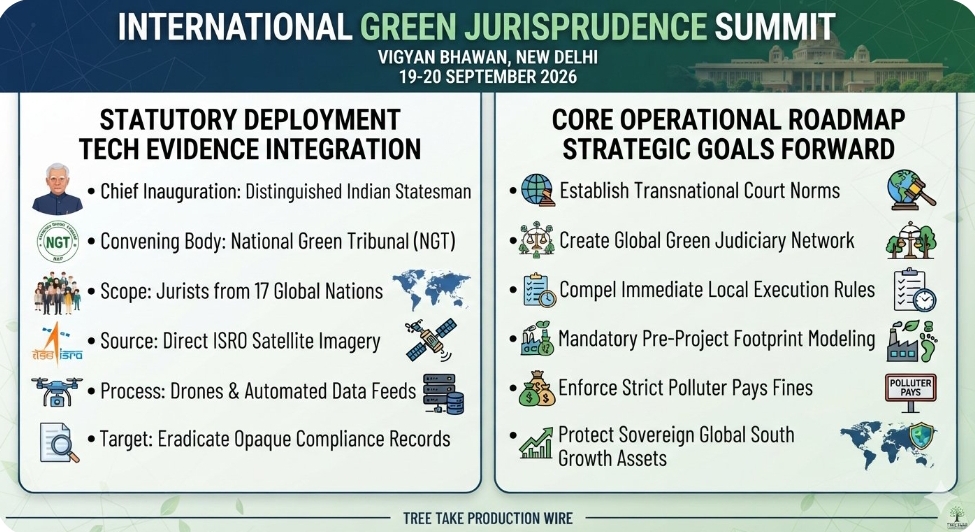
The international climate governance grid is moving directly into the judicial sphere as the National Green Tribunal (NGT) prepares to host a high-stakes global legal assembly in the national capital. On Saturday, 19 September 2026, Prime Minister Narendra Modi will officially inaugurate the International Conference on "The Future of Environment and Climate Dynamics" at Vigyan Bhawan, New Delhi. Running from 19 September to 20 November 2026, the apex summit gathers Supreme Court Justices, High Court Judges, environmental jurists, and administrative heads from 17 foreign nations to establish a unified framework for transnational climate jurisprudence.
The convention opens at a critical time of deep institutional friction between statutory environmental mandates and ground-level enforcement failures across the Global South. Following the recent diplomatic commitments forged under the BRICS New Delhi Declaration and the active launch of India’s National Net Zero Portal, domestic and international courts are facing intense pressure to completely modernise their judicial toolkits. The New Delhi sessions are designed to move past abstract policy agreements, shifting the focus toward establishing binding cross-border legal standards, standardising scientific evidence parameters, and building direct judicial accountability for cross-border ecological damage.
Targeting Enforcement and the Technology Gap
A primary focus of the closed-door judicial panels is the persistent gap between statutory environmental protections and the actual execution of court orders by local municipal bodies. Jurists from participating South Asian and African nations note that while environmental tribunals frequently issue progressive rulings against illegal mining, wetland encroachment, and industrial effluence, these directives are systematically stalled by bureaucratic delays and lack of technical tracking infrastructure. The conference will explicitly review mechanisms to legally compel state machinery to execute environmental rulings without delay.
To resolve these enforcement bottlenecks, the National Green Tribunal is leading a push to integrate advanced space-borne and automated technologies directly into environmental trial procedures. The panels will evaluate frameworks to accept real-time satellite biomass tracking from the Indian Space Research Organisation (ISRO) and automated drone surveillance data as certified forensic evidence in pollution disputes. This technical pivot aims to eliminate the long-standing scandal of falsified compliance data submitted by polluting conglomerates, allowing courts to issue immediate, data-verified environmental compensation penalties under the Polluter Pays Principle.
The Development Versus Conservation Dilemma
Beyond technology integration, the summit faces a fundamental, high-stakes debate over balancing aggressive national infrastructure expansion with rigid conservation laws. Developing economies are pushing the panel to draft context-specific environmental evaluation models that protect local livelihoods and national grid security, rather than adopting restrictive Western-mandated carbon litigation frameworks that could penalise domestic growth.
"Environmental justice cannot exist in a vacuum; it must be structurally responsive to the socio-economic realities of the societies it governs," stated Justice Prakash Shrivastava, Chairperson of the National Green Tribunal, during a preparatory briefing for the international delegation. He emphasised that the global legal community must evolve to catch highly volatile, fast-evolving climate challenges. "Through this international conference, India is actively bringing together diverse global jurisdictions to co-author the future rules of climate accountability. We are establishing a system where economic development and strict ecological preservation are no longer treated as opposing forces, but as co-equal pillars of national and international resilience."
Strategic Paths Forward
Transforming global environmental law into an effective shield against climate degradation requires moving beyond reactionary court rulings toward predictive, data-driven legal frameworks. First, the international community must formalise a permanent Global Green Judiciary Network to facilitate the seamless, cross-border sharing of environmental case law and forensic methodologies. Second, domestic ministries must establish independent, technically trained environmental enforcement units dedicated exclusively to executing tribunal directives, completely removing local police forces from the process. Finally, future infrastructure planning must legally mandate multi-agency biodiversity mapping and carbon footprint modelling before any project clearances are arbitrated, ensuring that long-term environmental sustainability is engineered directly into the foundational phase of national development.
Editor’s Note: As the climate crisis accelerates subcontinental monsoon failure and triggers unprecedented urban heat anomalies, the frontline of environmental defence has shifted from legislative chambers to the courts. The National Green Tribunal’s international conference at Vigyan Bhawan marks a critical turning point in global climate governance. By uniting judicial leaders from 17 nations, the summit seeks to transform the abstract ideals of the Net Zero transition into hard, enforceable legal mandates. TreeTake Magazine presents a detailed operational analysis of this judicial mobilisation, exploring how the integration of satellite forensics and independent enforcement frameworks could finally bridge the dangerous chasm between statutory environmental laws and ground-level ecological reality.



Leave a comment