

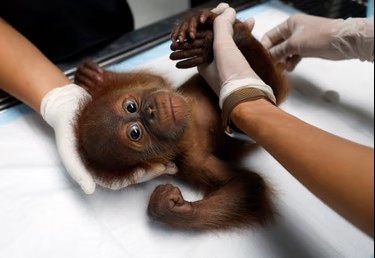
The operational focus surrounding India’s exotic wildlife crisis has shifted from high-stakes forest intercepts to critical neonatal intensive care. Following the dramatic seizure of five smuggled great apes in coastal Odisha, the temporary rehabilitation desk at the Nandankanan Zoological Park in Bhubaneswar faced an immediate, life-threatening emergency when severe environmental stress triggered an acute fever spike in one of the infant primates. TreeTake presents a detailed clinical update on their condition, evaluating the precise medical interventions deployed by the state's technical panel, the diagnosis of secondary systemic vulnerabilities, and the ongoing scientific push to map their genetic origins.
Subsiding the Acute Thermal Crisis
The intensive medical intervention spearheaded by the state-managed veterinary wing achieved a critical milestone as the acute fever scare affecting the youngest of the five rescued infant orangutans completely subsided. The juvenile primate, which had been battling a fluctuating high body temperature since its rescue from the illegal trafficking dragnet in Balasore, responded successfully to a targeted regimen of paracetamol-based veterinary therapeutics and continuous hydration therapy. Clinical monitoring confirms that the body temperatures of all five infants have returned to safe physiological parameters, stabilising between 98 and 99 degrees Fahrenheit.
The stabilisation marks a significant victory for the six-member technical committee of health and veterinary experts constituted by the state government to oversee the primates' mandatory 30-day quarantine phase. The infants, which are native exclusively to the tropical rainforests of Southeast Asia, are exhibiting normal feed acceptance and are being hand-reared at short intervals to reverse the severe dehydration induced by their prolonged confinement inside dark, unscientific smuggling crates. Caretakers have established a rigorous, round-the-clock diet chart that includes specialised milk formulas administered every two hours, fresh apple and banana fluids, and boiled potatoes to restore base energy levels.
Diagnosing Systemic Flaws and Anaemia
Despite the successful resolution of the acute fever, comprehensive baseline blood profiling and biochemical screenings have exposed secondary, long-term health vulnerabilities that require prolonged clinical management. The veterinary panel confirmed that three of the five juveniles are suffering from varying degrees of anaemia, classified as severe in one infant and mild in the remaining two. The diagnosis indicates severe nutritional deprivation and systemic neglect by the international poaching syndicates before their transit across the Indian border, prompting the care team to immediately initiate targeted iron supplementation and specialised multi-vitamin top-ups.
To facilitate their psychological recovery from the profound trauma of maternal separation, the zoo administration has completely barred the general public from the restricted nursery wing, eliminating all ambient human noise and visual disturbances. The infants are currently housed inside a highly controlled, temperature-regulated environment fitted with protective mosquito netting to prevent vector-borne monsoon infections. To soothe the motherless primates, caretakers have introduced soft, low-volume background music, customised indoor swings, and plush toys, successfully encouraging the infants to explore their expanded spaces and display natural, healthy social grooming behaviours.
The Scientific Push for DNA Profiling
While the immediate focus remains locked on physical stabilisation, the Odisha Forest Department and the Wildlife Crime Control Bureau are preparing to initiate advanced forensic mapping to trace the roots of the trafficking pipeline. Because orangutans are non-native to the Indian subcontinent, authorities are finalising arrangements to draw blood and serum samples for DNA profiling. This genetic testing will definitively identify whether the infants belong to the critically endangered Bornean (Pongo pygmaeus) or Sumatran (Pongo abelii) species, providing international investigators with the exact geographical markers needed to track the trans-continental syndicates behind their abandonment.
"The day-to-day observation is normal, and all five infants are currently alert, active, and accepting their feeds properly," stated Sanath Kumar Narayan, Director of the Nandankanan Biological Park, during a comprehensive update briefing on the nursery's clinical status. He emphasised that the technical care panel, which includes senior veterinary officers from Sri Chamarajendra Zoological Gardens in Mysuru and representatives from the Wildlife Institute of India in Dehradun, is maintaining an unyielding watch over the quarantine protocols. "We have transitioned these vulnerable animals from a state of acute medical crisis to a stable recovery phase. However, our vigilance remains absolute. The technical committee is continuously auditing their haematological progress to ensure their complete long-term resilience before any future habitat transitions are arbitrated."
Strategic Paths Forward
Securing the long-term survival of rescued non-native wildlife requires transforming temporary zoo nurseries into permanent, institutional quarantine networks. The Ministry of Environment, Forest and Climate Change must establish a specialised, federal protocol that automatically mandates DNA profiling within forty-eight hours of any exotic animal seizure, accelerating international wildlife forensics. Furthermore, state governments must mandate the permanent presence of primate neonatologists at all major biological parks, reducing reliance on temporary non-governmental field deployments during acute health crises. Finally, India must collaborate with the CITES Secretariat to create an automated, global fund for exotic animal repatriation, ensuring that the heavy financial burden of multi-month quarantine, genetic mapping, and specialised medical care is shared collectively by the international community rather than draining localised conservation budgets.



Leave a comment