

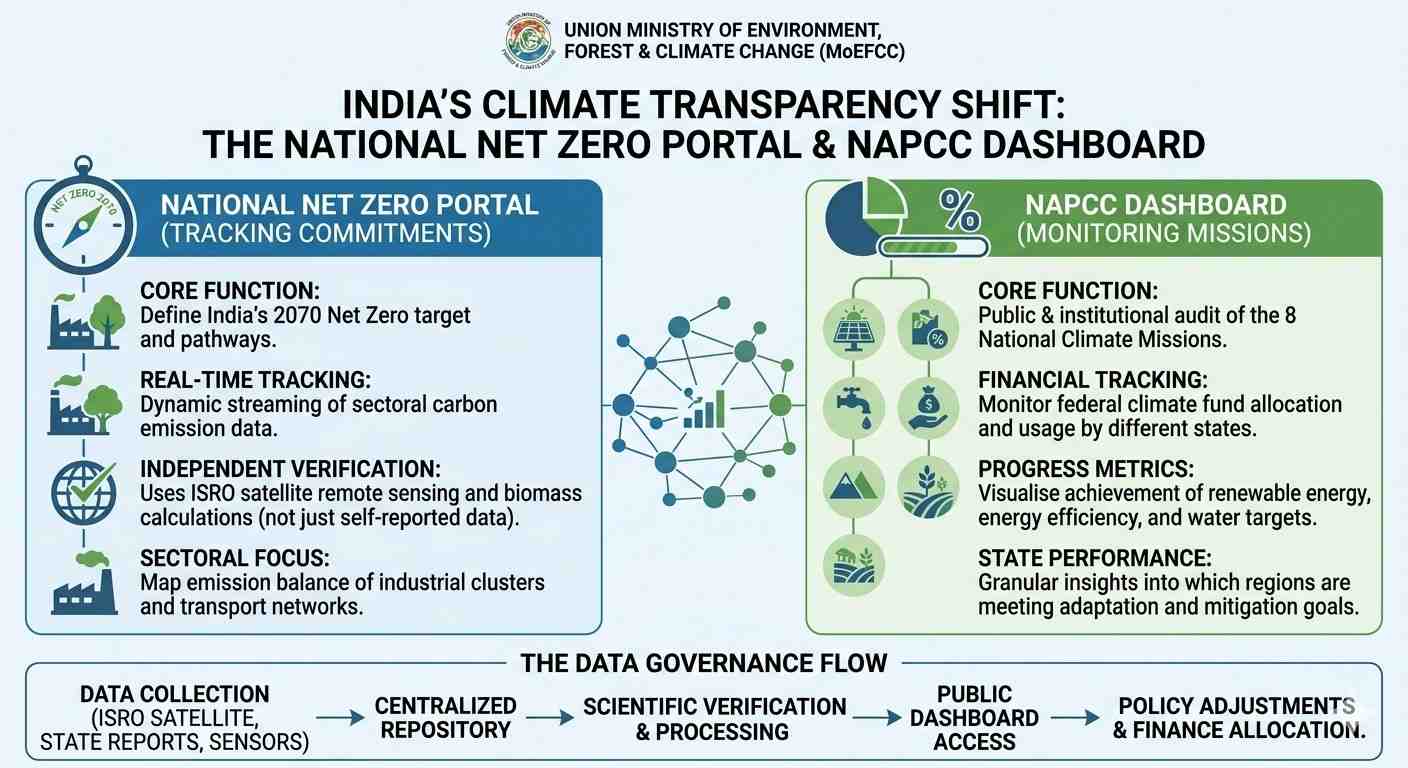
As global scrutiny over national emission trajectories intensifies, the accurate reporting of carbon data has become a critical geopolitical asset. For years, India’s climate tracking has been fragmented across decentralised state departments, making it exceptionally difficult to verify the actual efficacy of regional conservation policies. To address this structural data deficit, the Union Ministry of Environment, Forest and Climate Change has officially launched India's Net Zero Portal alongside a comprehensive digital dashboard for the National Action Plan on Climate Change (NAPCC). TreeTake evaluates this digital deployment, analysing how real-time transparency can dismantle bureaucratic padding and provide local communities with a powerful mechanism for environmental accountability.
Centralising Subcontinental Climate Data
On Thursday, 17 September 2026, the Union Ministry of Environment, Forest and Climate Change formally went live with the National Net Zero Portal during a high-level digital governance convention in New Delhi. Financed and developed in coordination with national scientific institutions and data analytics agencies, the integrated platform serves as India’s definitive, public-facing digital repository for all climate adaptation and mitigation metrics. The portal marks a fundamental departure from the historical practice of releasing opaque, multi-year retrospective environmental reports, shifting instead to a dynamic model of real-time data streaming.
The platform is anchored by the newly deployed National Action Plan on Climate Change (NAPCC) Dashboard. This tracking interface maps out the performance parameters of India's eight core climate missions, offering granular insights into renewable energy capacity additions, energy efficiency certificates traded, water conservation targets achieved, and the precise financial allocations deployed across different states. For the first time, researchers, policy analysts, and the public can directly audit how federal climate funds are being utilised on the ground, exposing which regions are meeting their green targets and which municipalities are lagging.
Dismantling Carbon Padding Through Science
The defining scientific feature of the Net Zero Portal is its reliance on independent, multi-source verification streams to validate carbon data. Moving away from self-reported municipal tallies, the system integrates high-resolution remote sensing data from the Indian Space Research Organisation (ISRO) to map the country's forest cover and evaluate changes in the national carbon sink. By layering satellite biomass calculations over regional industrial emission data, the portal calculates the net carbon balance of individual industrial clusters with unprecedented mathematical precision.
"True climate action demands absolute transparency, and this portal is designed to provide the empirical foundation for India’s green transition," announced a senior scientific advisor to the Ministry of Environment during the launch presentation. "We are providing a centralised, tamper-proof system where every tonne of carbon sequestered and every rupee spent on climate resilience is visible to the public. This platform eliminates the possibility of data manipulation or double-counting, ensuring that our progress toward the 2070 Net Zero target is verified by hard atmospheric and terrestrial science, thereby strengthening India's credibility in international climate negotiations."
The Verification Challenge and Independent Views
Independent environmental economists and data activists have welcomed the digital deployment but urge caution, noting that a portal is only as reliable as the raw data inputs running through its algorithms. Critics point out that while satellite tracking can accurately map dense forest canopies, it frequently struggles to differentiate between high-biodiversity natural forests and commercial timber monocultures, creating a persistent risk that commercial plantations could be misclassified as robust carbon sinks.
"The launch of the Net Zero Portal is a significant step toward structural transparency, but we must remain vigilant against algorithmic greenwashing," argued a prominent environmental data analyst based in New Delhi. "If the dashboard relies on state-level pollution control boards to manually upload industrial emission compliance data without independent third-party audits, the system will simply digitise old bureaucratic inaccuracies. We need to ensure that local communities and independent research units are given formal data-submission channels on the portal to cross-verify official claims against ground-level environmental realities."
Strategic Paths Forward
To transform the Net Zero Portal into an unyielding instrument of ecological accountability, the central government must implement strict data-governance protocols. The Ministry should integrate blockchain technology into the portal's backend architecture to ensure that carbon credit data and state-level emissions reporting are completely immutable and safe from retroactive administrative adjustments. Furthermore, the dashboard must expand its metrics to incorporate humidity-adjusted wet-bulb temperature indices and localised groundwater depletion rates, turning the platform into a comprehensive public health warning system. Finally, the federal framework must link state fiscal allocations directly to the performance scores displayed on the NAPCC dashboard, effectively incentivising regional administrations to accelerate their green transitions through direct financial rewards.



Leave a comment