

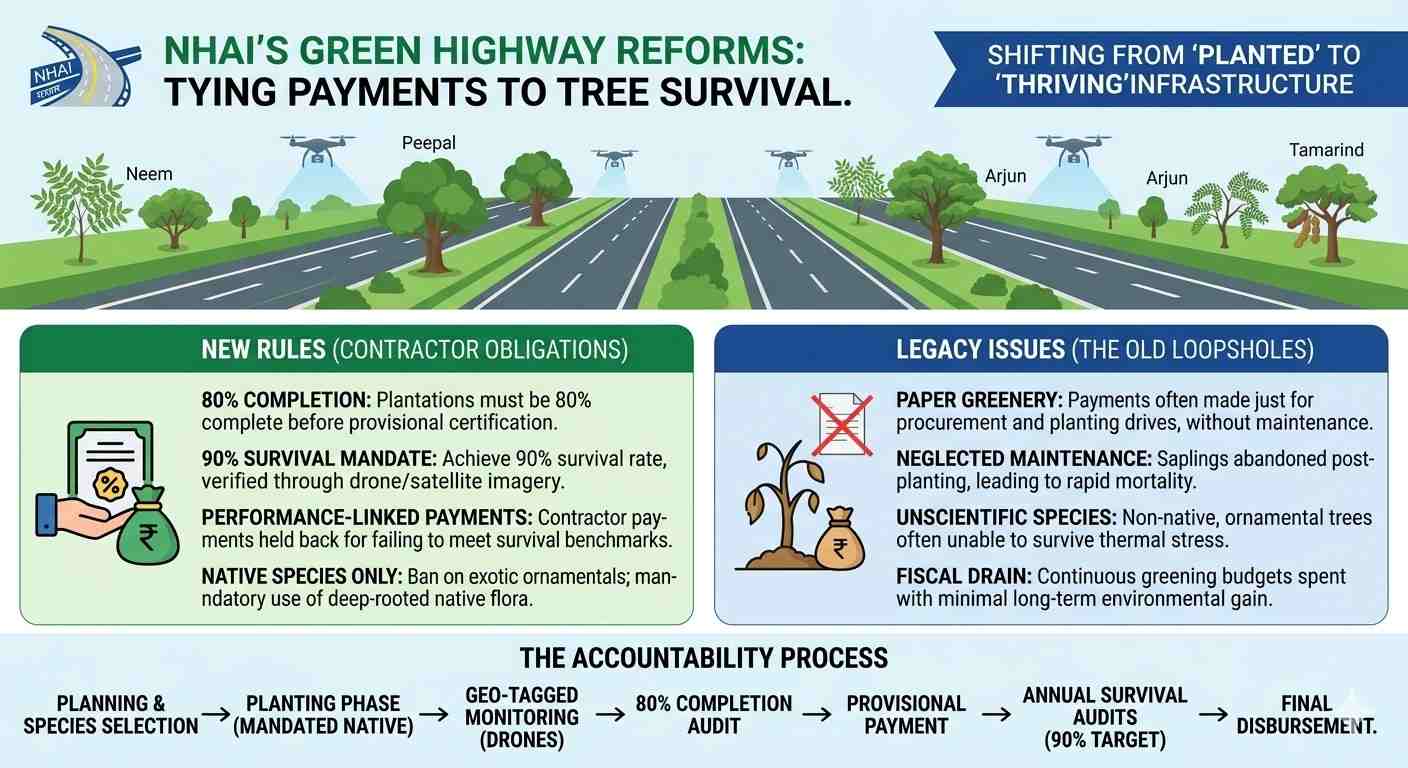
For decades, India’s massive road expansion campaigns have been accompanied by highly publicised highway greening drives. However, once the initial planting ceremonies conclude, the vast majority of these saplings are left to wither due to structural neglect, turning national greening budgets into a recurring fiscal drain. In a major policy shift, the National Highways Authority of India (NHAI) has officially overhauled its regulatory guidelines, tying contractor compensation directly to long-term tree survival metrics. TreeTake unpacks this infrastructural rewrite, examining the new penalty frameworks, the transition to native species selection, and the expert scepticism surrounding local enforcement capabilities.
Tying Payments to Plant Survival
On Thursday, 17 September 2026, the National Highways Authority of India (NHAI) issued a comprehensive regulatory circular to all regional offices and private infrastructure developers, completely reforming the execution parameters for green corridor projects. Under the newly notified rules, the highway authority has eliminated the traditional loophole where developers were compensated simply for the volume of saplings purchased and planted. The updated framework introduces an aggressive two-tier accountability system that mandates a minimum 80 per cent completion rate of designated green belt layouts before a highway project can receive its provisional completion certificate.
Furthermore, the new rules establish a strict 90 per cent plant survival benchmark that must be maintained during annual field audits throughout the concession period. If a private contractor fails to meet these survival rates during independent drone and satellite surveillance checks, the NHAI is now statutorily empowered to legally withhold performance-linked payments and impose heavy financial penalties under the contract. The policy explicitly shifts the financial burden of maintenance, irrigation, and soil replenishment entirely onto the concessionaire, transforming highway greening from a superficial post-construction compliance box into an active, long-term engineering obligation.
Official Mandates and The Native Species Shift
To support the survival targets, the new guidelines completely ban the unscientific use of exotic, fast-growing ornamental trees that frequently fail to adapt to local semi-arid road environments. Contractors are now legally required to procure and nurture native, deep-rooted species such as Neem, Peepal, Arjun, and Tamarind, which possess high dust-absorption capacities and can withstand the extreme thermal stress of vehicular emissions. The authority has also mandated the integration of automated drip-irrigation networks fed by localised rainwater harvesting pits built directly along the highway medians.
"We are ending the era of paper greenery on India’s national highways," stated a senior technical director at the National Highways Authority of India during an institutional briefing on the updated contract templates. "Historically, millions of rupees were spent on planting drives that existed only in municipal ledger books and initial press releases. By locking contractor disbursements to verified, multi-year survival rates verified through geo-tagged satellite imagery, we are forcing developers to invest in proper soil preparation, structural tree guards, and dedicated watering schedules. Green corridors must function as active, living carbon sinks, not disposable corporate social responsibility photo opportunities."
Field Realities and Contractor Counterviews
While environmental groups have widely praised the policy shift, the infrastructure development sector has raised immediate operational concerns, warning that the rigid survival benchmarks fail to account for complex field realities. Representatives from several prominent road-building conglomerates argue that maintaining a 90 per cent survival rate along unfenced national highways is a structural impossibility due to uncontrolled cattle grazing, localised soil salinity variations, and ambient theft of tree guards by local communities.
"The intent behind the new NHAI guidelines is commendable, but the execution matrix is detached from ground realities in rural corridors," noted an executive committee member of the National Highway Builders Federation. "Contractors cannot act as round-the-clock security forces against wandering livestock or local vandalism across hundreds of kilometres of open infrastructure. If the state machinery fails to provide adequate protection or if regional water tables collapse during late-stage monsoon failures, penalising the developer by freezing vital infrastructure funds will severely stall project timelines and hurt the financial viability of future highway biddings."
Strategic Paths Forward
Transforming India’s transport networks into resilient ecological corridors requires moving beyond punitive contract clauses toward collaborative local governance. The NHAI must establish joint monitoring panels that include local village panchayats and forest protection committees, incentivising rural communities to safeguard highway plantations by granting them controlled harvesting rights for minor non-timber forest produce. Technologically, regional offices must deploy automated soil-moisture sensors linked to centralised dashboards to proactively detect irrigation failures before saplings wilt. Finally, the Ministry of Road Transport and Highways should create a national registry of certified native nurseries, ensuring that developers have immediate access to high-quality, climate-resilient sapling stocks adapted to specific regional microclimates.



Leave a comment