

TreeTake Network
The international black-market trade in exotic wildlife has landed directly on the doorstep of India's environmental law enforcement grid. Following the high-profile interception of five infant orangutans by state authorities in Odisha’s Balasore district, a severe, fast-evolving crisis has emerged within their temporary holding facilities. TreeTake presents a critical operational update on the condition of these highly endangered primates, exposing a harrowing narrative of acute physiological stress, lack of specialised quarantine infrastructure, and the immense bureaucratic gridlock that currently threatens their immediate survival.
The Intercept and The Health Crisis
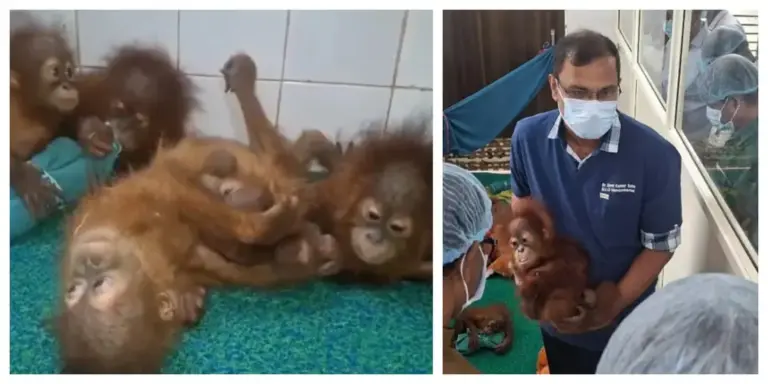
The regulatory urgency surrounding exotic animal smuggling reached a boiling point this week following a dramatic enforcement breakthrough in coastal Odisha. State forest departments, acting on actionable intelligence regarding trans-continental smuggling routes, intercepted a localised transit vehicle in the Balasore district, leading to the rescue of five infant orangutans packed into commercial travel crates. The discovery marked one of the largest single seizures of smuggled great apes in recent Indian conservation history. The primates, native exclusively to the rainforests of Sumatra and Borneo, were immediately moved into a localised state-managed transit facility to begin diagnostic testing and basic stabilisation.
However, the rescue narrative has rapidly transformed into a critical veterinary emergency. Wildlife veterinarians and field teams monitoring the infants have sounded immediate alarms over a swift, life-threatening deterioration in their vital parameters. Deprived of maternal care at a highly sensitive developmental stage and subjected to days of dark, suffocating transit through illegal trafficking pipelines, all five infants are currently battling severe dehydration, acute gastrointestinal infections, and profound psychological trauma. The state's temporary holding enclosures have proven dangerously inadequate, lacking the precise environmental controls, high-humidity parameters, and sterile isolation zones necessary to protect the compromised immune systems of infant great apes.
Veterinary Forensics and Official Structural Standoffs
The medical crisis is compounded by the structural inability of local facilities to handle complex primate diagnostics. Blood panels and faecal samples gathered by regional teams indicate highly elevated cortisol levels—a direct physiological signature of extreme, long-term stress—and the presence of opportunistic bacterial pathogens that thrive in unscientific transit setups. The infants are refusing baseline nutritional supplements, requiring intensive, round-the-clock subcutaneous fluid therapy to stave off hypovolemic shock.
"The current situation of these infant orangutans is exceptionally critical, and their survival hangs on a very thin thread," stated a senior wildlife veterinary officer attached to the state team, speaking on condition of anonymity due to the sub judice nature of the ongoing probe. "We are dealing with animals that have experienced severe sensory deprivation and physical battery during smuggling. Local transit centres are designed for regional fauna like leopards or deer; they completely lack the specialised neonatal incubators and targeted nutritional formulas required to stabilise infant great apes. Without immediate transfer to an advanced, climatically controlled quarantine sanctuary, we risk losing these highly endangered animals to systemic organ failure induced by shock."
The Wildlife SOS Intervention and Structural Gaps
To counter the escalating emergency, state authorities have reached out to major national conservation networks to provide immediate clinical support. Wildlife SOS, a prominent non-governmental organisation with extensive veterinary resources, has deployed a specialised emergency medical team to assist the state forest department. However, field workers note that temporary non-governmental interventions cannot override the absolute lack of statutory, state-backed exotic rescue infrastructure across eastern India, leaving the animals caught in a dangerous waiting game.
"Our veterinary teams are working closely with the state forest department to provide immediate, life-saving stabilisation measures, but the long-term prognosis remains highly guarded," noted a legal spokesperson for Wildlife SOS during an operational briefing regarding the rescue coordination. "This heartbreaking episode underscores the devastating physical toll that the illegal pet trade inflicts on wild populations. These infants are not just facing physical infections; they are grieving the loss of their mothers, who are invariably slaughtered in the wild by poachers to capture the young. India's enforcement agencies must work hand-in-hand with global primate specialists to ensure that these victims receive long-term, specialised rehabilitation far away from commercial urban centres."
Strategic Paths Forward
Preventing future veterinary tragedies and dismantling the exotic pet trade requires completely rewriting India's wildlife protection mechanisms. First, the Ministry of Environment, Forest and Climate Change must establish dedicated, state-funded Exotic Wildlife Quarantine Hubs at major entry and transit ports, equipped with permanent neonatal care units for non-native species. Second, the central government must urgently amend domestic legislation to criminalise the private possession and commercial display of all foreign great apes, closing the legal loopholes that allow international cartels to use the subcontinent as a safe transit zone. Finally, local enforcement wings must collaborate with international bodies like the CITES Secretariat to create fast-track repatriation protocols, ensuring that rescued endangered wildlife can be safely returned to specialised sanctuary networks in their home ranges before their health undergoes irreversible failure.



Leave a comment