

TreeTake Network
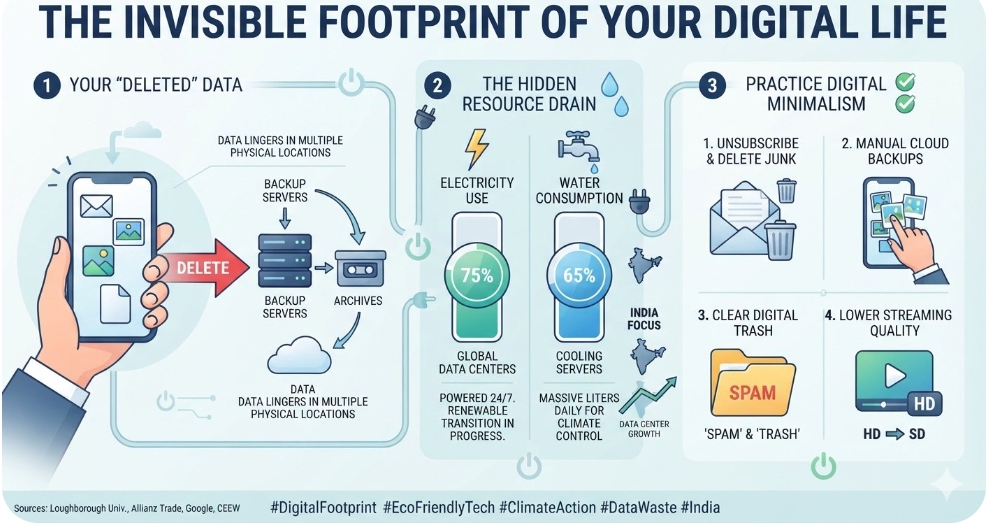
Every time you hit delete on a useless email, clear out an old photo album from your cloud storage, or wipe away an old post, you probably feel a small sense of mental relief. We have been conditioned to believe that the digital world is weightless, clean, and completely divorced from physical reality. The tech industry loves using terms like the cloud to make us picture our data floating in a pristine, atmospheric space. But the reality is that the digital world is built on a massive foundation of concrete, steel, and screaming server racks that never sleep. Deleting a file from your screen does not instantly vanish it from existence. Instead, that data lingers across a web of physical backup storage facilities, secondary hard drives, and disaster recovery networks that draw immense power twenty-four hours a day. Professors Tom Jackson and Ian Hodgkinson from Loughborough University actively highlight this illusion, warning against the dangerous assumption that digital data is carbon neutral. When we look closely, it carries a heavy, physical toll on the planet.
The Staggering Global Resource Drain
The hidden environmental cost of this digital retention is staggering when you look at the raw infrastructure required to maintain it. Global data center electricity consumption is projected to double to 945 terawatt-hours. Research shows that global data center carbon emissions reached a massive 286 million tonnes. Keeping these massive server farms from overheating requires a devastating amount of resource consumption, with estimates showing that facilities consumed 222 billion litres of water directly for cooling, a number expected to hit trillions of litres globally. Tech giants face severe surges in consumption, with companies like Google reporting a thirty-four percent annual spike in water usage, pushing their consumption to 10.9 billion gallons. As global digital sustainability author Gerry McGovern famously notes, digital is not weightless—it is intensely physical, and every single megabyte stored requires electricity, cooling, and real-world resources. When we leave hundreds of unread newsletters in our inbox or upload thousands of duplicate photos to automated cloud backups, we are directly contributing to a physical power grid that burns fossil fuels. Digital waste is real waste, and it leaves a very real carbon footprint on our planet.
The Developing Crisis in the Indian Tech Landscape
This problem hits incredibly close to home as India goes through a massive digital expansion. Arunabha Ghosh, the CEO of the Council on Energy, Environment and Water, has strongly sounded the alarm on this boom, describing modern data centers as being incredibly thirsty for power and water for cooling. The data backs up his warning completely. Local environmental research reveals that India’s data centers consume a staggering 150 billion litres of water annually, a massive resource strain that is projected to more than double to 358 billion litres by 2030. The crisis is intensified because these power-hungry facility clusters are expanding rapidly in India's most water-stressed regions, including tech hubs like Mumbai, Chennai, Hyderabad, and Bengaluru. To give you an idea of the sheer scale, experts note that a single 100-megawatt hyperscale data center can chug down roughly 2 million litres of water every single day—the exact same amount of water used daily by about 6,500 local households. As research analyst Abhishek Chakravarty points out, India's high humidity and intense climate mean our local cooling systems have to work twice as hard, drastically elevating the local environmental footprint and putting an unsustainable load on an electricity grid that is still heavily reliant on coal power.
Shifting Toward True Digital Minimalism
The true danger lies in our collective complacency because we cannot physically see the smoke or the trash piles generated by our internet habits. As environmental researchers point out, digital technology contributes roughly four percent of global greenhouse gas emissions. Highlighting this invisible crisis, data analytics expert Dr. Joana Chillón explains that over half of the world's stored digital data is actually dark data—useless files that are gathered and hoarded once but completely forgotten, quietly draining energy forever. Because digital storage has become so incredibly cheap and accessible, we have developed a culture of endless accumulation where we hoard data we will never look at again. Every single automated backup, cached file, and forgotten video sitting in a server rack somewhere requires constant electrical currents to remain viable. If we want to genuinely protect our environment, we need to stop looking only at plastic bags and fuel emissions, and start looking at our smartphones. True sustainability requires us to practice digital minimalism, treating our data storage with the same careful restraint we apply to the physical world around us.
Editor's Note: Practical Steps to Reduce Your Digital Footprint
While the scale of global data centers feels overwhelming, individual actions collectively shift the needle on carbon and water strain. To actively curtail your digital footprint, begin by unsubscribing from junk newsletters and automated updates that you never open, which prevents them from permanently occupying server space. Turn off automatic cloud backups for duplicate media, burst photos, or blurry videos, and choose to manually back up only meaningful data. Regularly clear out your digital trash, spam folders, and expired downloaded files so they are actually flagged for permanent removal from backup networks. Finally, turn down streaming quality to standard high-definition when casual viewing permits, and download your favorite playlists or videos locally rather than streaming them on loop over data networks. By shifting our daily internet habits from endless hoarding to mindful consumption, we can significantly reduce the physical demands placed on our planet's power grids and water reserves.



Leave a comment