

TreeTake Network
The tragic escalation of the Kheda district dog-biting incident serves as a stark reminder that public safety and animal welfare are deeply intertwined. When communities react to public health crises with panic-driven violence rather than scientifically sound procedures, human risk increases, and the rule of law collapses. The moral of this event is clear: managing zoonotic diseases like rabies requires institutional accountability, civic education, and structured compassion. Brute force cannot cure a viral infection; only systematic, legal, and humane interventions can protect both human lives and the animals coexisting within our communities.
The Kathlal Incident: A Breakdown of the Outbreak
On September 15, 2026, panic gripped Kathlal town in Gujarat’s Kheda district when a single street dog went on a severe biting spree, attacking 18 people. The animal targeted residents walking on the streets and standing outside their homes before a distressed crowd of locals cornered and beat the canine to death. While the sheer scale of the attack triggered survival instincts among the townspeople, animal behaviourists and veterinary experts emphasise that the incident, and the resulting violent public reaction, highlights a profound misunderstanding of how the rabies virus operates.
The Pathology of Furious Rabies vs. Public Panic
While it is a well-documented veterinary fact that many rabid animals undergo a "prodromal" or "paralytic" phase where they become quiet, seek isolation, and only bite if provoked, the virus can also manifest in a highly volatile form known as "furious rabies." In this state, the virus directly hijacks the animal's central nervous system. According to veterinary research, the virus alters brain chemistry to strip away the animal’s natural fear and caution. This means a dog that would normally hide is driven by neurological chaos to snap at imaginary objects, experience severe hallucinations, and exhibit unprovoked, continuous aggression.
The Kathlal incident was likely triggered by this neurological "furious" stage, combined with environmental stressors. Experts note that sudden crowding, loud shouting, and physical retaliation from a panicked public create a "stress-stacking" effect. For a neurologically compromised animal, noises and aggressive human movements are perceived as direct threats, transforming defensive reflexes into a continuous, chaotic rampage.
The Ethical and Biological Risk of Public Culling
The brutal bludgeoning of the animal raises critical ethical and safety questions. Public health officials and animal welfare advocates argue that killing a diseased animal in such a chaotic manner is not only inhumane but highly dangerous. Dr Vinay Kumar, a senior veterinary public health expert, points out that just as society does not execute a human suffering from severe psychosis or a brain disease, bludgeoning a rabid animal is an erratic response that actively increases human risk. Beating a rabid animal to death creates a high-velocity environment where infected saliva and blood can easily spray onto bystanders, entering open wounds or mucous membranes, potentially spreading the fatal virus to even more people.
Distinguishing Territoriality from Viral Aggression
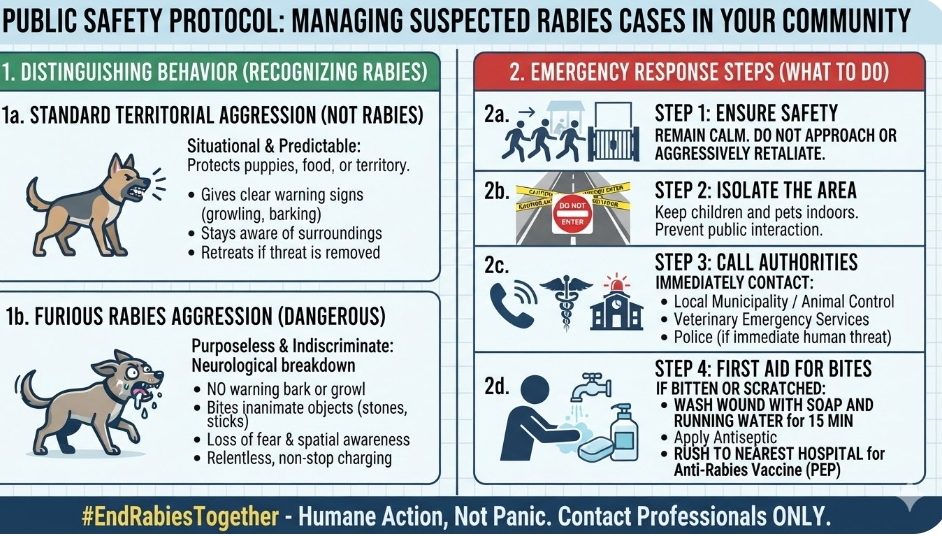
To prevent such chaotic outcomes, citizens must understand how to distinguish between standard territorial aggression and rabies in street animals. Standard territorial aggression is situational, calculated, and predictable. A street dog defending its pack, food source, or puppies will give clear warning signals such as growling, exposing teeth, stiffening its posture, and barking loudly. Territorial dogs remain acutely aware of their surroundings, recognise human presence, and will usually retreat if a human backs away or ignores them.
Conversely, a rabid dog exhibits purposeless, indiscriminate, and erratic aggression. It does not issue warnings or bark normally; instead, it may emit a distorted, hoarse howl due to laryngeal paralysis. A rabid animal loses all sense of spatial awareness and territorial boundaries, biting inanimate objects like rocks or sticks, and charging relentlessly at humans or other animals without any underlying motive or threat display.
India's Legal Framework and Institutional Responsibilities
India possesses a clear legal framework designed to manage these exact crises, yet it suffers heavily from poor field execution. Under Article 51A(g) of the Constitution, citizens have a fundamental duty to show compassion to living creatures. Population control is strictly regulated by the Animal Birth Control Rules 2023 under the Prevention of Cruelty to Animals Act. These national rules mandate a humane Catch-Neuter-Vaccinate-Return model to scientifically stabilise the street dog population and build herd immunity against rabies.
Furthermore, in its landmark May 2026 judgment, the Supreme Court of India reaffirmed that while large-scale sterilisation and anti-rabies vaccination are the legally mandated approach, civic authorities are fully empowered to take immediate action on aggressive or dangerous strays. The apex court explicitly permitted the isolation and legal euthanasia of demonstrably dangerous, incurably ill, and rabid dogs under strict veterinary supervision, reinforcing that ad-hoc public culling is illegal.
Clinical Signs and Emergency Protocols
Understanding these legal avenues is essential, but recognising the clinical signs of a rabid animal remains the first line of defence. In the furious form, animals show extreme anxiety, restlessness, dilated pupils, unprovoked snapping, and a loss of fear. In the paralytic or "dumb" form, signs include a dropping lower jaw, an inability to swallow, excessive drooling or foaming, and progressive weakness in the hind legs. As Dr Anjali Mehta, a prominent animal welfare officer, notes, municipal tracking mechanisms fail when the public panics, making widespread knowledge of these symptoms a necessity for community safety.
If a suspected rabid animal is spotted, citizens must never take the law or a weapon into their own hands. The correct procedure is to immediately retreat to a safe, indoor location and isolate the area. Local municipality authorities, the forest department, or veterinary emergency services must be contacted immediately so professionals can safely tranquillise and quarantine the animal.
In the event of any animal bite or scratch, the World Health Organisation outlines non-negotiable first aid: immediately wash and flush the wound under running water with soap for at least 15 minutes, clean it with an antiseptic, and rush to the nearest healthcare centre to begin the post-exposure prophylaxis vaccine course, as rabies is fatal once symptoms develop.



Leave a comment