

TreeTake Network
Every year on September 16, the world observes World Ozone Day to commemorate the signing of the 1987 Montreal Protocol, an event routinely celebrated as humanity's greatest environmental success story. For decades, the collective global effort to phase out nearly 99% of banned ozone-depleting substances (ODSs), such as chlorofluorocarbons (CFCs), has been heralded as definitive proof that nations can unite to repair the global commons. However, beneath the triumphant headlines and bureaucratic self-congratulation lies a troubling gap between geopolitical rhetoric and atmospheric reality. While institutional lip service paints a picture of a problem fully resolved, recent scientific data, atmospheric warnings, and structural legal loopholes demonstrate that the safety of our planet's stratospheric shield is not yet guaranteed.
The Real Situation: Scientific Success Countered by New Threats
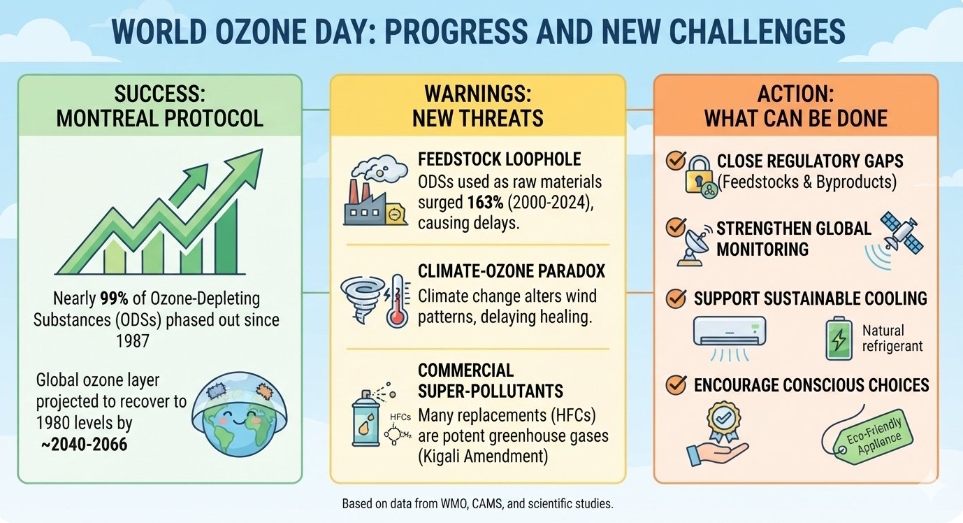
Statistically, the Montreal Protocol has yielded monumental achievements, but the actual state of the atmosphere reveals significant roadblocks that are actively delaying recovery. World Meteorological Organisation Secretary-General Celeste Saulo recently emphasised that while the long-term recovery trend remains an environmental success story, annual fluctuations heavily remind us of the fragility of this balance. Under current policies, the global ozone layer is projected to recover to 1980 levels by around 2040 for most of the world, 2045 over the Arctic, and 2066 over the Antarctic. Yet, a major structural blind spot known as the feedstock loophole threatens this timeline. The Montreal Protocol originally exempted ODSs used as feedstocks—raw materials consumed to manufacture other chemicals—under the assumption that their emissions would be negligible.
Exposing this regulatory failure, atmospheric researcher Stefan Reimann and a team of international scientists published a landmark study in Nature Communications revealing that the global use of ODSs as feedstock chemicals did not decline after 2000, but instead surged by 163% between 2000 and 2024. The authors report that actual feedstock emissions are substantially higher than the historically assumed 0.5%, sitting typically at 3.6% of production due to industrial leaks. The study explicitly warns that without additional measures, these elevated, unmonitored emissions will delay the recovery of the mid-latitude stratospheric ozone layer by 6 to 11 years, shifting full restoration past previous optimistic estimates.
Furthermore, the stratospheric ozone layer does not exist in isolation from climate change, creating a paradox in which broader atmospheric shifts alter wind and temperature patterns. Data from the Copernicus Atmosphere Monitoring Service highlighted that extreme winter polar vortices have caused unseasonal, negative ozone anomalies extending across Greenland, Europe, and parts of Asia. To replace banned CFCs, the cooling industry also pivoted heavily to Hydrofluorocarbons (HFCs), which do not directly destroy ozone but act as extremely potent greenhouse gases. This dynamic triggered the Kigali Amendment, an initiative designed to drive a global phase-down of HFCs and avoid up to 0.5 degrees Celsius of global warming by 2100.
Mere Lip Service and the Enforcement Shadow
Celebrating World Ozone Day risks devolving into a hollow public relations exercise if governments do not address structural enforcement deficits. The danger of superficial compliance became undeniable when global atmospheric monitoring networks detected a mysterious, sudden spike in illegal CFC-11 emissions, which investigators later traced to localised manufacturing hubs using banned chemicals simply to cut costs. Atmospheric scientists warn that global treaties are only as strong as their local enforcement mechanisms. Furthermore, emerging industrial frontiers present unmonitored hazards; the exponential increase in commercial rocket launches and the resulting fallback of satellite debris are depositing aluminium oxides directly into the stratosphere, triggering catalytic reactions that destroy ozone molecules.
What Can Be Done: Moving from Rhetoric to Action
To transform World Ozone Day from an annual press release into active ecological defence, the global community must move from rhetoric to action. International policy must be revised to strictly regulate feedstock chemicals and establish zero-tolerance caps on industrial byproducts that escape under the guise of chemical manufacturing. Governments must heavily fund and expand networks like the World Meteorological Organization's Global Atmosphere Watch, as ground-based and satellite tracking are the only reliable mechanisms to catch illegal chemical production and hold rogue industrial actors accountable. Simultaneously, developing nations require robust financial and technological support to meet the mandates of the Kigali Amendment, ensuring the global cooling sector transitions to natural refrigerants. On an individual level, citizens can directly lower chemical leakage by ensuring old air conditioners and refrigerators are serviced by certified technicians and ensuring chemical coolants are disposed of safely rather than being left to vent into the air.
Conclusion
The recovery of the ozone layer remains an undeniable testament to what humanity can achieve when it aligns policy with rigorous scientific consensus. However, treating a recovering system as a completely solved problem invites dangerous industrial regression and complacency. True commemoration of World Ozone Day requires moving past static platitudes to actively face modern threats like unregulated chemical feedstocks, stratospheric aerospace debris, and unmonitored byproduct leaks. The sky above us is a dynamic, vulnerable shield; keeping it intact demands relentless global vigilance, independent scientific monitoring, and unwavering enforcement rather than passive celebration.



Leave a comment