

Selfless Souls
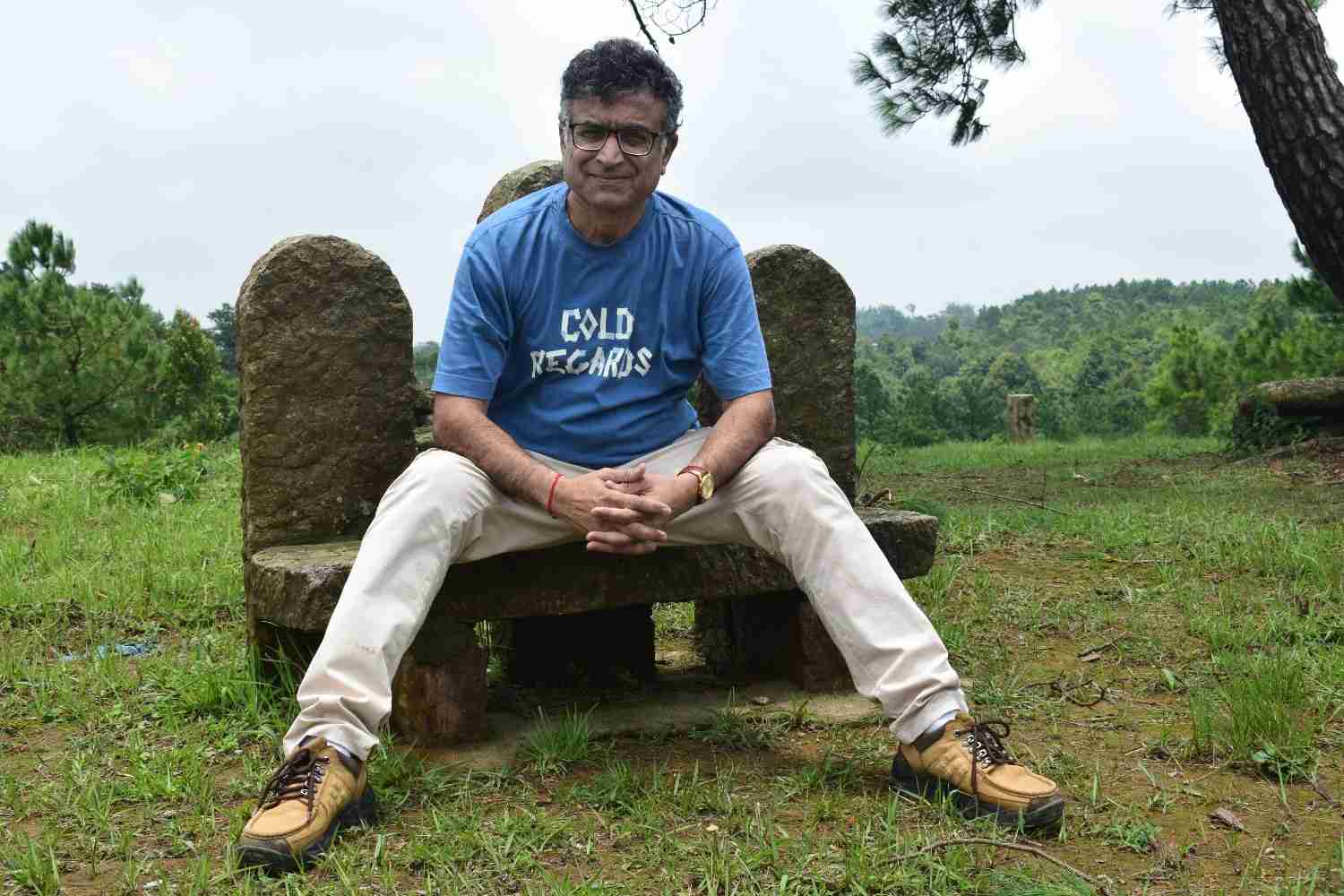
Prof Mahesh G Thakkar, Director of the Birbal Sahni Institute of Palaeosciences, Lucknow, says his journey as a geoscientist has essentially been a journey of curiosity--of walking through landscapes, observing how they evolve and trying to understand the stories written in the rocks, fossils and landforms.
Q: Your career spans extensive field studies from the seismic landscapes of Kachchh to leading the prestigious Birbal Sahni Institute of Palaeosciences. What is the personal philosophy or driving force that keeps you so selflessly dedicated to uncovering Earth's ancient secrets?
My journey as a geoscientist has essentially been a journey of curiosity--of walking through landscapes, observing how they evolve and trying to understand the stories written in the rocks, fossils and landforms. I have been particularly fascinated by tectonic geomorphology, landscape evolution and earthquake-generated features, which has taken me to the seismic landscapes of Kachchh, the Himalaya and the Andaman Islands, where palaeoseismic studies have become an important part of my research. The philosophy that keeps me moving is deeply rooted in the “Karma ka Siddhant” of the Bhagavad Gita. I believe in doing my work sincerely and selflessly, without being overly attached to the outcome. For me, Karma Yog and Gyan Yog are two guiding principles--doing one’s duty with dedication and continuously seeking knowledge. I have learnt from both success and failure. I have never allowed failure, disappointment or even betrayal to stop me, because every experience teaches us something. Above all, I consider Earth my greatest teacher. The more I try to uncover its ancient secrets, the more it teaches me about change, resilience, time and, ultimately, the meaning and value of life. Perhaps that is my real driving force--the quest for knowledge and the continuous learning that comes from understanding the Earth.
Q: Palaeosciences often deal with deep-time history, yet your work connects these ancient clues to modern environmental and societal challenges. How do you view the role of your research in securing a sustainable future for our planet and its ecosystems?
Palaeoscience is not simply the study of the distant past; it is a way of understanding how our planet and its ecosystems have responded to natural changes and extreme events over thousands and millions of years. The geological and biological archives of the Earth preserve valuable clues about past climate change, droughts, floods, earthquakes, sea-level fluctuations, ecosystem changes and the evolution and adaptation of life. These records provide a much longer perspective than the instrumental observations available to us today. At BSIP, our scientists are trying to decode these natural archives using palaeobotany, palaeoclimate studies, palaeoseismology, geochronology, ancient DNA, micropalaeontology and several advanced analytical techniques. By reconstructing past environmental changes and understanding the causes, rates and impacts of these changes, we can better assess the vulnerabilities and resilience of present-day ecosystems and societies. I therefore see palaeoscience as a bridge between Earth's past and humanity's future. The past cannot predict the future in a simplistic sense, but it can provide invaluable lessons about how the Earth behaves under changing conditions. Understanding these lessons can help us develop more realistic climate projections, prepare for natural hazards, conserve ecosystems and make informed decisions for a more resilient and sustainable future.
Q: As a leader and educator who has mentored dozens of scholars, what is the greatest personal joy or fulfilment you receive from guiding the next generation of Indian scientists?
For me, the greatest joy of being a teacher and a ‘Guru’ is to see my students grow, prosper and create their own identity. There is a special sense of fulfilment when I see a student whom I have guided becoming an independent scientist, making discoveries of his own and eventually guiding others. In many ways, their growth becomes a part of my own journey. I also feel that the responsibility of a teacher changes with time. The new generation is growing up in a very different social, technological and human ecosystem and therefore we cannot simply prepare them with the knowledge of today. We have to encourage them to think differently, question established ideas, take new approaches and look at scientific problems beyond conventional boundaries. For me, true teaching is not about creating replicas of ourselves; it is about helping young scientists discover their own potential and develop the courage to walk their own path. When they go beyond us, I believe that is the real success of a Guru.
Q: Tree-Take magazine celebrates the profound bond between humans and nature. On a personal level, is there a specific landscape, fossil discovery, or moment in the wild that completely transformed how you connect with the natural world?
For me, the transformation did not come from a single fossil discovery or one particular moment in the wilderness. It has been a gradual realisation developed through years of being in the field and observing the Earth closely. I have always found our planet deeply fascinating. Earth is not a static stage on which life simply exists; it is a dynamic and ever-changing system. Every landscape we see today-whether it is a mountain, a river, a coastline, a desert or a sedimentary basin - is only a moment in a much longer journey. What exists today will continue to change and eventually become something very different. This continuous transformation made me curious about the changing energy systems of the Earth, both within its interior and on its surface and how these processes shape the landscapes and ultimately influence life. My field studies, particularly in tectonic landscapes, earthquake-affected regions and the changing landscapes of Kachchh and other parts of India, strengthened this feeling. I gradually began to understand that what we call the “living” and “non-living” worlds are not really separate. Our lives are intimately connected with rocks, soil, water, oceans, mountains, rivers, climate and the atmosphere. The landscape around us is not merely our physical surroundings - it is an active part of the system that sustains life. In fact, I sometimes hesitate to call rocks, oceans or mountains simply “non-living.” At the fundamental level of matter, they are constantly undergoing change and interaction, governed by the same natural laws that operate throughout the universe. Their timescales are simply very different from ours. A human life may span decades, whereas a mountain may evolve over millions of years. Yet both are part of the same Earth system. This realisation has profoundly influenced the way I look at nature. I no longer see nature as something separate from us, or merely something that we should conserve for our benefit. We are a part of nature, and nature is a part of us. The real lesson, for me, is to understand the harmony and interconnectedness between the biotic and abiotic worlds - how rocks become soil, how soil supports plants, how plants influence ecosystems, how water shapes landscapes and how all these processes together create the conditions for life to emerge, evolve and regenerate. Perhaps this is what my years in the field have taught me most deeply: the Earth is not just the place where we live; it is a living, evolving story of which we are only a very small chapter. The more I try to understand that story, the more connected I feel to the natural world.
Q: Leading a premier national institution requires balancing administrative responsibilities with scientific passion. What personal sacrifices have you had to make along this journey and what keeps you motivated to serve the scientific community every day?
This is perhaps one of the most personal questions for me. For most of my life, I have been a field geologist. I have spent countless days and sometimes in very difficult conditions, in the Kachchh Basin, the Himalayas, the Andaman Archipelago and many other parts of India, wherever nature has preserved its remarkable geological stories. The field has been my classroom and nature has been my teacher. Whatever I have learnt from the Earth, I have always tried to pass on to my students, young researchers and colleagues, giving them the best that I could. Today, as the Director of BSIP, my role has changed, but my basic purpose has not. I now have an opportunity to use the knowledge and experience I have gathered over decades to build larger national research programmes, strengthen scientific infrastructure and create an environment where our scientists can pursue ambitious research of national importance. I see this as my contribution towards the larger vision of Viksit Bharat 2047. Of course, this journey demands a different kind of commitment. I have had to learn administration, institutional management and leadership—areas very different from working in the field. Sometimes, this responsibility leaves less time for family and personal life. But I would not call this a sacrifice. I see it as part of the path I have chosen and the responsibility I have accepted. Every meaningful journey requires some compromises. What keeps me motivated is the feeling that my work can create something that will continue beyond me—whether it is a new research facility, a national scientific programme, a young scientist who finds a direction, or an institution that becomes stronger and more productive. I believe that when we are allowed to serve, we should think beyond ourselves and work for a larger cause. My motivation, therefore, comes from the same place where my journey began—curiosity about the Earth, a passion for science, and a desire to share knowledge. The only difference is that earlier I was trying to understand the Earth myself; today, I have the privilege and responsibility of creating an ecosystem where many others can explore it, understand it and use that knowledge for the larger benefit of society and the nation.


Leave a comment