

TreeTake Network
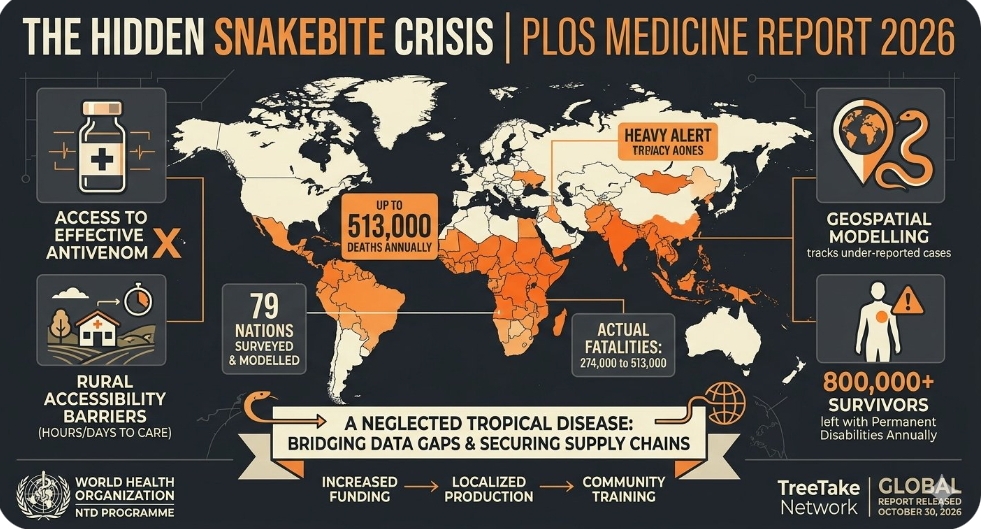
A startling geo-statistical modelling study published by an international coalition of epidemiology experts on October 30, 2026, has revealed that venomous snakebites are killing far more individuals worldwide than official government statistics indicate. The breakthrough paper, featured in the medical journal PLOS Medicine, tracks the under-reported global burden of snake envenoming by combining historical community surveys from 79 nations with localised socio-economic datasets. The model's findings indicate that annual global fatalities actually range between 274,000 and 513,000, exposing a massive public health crisis that quietly decimates impoverished agrarian societies across tropical and subtropical regions.
The data reveals that previous monitoring efforts severely underestimated the true scale of the crisis due to deep systemic data gaps. In many rural zones within sub-Saharan Africa and South Asia, over half of the countries where venomous snakes pose an everyday occupational hazard do not maintain official regulatory logs of snakebite admissions. Victims often reside multiple hours away from the nearest clinical facility, lack access to reliable transport, or rely entirely on traditional healers. Consequently, their cases remain completely unrecorded in national health frameworks, masking a crisis where up to 7,000,000 individuals suffer venomous envenomings every single year.
The geographic distribution of this environmental health burden is heavily skewed toward low-income, tropical territories. According to the study's high-resolution mapping, sub-Saharan Africa alone bears 45 per cent of the entire global mortality and disability toll—a rate nearly three times higher than that of South Asia. Furthermore, the long-term societal impacts extend far beyond immediate deaths; the researchers calculated that more than 800,000 survivors are left with permanent physical disabilities each year, including extensive tissue necrosis that leads to limb amputations, chronic psychological trauma, and complete economic displacement.
To address this hidden crisis, international public health bodies are demanding an urgent restructuring of how antivenom therapies are manufactured and distributed globally. The World Health Organisation has established a legally binding commitment to halve snakebite mortality and long-term disability parameters by 2030, but experts warn this target remains unachievable without a massive scaling up of regional healthcare funding and localised infrastructure upgrades.
"Snake envenoming is a far greater global crisis than the international community has ever recognised," stated Dr David Williams, a leading epidemiological scientist and World Health Organisation specialist on venomous bites, during the public release of the report. "We are dealing with a classic neglected tropical condition that primarily targets the poorest rural farmers who keep our agricultural systems running. Mapping the exact density of this burden at the country level is merely the opening phase; our terminal goal must be establishing robust local surveillance structures and ensuring that high-quality, affordable antivenom therapies reach vulnerable clinics before a patient ever succumbs to systemic envenoming."
Editor's Note
The revelation that venomous snakebites claim over half a million lives annually exposes the profound vulnerabilities within global rural health infrastructure. Moving forward, governments must stop treating snakebites as isolated medical accidents and instead classify them as a direct environmental health hazard deeply linked to agricultural expansion and regional habitat fragmentation. The way forward requires implementing real-time digital surveillance systems across rural clinics and subsidising localised antivenom production hubs to break the current commercial supply monopolies. We must systematically train rural community leaders in basic first-aid management and rapid transport logistics, transforming our response framework from retroactive emergency treatment to a proactive, state-funded safety net that shields rural populations from the hidden dangers of the natural world.



Leave a comment