

TreeTake Network
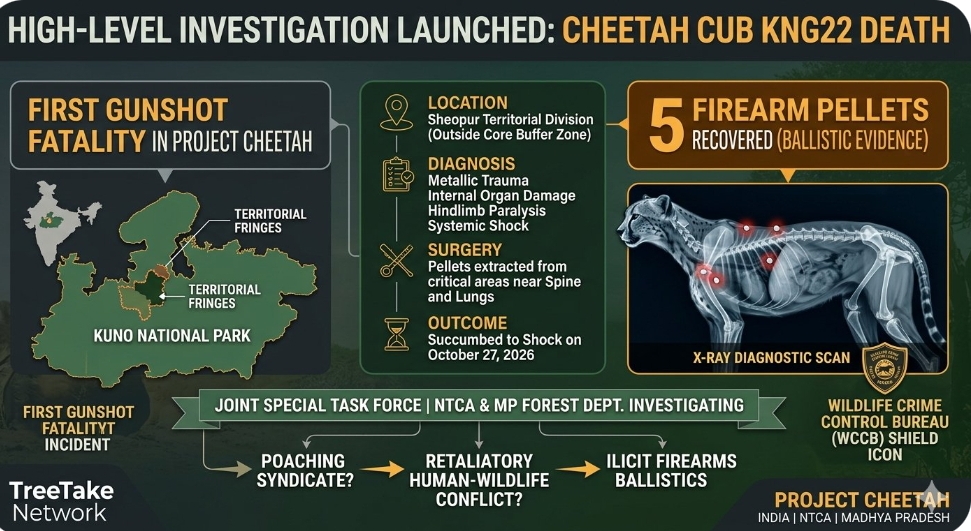
In a severe and unprecedented blow to India's flagship wildlife reintroduction initiative, the Union Ministry of Environment, Forest and Climate Change ordered a high-level investigation into the tragic death of a nineteen-month-old male cheetah cub that succumbed to gunshot wounds on October 27, 2026. The cub, designated as KNG22, was the India-born offspring of Nirva, a six-year-old female cheetah brought from South Africa under Project Cheetah. The critical incident marks the first documented instance of a reintroduced big cat being killed by human gunfire since the ambitious transcontinental translocation project commenced in September 2022, prompting emergency deployments of elite wildlife crime investigators to central India.
Field monitoring reports indicate that the young male had recently dispersed beyond the safety of the protected core boundaries of Kuno National Park into surrounding territorial forests. Tracking teams first located the animal in a stationary, highly distressed state on the morning of October 25, 2026, within Compartment Number 748 of the Sheopur Territorial Forest Division in the Morena district of Madhya Pradesh. Recognising the immediate severity of its condition, forest officials coordinated a rapid rescue operation, tranquilising the immobile cub and transporting it under intensive veterinary supervision to the Department of Veterinary Surgery and Radiology at Nanaji Deshmukh Veterinary Science University in Jabalpur.
Comprehensive diagnostic imaging exposed the catastrophic extent of the trauma inflicted upon the young animal. An initial X-ray followed by a high-resolution CT scan confirmed that multiple metallic foreign bodies had penetrated deeply into the cheetah's musculoskeletal structure, causing extensive damage to its internal organs and central nervous system, which resulted in hindlimb paralysis. A specialised team of veterinary surgeons operated under general anaesthesia to remove five firearm pellets from critical locations near the spine, left shoulder, and right lung tissue. Despite these intensive surgical interventions, the cub succumbed to severe systemic shock early on October 27, 2026.
To ensure accountability, the Madhya Pradesh state government immediately constituted a joint Special Task Force, mobilising senior police officials and wildlife forensic experts to track down the perpetrators. The central government has additionally deputed a high-level team comprising the Inspector General of Forests from the National Tiger Conservation Authority and the Additional Director of the Wildlife Crime Control Bureau to manage the field investigation. The sudden loss brings the surviving cheetah population across the state's reserves down to fifty-eight individuals, with fifty-two remaining inside the primary habitat at Kuno National Park.
"This is an incredibly grave wildlife crime that threatens the long-term survival model of our entire reintroduction programme," stated Dr Sameeta Rajora, Principal Chief Conservator of Forests and Chief Wildlife Warden of Madhya Pradesh, in an official press release. "The forensic data and the recovery of five distinct firearm pellets confirm a direct human attack. Our teams are exploring every possible angle on the ground, analysing whether this incident stems from an escalating local human-wildlife conflict or the deliberate actions of an active commercial poaching syndicate operating outside our core buffer sones."
Emphasising the strict regulatory and legal response to this ecological crisis, a senior investigative officer from the Wildlife Crime Control Bureau stated during an emergency briefing: "We have activated our regional intelligence networks and are treating this as an absolute priority. Forensic ballistic teams are currently examining the recovered pellets to determine the exact make and calibre of the firearm used in the assault. We will ensure that anyone involved in this heinous act faces the full, uncompromised force of the law under the non-bailable provisions of the Wildlife Protection Act."
Expressing profound concern over the strategic challenges of managing free-ranging big cats across human-dominated landscapes, a senior wildlife conservation scientist added: "Project Cheetah is entering its most volatile phase as young, independent males naturally explore territorial fringes. We cannot protect these wide-ranging carnivores solely with physical barriers. Local communities must be systematically integrated into our conservation matrices, and those who deploy illicit firearms against protected species must face the absolute maximum penalties under the law without exception."
Editor's Note
The tragic shooting of cheetah KNG22 exposes a critical vulnerability in India's reintroduction strategy, which has focused heavily on secure core habitats while leaving dispersal corridors largely unmonitored. Moving forward, wildlife authorities must rapidly transition from reactive tracking to proactive community-led co-management. The way forward requires expanding the localised 'Cheetah Mitras' volunteer network into a formally compensated conservation vanguard, coupled with deploying high-resolution drone surveillance across vulnerable territorial fringes. Furthermore, agricultural communities surrounding these sones must receive immediate, streamlined financial compensation for livestock losses to eliminate the economic incentive for retaliatory violence. If we cannot secure the safe passage of these apex predators across human-dominated landscapes, the entire transcontinental experiment risks collapsing into a series of isolated, unviable populations.



Leave a comment