

TreeTake Network
The Republic of Armenia, in its official capacity as the Convention on Biological Diversity COP17 Presidency, formally partnered with the United Nations Environment Programme on October 28, 2026, to launch a historic global initiative aimed at safeguarding the planet’s increasingly threatened highland habitats. Officially named the Yerevan Platform on Mountains and Related Freshwater Ecosystems, the multilateral strategic framework was unveiled during the high-level Mountain Ecosystems Day segment at the UN Biodiversity Conference in Yerevan. The platform establishes a unified political mechanism to accelerate international funding, cross-border science sharing, and habitat restoration across high-altitude regions that directly support over a billion downstream lives.
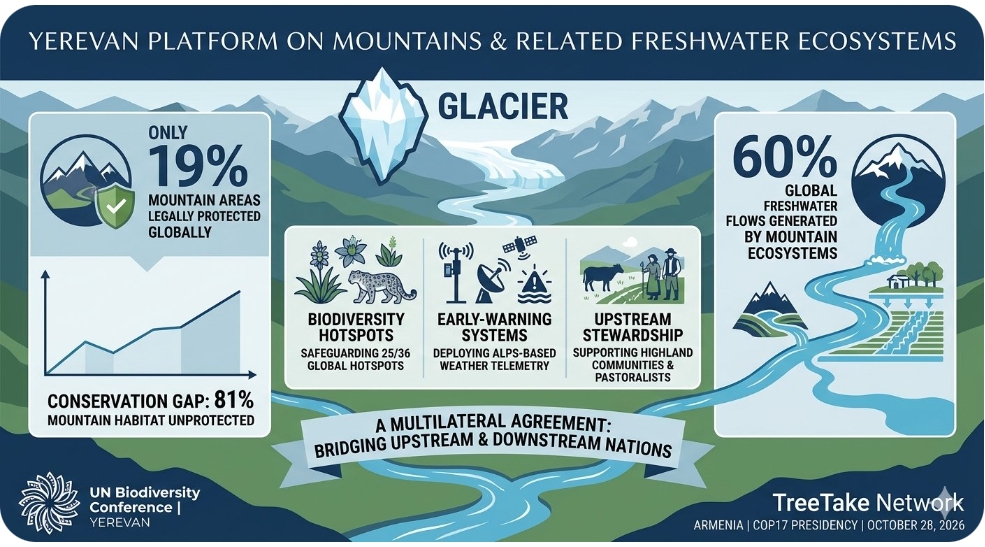
Scientific audits presented alongside the launch highlight the extreme ecological vulnerability of mountain biomes. Despite generating nearly 60 per cent of the world's annual freshwater flows and hosting 25 out of the planet's 36 designated biodiversity hotspots, only a minor 19 per cent of global mountain land is currently under any form of formal legal protection. This extensive conservation deficit leaves major downstream human populations vulnerable to severe environmental disruptions, including catastrophic alpine landslides, sudden glacial lake outbursts, and acute water shortages driven by accelerating climate volatility.
The Yerevan Platform structurally addresses these gaps by creating a direct diplomatic seat at the table for both highland nations and the downstream countries dependent on their seasonal water discharge. The initiative aims to deploy high-resolution early-warning systems, modernise weather telemetry networks, and channel targeted international environmental finance toward vulnerable pastoralist communities. Operational execution will be coordinated closely with established frameworks, including the international Mountain Partnership Secretariat and a series of regional UNEP alpine conservation programmes running across East Africa, the Andes, Central Asia, and the Hindu-Kush Himalayas.
During the official launch ceremony, Armenian Minister of Environment Hambardzum Matevosyan delivered a definitive opening statement highlighting the platform’s foundational vision: "Mountain ecosystems are the true water towers of our planet, but they are also the front lines of climate collapse. By establishing the Yerevan Platform, Armenia is taking up its duty as the COP17 Presidency to bridge the gap between high-altitude environmental stewardship and downstream economic dependencies. We must institutionalise a global mechanism where upstream preservation is actively co-financed by the nations that rely on these waters."
Reinforcing the necessity for immediate institutional action, UNEP Executive Director Inger Andersen stated: "Mountains are not isolated peaks; they sit directly at the intersection of all three Rio Conventions—on biodiversity loss, climate change, and desertification. We cannot hope to meet the targets of the Kunming-Montreal Global Biodiversity Framework if we continue to leave eighty per cent of our alpine ecosystems entirely unprotected against industrial exploitation and melting glacial ice."
Adding to the call for immediate regulatory oversight, Astrid Schomaker, Executive Secretary of the Convention on Biological Diversity, noted: "True ecological resilience requires us to look upward. The Yerevan Platform serves as a critical warning to global financial institutions that mountain biodiversity cannot remain a blind spot in sustainable development planning. We need robust, standardised cross-border tracking networks and mandatory protections enforced against unsustainable high-altitude resource extraction."
Editor's Note
The Yerevan Platform marks a crucial shift in recognising mountains as essential water towers that have historically been overlooked in favour of lowland ecosystems. Moving forward, downstream economies must transition from treating mountain resources as an infinite utility to actively co-financing upstream stewardship and enforcing protections against high-altitude mining and overgrazing.



Leave a comment