

TreeTake Network
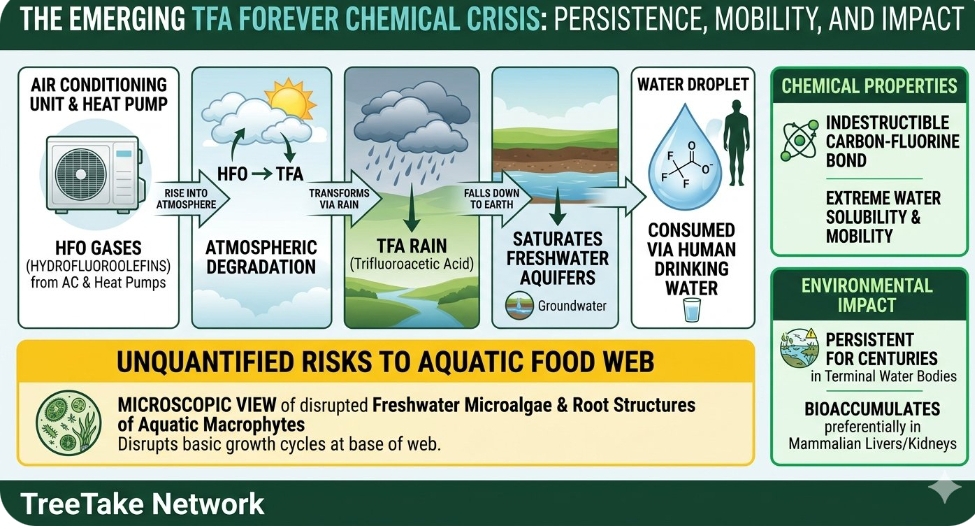
In a comprehensive chemical safety assessment published on October 30, 2026, an international coalition of ecotoxicologists and environmental chemists issued an urgent warning regarding the exponential accumulation of trifluoroacetic acid—commonly known as TFA—in global freshwater networks and human drinking water supplies. The peer-reviewed study tracks the environmental degradation pathway of next-generation hydrofluoroolefins, which were widely introduced by global chemical manufacturing conglomerates as eco-friendly replacements for ozone-depleting substances in air conditioning systems, industrial refrigerants, and heat pumps. However, the data prove that these volatile gases degrade rapidly in the upper atmosphere into TFA, an incredibly stable and highly mobile "forever chemical" that falls via precipitation back into the biosphere.
The laboratory data points to an alarming level of environmental persistence. Because TFA contains an indestructible carbon-fluorine bond, it is entirely resistant to natural breakdown mechanisms like microbial biodegradation, photolysis, or hydrolysis, allowing it to persist in the environment for centuries. Furthermore, due to its high water solubility and extreme mobility, the chemical completely bypasses standard municipal drinking water filtration systems, including activated carbon filters. This has resulted in a chronic accumulation loop where TFA is systematically concentrated in terminal water bodies, agricultural soils, and food crops, leading to direct human and animal dietary exposure.
Toxicological monitoring conducted across vulnerable aquatic ecosystems has revealed worrying baseline anomalies. High concentrations of TFA in localised wetlands have been shown to disrupt the growth cycles of freshwater microalgae and root structures of aquatic macrophytes, which form the absolute base of the aquatic food web. Experts warn that because TFA bioaccumulates preferentially in the livers and kidneys of mammals, prolonged low-dose exposure poses unquantified long-term risks to both wild mammalian populations and human communities dependent on contaminated regional aquifers.
"The unchecked accumulation of trifluoroacetic acid in our global hydrological cycle is an unfolding ecological blind spot," stated Dr Regina Griebler, a lead environmental toxicologist involved in the multi-centre study. "We are repeating the same historical mistakes we made with older persistent substances by pumping millions of tonnes of hydrofluoroolefins into the atmosphere without evaluating the terminal breakdown products. Once an aquifer is thoroughly saturated with an ultrafast-moving compound like TFA, it is practically impossible to remediate with our current technological toolkit."
Demanding an immediate regulatory re-evaluation of industrial cooling agents, Professor David Santillo, a senior specialist in environmental health science, noted: "The chemical industry greenwashed these materials as climate-safe alternatives simply because they have a low global warming potential. This data forces a radical rewrite of that narrative. Regulatory bodies like the European Chemicals Agency must enforce a strict, comprehensive restriction on all non-essential uses of fluorinated gases, shifting chemical manufacturing priorities toward natural refrigerants like carbon dioxide, ammonia, and hydrocarbons before this contamination loop becomes completely irreversible."
Editor's Note
The pervasive spread of trifluoroacetic acid pollution exposes a critical flaw in global chemical regulation frameworks that evaluate industrial compounds in complete isolation rather than tracking their atmospheric life-cycle transformations. Moving forward, environmental agencies must abandon the narrow "one-for-one" substitution model and enforce strict, cradle-to-grave lifecycle assessments on all industrial alternatives. The way forward requires governments to enact emergency statutory limits for TFA in drinking water and provide immediate infrastructure funding to upgrade regional water plants to advanced reverse osmosis and specialised ion-exchange technology. We must transition entirely to natural refrigerants, ensuring that our efforts to heal the atmospheric ozone layer do not end up poisoning the very freshwater sources that sustain global biodiversity.



Leave a comment