

Know Your Pooch
VK Joshi
The writer is former director, GSI, and an avid animal lover. His understanding of man's best friend comes from over six decades of dedicated association with it
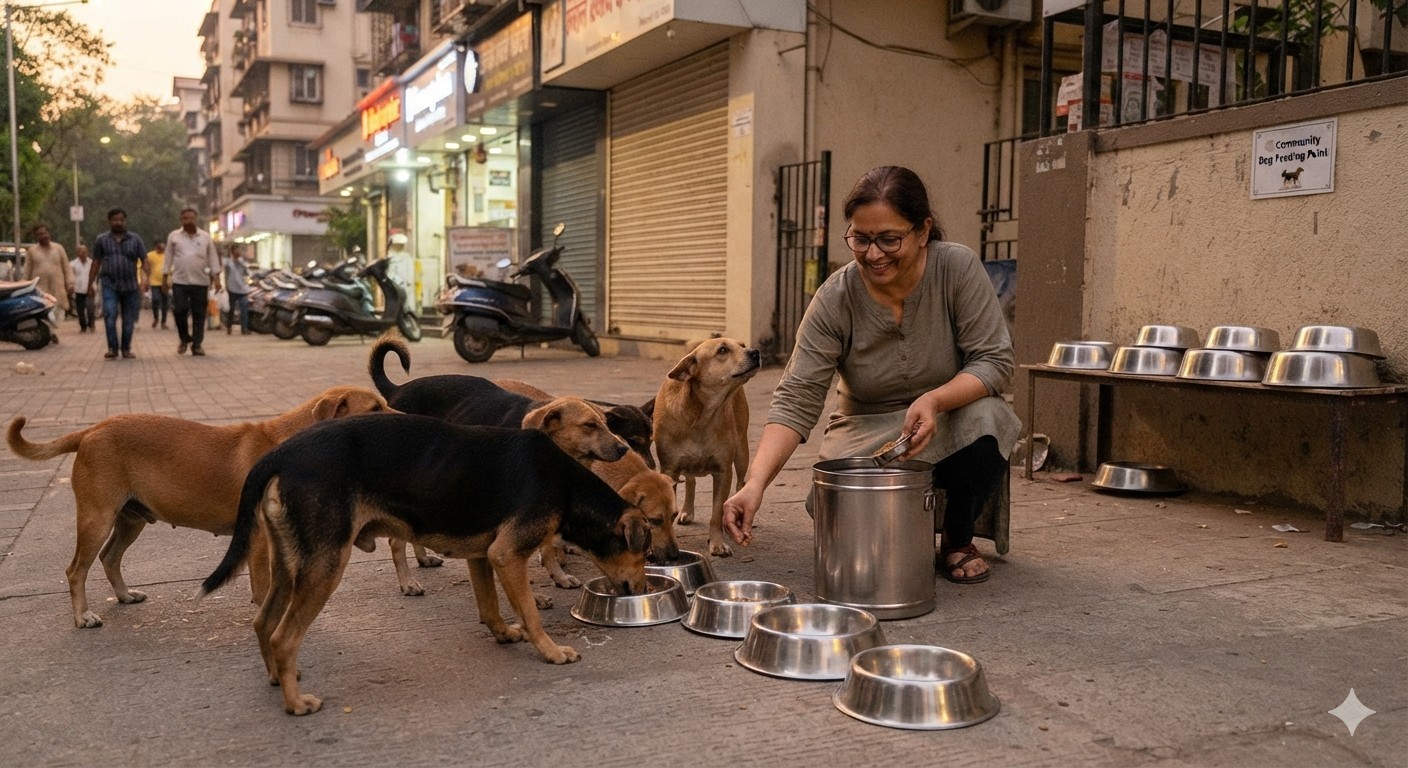
Over the past quarter century, I have seen a new culture of feeding street dogs evolve. In Heeranandani, Powai, Mumbai, there is a shopping centre, Galeria. There, I noticed that a lady visited the market daily at 7 P.M. with a bag full of food for dogs. She had encroached on a corner of the market to keep the feeding bowls, despite the shopkeepers' protests. The bowls were cleaned daily, turned upside down, and kept outside the reach of the dogs. Yet there were two or three dogs lurking around as if guarding their bowls!
Dogs are pack animals, territorial, with a strong possessive and guarding instinct.
Where is the problem
These days, there is a spurt of high-rise housing societies, where all kinds of people live. Some are traditional dog lovers with their pet inside their flat. Others are the new type of dog lovers who like to take care of the street dogs. In my observation, there are very few genuine dog lovers in this category. They not only feed the dogs but also get them vaccinated, treated when needed and keep a regular check on the canines they look after.
In Delhi, I know a lady who commutes from Gurgaon to R.K. Puram every day to feed dogs. They wait for her near her house and get excited on seeing her car. She takes out the shiny feeding bowls from the boot of the car and feeds them lovingly. If a dog is not eating, she takes him to the vet immediately. She has engaged a trainer who trains some of them to guard a designated area.
This indicates the genuine type of dog lover, who, due to some constraints, is not able to keep the dogs in her house. Out of sheer love for dogs, she spends her time and money to keep her hobby alive, without disturbing anyone else.
The problem lies with the new type of dog lovers who feed the dogs out of love/ impulse/ to show off/ to satisfy the whims of their children. Their love is restricted to mere feeding.
These dog lovers (though in the minority) prefer to keep the feeding bowls near the entrance of their block.
Here comes the problem. For dogs, that place becomes their own, and they guard it. A child or an old person passing by is attacked by the ‘guards’ who are zealously guarding their bowls. They may be sitting under a car, 50-60 feet away, yet they are able to spot the guy near their bowls. Unfortunately, their bowls are never cleaned and such bowls are often visited by rats or crows searching for tiny morsels of food. Some of them may be carrying the rabies virus and inadvertently transfer it to the bowl. During the next meal, the dog who licks the particular bowl may develop rabies. God forbid what will happen then! Their foster parent never cares to get them vaccinated, which is a continuous process.
This leads to strife between the new type of dog lovers and the victims or those who are scared of dogs. I can jolly well understand the emotions of both sides.
Points to be noted
When stray dogs are fed irresponsibly—without fixed locations, schedules, clean-up, or sterilisation plans—it triggers a chain reaction of public safety, health, and environmental hazards. The primary problems arising from unmanaged feeding can be grouped into three major categories:
1. Public safety & behavioural issues
Increased territorial aggression: Dogs naturally guard their food sources. If they are fed near building gates, main roads, or common corridors, they begin to view those public areas as their territory. This leads to them chasing, barking at, or biting unsuspecting residents, delivery partners, and vehicles entering the space.
Pack formation: Regular, unmanaged food dumps draw dogs from neighbouring streets. These individual animals soon merge into large, highly protective packs. A high concentration of free-roaming dogs significantly escalates the risk of coordinated pack attacks on children, senior citizens and cyclists.
Begging interventions: When dogs lose their natural hunting instincts and rely entirely on human handouts without a fixed schedule, they begin following and cornering passersby out of anticipation, which people often misinterpret as an impending attack.
2. Sanitation & environmental hazards
Pest and rodent infestations: Leaving food scraps, plastic packets or raw meat directly on pavements attracts rats, mice, crows, and stray cats. This debris creates breeding grounds for maggots and flies, turning the locality into a hygiene nightmare.
Foul odours and public nuisance: Decomposing food leftovers combined with dog faeces concentrated heavily around specific uncleaned feeding points create strong, foul odours that ruin the quality of life for nearby residents.
Water contamination: Rainwater often washes rotting food debris and animal waste from uncleaned spots straight into open storm drains, clogging drainage systems and contaminating localised groundwater channels.
3. Worsening animal welfare
Population explosion: Giving stray dogs regular meals boosts their energy levels, health, and overall fertility rates. If feeding is not tied directly to a sterilisation (ABC) programme, the birth rate of puppies skyrockets. This traps more animals in a cycle of suffering, disease, and road accidents.
Rapid disease transmission: Feeding a large number of unvaccinated dogs out of a single uncleaned bowl or spot accelerates the spread of highly contagious canine illnesses like Parvovirus, Canine Distemper, and mange. Most critically, it increases the localised risk of Rabies transmission to both animals and humans.
Dietary complications: Feeding street dogs highly processed, spicy, oily, or sweet human food (such as sugary biscuits or leftover fast food) causes severe long-term medical issues, including chronic skin allergies, hair loss, liver damage, and obesity.
What is the solution?
As I said, the place where their feeding bowls are kept becomes their very own place. If the bowls are kept at or near the entrance of a block, the dogs will guard it zealously. In that process, they may attack/bite a person whom they feel suspicious of.
Dogs are creatures of routine. They know the time when their food will be served. At that time, they are hyperactive. In a high-rise housing society, it would be ideal to select a spot that is not frequented by the residents. It would be nice to enclose their feeding area. Of course, once enclosed, the dogs will guard it with more zeal, but a warning sign for the residents will save them from dog attacks/bites. It would be better if their feeding bowls are cleaned after meals. This will save the dogs from several infections.
There is a catch here. I have noticed that the so-called dog lovers, instead of bothering to go to the feeding area, drop chunks of bread and biscuits near the entrance of their blocks. The problem remains as it was. Moreover, bread and biscuits are poison for dogs. If one has to feed them, one should spend some money and buy dog food. However, this can be fed only in a bowl.
A little bit of effort by the street dog feeders will keep everyone safe, and there will be no fights/heated arguments. Think over it!



Leave a comment