

Expert Expressions
CP Rajendran is a geoscientist and an adjunct professor at the National Institute of Advanced Studies, Bengaluru and co-author of the book: The Rumbling Earth – The Story of Indian Earthquakes
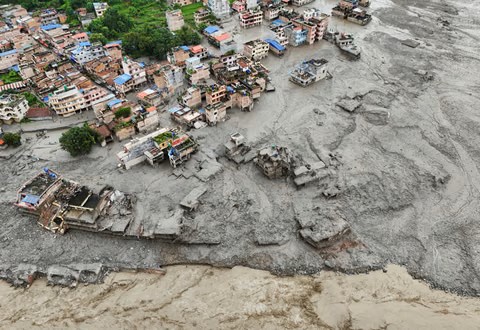
On the morning of August 26, a catastrophic flash flood tore through the Lende Khola–Trishuli–Narayani river corridor in Nepal, near the border with Tibet. By the disaster authority’s tally on August 31, more than 900 people were confirmed dead and over 4,000 more were listed as missing—figures that continue to rise inexorably as rescue teams struggle to reach remote villages cut off by the deluge. The sheer velocity of the event was staggering: water in the Trishuli River rose by as much as nine meters in a mere half an hour at the town of Ghalchi. Bustling market towns along the corridor—including Timure, the Rasuwagadhi customs zone, Syafrubesi, Mailung, Shantibazar and Betrawati—were effectively wiped off the map. Along with them went crucial infrastructure: more than 30 bridges, some 40 kilometres of vital roadway and over a dozen hydropower and solar installations were instantly obliterated.
The immediate cause of this devastation is slowly coming into focus, even if some granular details are still being worked out by researchers. A colossal mass of ice, snow and rock broke free from the northern face of Langtang Lirung, a prominent peak that rises above 7,200 metres near the Chinese border and plummeted roughly two kilometres down the sheer mountainside. The colossal energy of this impact sent a profound seismic signal—equivalent to a magnitude 5.2 earthquake—that monitoring stations around the world picked up shortly after 8:30 AM local time. For a few uncertain hours, seismologists initially read that signal as a conventional tectonic earthquake. However, the U.S. Geological Survey’s subsequent analysis showed otherwise: the specific wave pattern matched a massive surface mass falling, not a deep-seated fault slipping. The resulting debris and sudden meltwater dammed the Lende Khola, creating a transient, highly unstable reservoir that rapidly broke through its own confinement, sending a catastrophic wall of water down the Bhote Koshi and Trishuli valleys.
Some early accounts hastily labelled this event a classic glacial lake outburst flood (GLOF)—the kind of disaster that occurs when a natural lake dammed by fragile glacial debris breaches suddenly due to hydrostatic pressure. Yet, researchers who have since meticulously reviewed the satellite record aren’t convinced a pre-existing lake was involved at all. Instead, the evidence points toward a complex ice-rock avalanche that dynamically blocked the river channel and then violently let go. This distinction is far from academic. A high-altitude hazard driven by an unstable, warming rock face requires fundamentally different sensors, placed in entirely different structural locations, than a hazard driven purely by a growing proglacial lake waiting to burst. Misdiagnosing the mechanism directly compromises our capacity to build effective early warning architectures.
Whatever the exact triggering mechanism, the broader geological and environmental setting explains why disasters of this scale keep recurring with terrifying frequency. Nepal sits squarely on the collision zone where the Indian tectonic plate continues to relentlessly push beneath the Eurasian plate, building and uplifting some of the least stable, most fractured terrain on the planet. Anthropogenic climate warming has made this naturally volatile terrain more dangerous still. The zero-degree isotherm—the elevation at which precipitation falls as snow rather than rain—has been steadily climbing. Consequently, more of what used to blanket the high peaks as stabilising winter snow now arrives as liquid rain, driving accelerated thermal erosion and faster melt. Furthermore, as high-altitude ice thins, it ceases to buttress the fractured rock faces around it, causing slopes that held secure for centuries to suddenly fail. Retreating glaciers also leave behind loose, unsorted ridges of rock and gravel called moraines. These fragile formations dam meltwater into precarious lakes capable of breaching without warning once pressure builds behind them, acting as geological time bombs scattered across the high valleys.
The systemic nature of this crisis is well-documented. Two landmark reports published in March by the International Centre for Integrated Mountain Development (ICIMOD), the Kathmandu-based mountain research body, found that glaciers across the Hindu Kush Himalaya have lost as much as 27 metres of vertical thickness since 1975, with the rate of ice loss doubling since the year 2000. This data was a clear, unvarnished warning, delivered a mere five months before the Trishuli disaster, about exactly the kind of structural instability that ultimately produced it.
Regrettably, Nepal has seen this harrowing script play out before and so have its immediate neighbours. In 2024 alone, two glacial lakes above Thame village burst unexpectedly, destroying homes and a local school. In 2021, a massive block of rock and ice broke off a high ridge above the village of Raini in India’s Chamoli district, killing more than 200 people and destroying a major hydropower plant on the Rishiganga River. Before that, the Kedarnath floods of 2013 claimed thousands of lives under broadly similar meteorological triggers. This is not a localised South Asian anomaly; it is a global phenomenon. In Switzerland, the sudden collapse of the Birch Glacier buried the village of Blatten last year, while a catastrophic landslide at a mountain resort in Georgia killed 33 people in 2023. None of these can be dismissed as freak, isolated anomalies anymore. They are the systemic outcomes of a warming atmosphere interacting with inherently unstable high-mountain environments.
This reality ought to be read as a stern warning to the governments currently racing to aggressively develop these mountains, rather than just a tragic reason to mourn. Driven by geopolitical competition and resource demands, China, India, and, on a smaller scale, Nepal have all been pushing heavy infrastructure—dams, tunnels, highways and high-voltage transmission lines—deeper into the fragile inner tiers of the Himalayas. The objective is to capture the region's vast hydropower potential and mineral wealth, yet these projects are being executed in some of the most seismically active and geologically fragile terrains on Earth. Each of these interventions adds the violent dynamics of heavy construction, blasting and extensive road-cutting to a steep landscape that is already destabilising on its own. This recent flood stands as unambiguous evidence against the current reckless pace of mountain building, not as an unfortunate, disconnected coincidence alongside it. The mechanical vibrations and altered slope hydrology inherent to these megaprojects are actively accelerating the mountain's natural decay.
Some of what would blunt the human and economic toll of the next inevitable flood is relatively straightforward, if not cheap. Deploying arrays of solar-powered sensors and automated cameras near high-risk lakes and unstable slopes, tied directly to real-time satellite telemetry and weather radar networks, can give vulnerable downstream villages minutes or even hours of advanced warning. This is precisely the kind of proactive infrastructure that allowed the Swiss authorities to evacuate the village of Blatten before its glacier collapsed.
Currently, Nepal completely lacks that kind of comprehensive coverage across the vast majority of its high mountains. This deficiency exists largely because the specialised equipment and technical expertise are prohibitively expensive and thin on the ground in a developing country faced with far more immediate, competing claims on its national budget. Without international climate financing earmarked for adaptation, the mountain communities remain exposed.
There is also a sensitive transboundary question here that is worth putting plainly rather than assuming an easy answer to. China has invested heavily in sophisticated glacial monitoring on its side of the border and its authorities did issue a warning, well after the fact, that a secondary flood remained possible if the debris-dammed lake above the border breached again. Whether that upstream monitoring network picked up any early signals of structural instability before the catastrophic failure on August 26 and whether that crucial data could have reached Nepalese authorities in time to execute downstream evacuations is a question worth asking both governments directly. The lack of robust, real-time data-sharing protocols across geopolitical borders remains a glaring vulnerability in global climate adaptation efforts.
Ultimately, the rapidly degrading glaciers above Nepal, India, Pakistan and China are not merely localised natural hazards. They function as the essential "water towers" of Asia, feeding the great river systems that supply critical drinking water and agricultural irrigation to nearly two billion people downstream. Accelerated melting will, for a limited number of years, manifest as increased annual volume in these rivers. However, this temporary abundance is a dangerous illusion. As the finite glacial ice reserves run down, the vital dry-season flow that millions of farmers and major cities depend upon will inevitably shrink. This systemic water scarcity will persist as a generational crisis, long after this specific flood has stopped making international headlines.



Leave a comment