

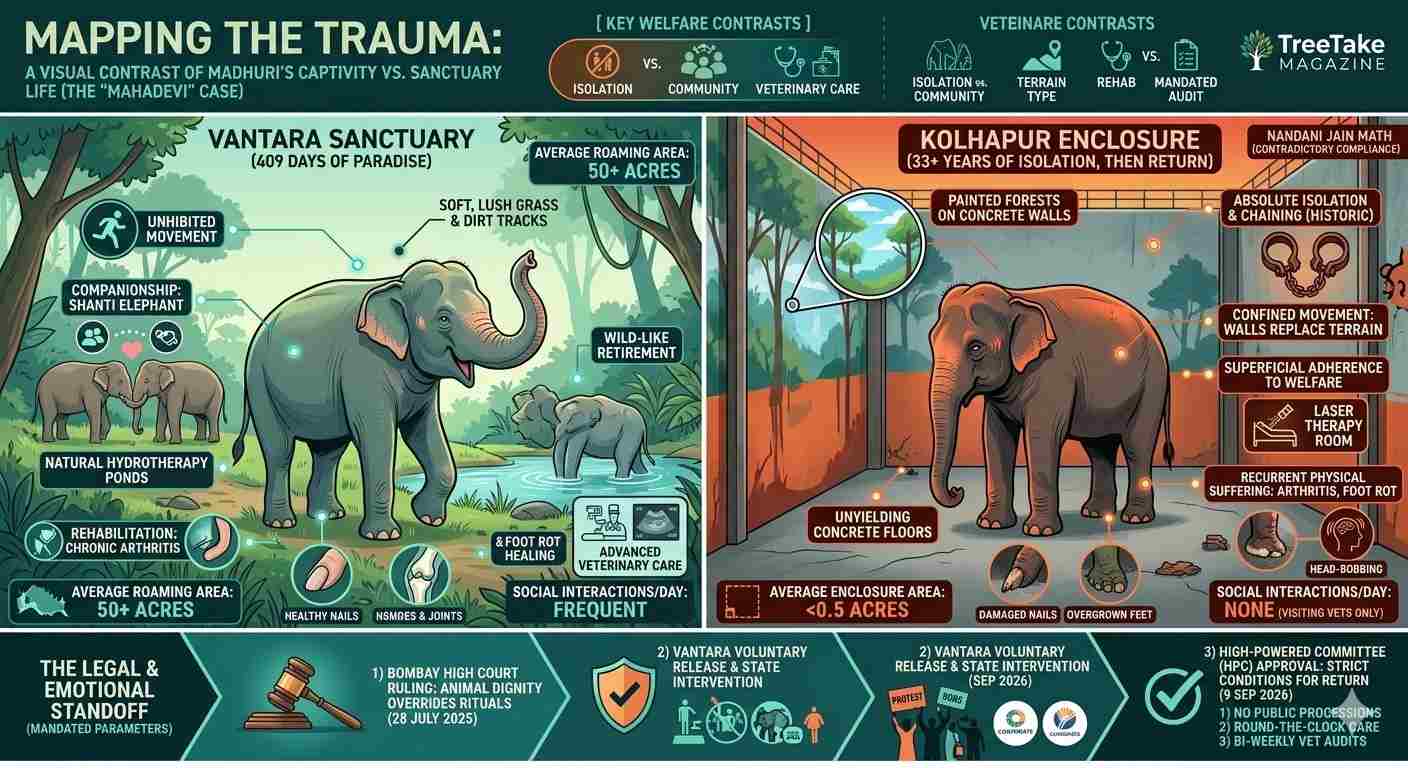
The intersection of deep-rooted cultural reverence and modern animal welfare legislation has reached a heartbreaking nexus in the state of Maharashtra. Following a fierce tug-of-war spanning the highest courts, corporate rehabilitation infrastructures, and massive local civil resistance, the 36-year-old elephant Madhuri, also known as Mahadevi, has been officially uprooted from sanctuary life. TreeTake presents a detailed chronological analysis of this unprecedented case, examining the official regulatory parameters, the specific infrastructure flaws in her new enclosure, and the documented violations of court mandates that defined her highly controversial homecoming to Nandani village.
For thirty-six years, an elephant named Madhuri, also known as Mahadevi, lived a life defined by heavy iron shackles, unyielding concrete floors, and absolute isolation at the Shri Jinsen Bhattarak Pattacharya Mahaswami Jain Math in Nandani village, Kolhapur. Brought to the monastery as a mere three-year-old calf, she grew up fulfilling human demands instead of roaming the vast forests she belonged to. Decades of forced participation in loud, chaotic religious processions took an unbearable toll. Starved of companionship and suffering from severe chronic arthritis, foot rot, and overgrown nails, her psychological distress became deeply rooted. Her inner trauma manifested in tragedies, including a fatal attack on the math’s chief priest in 2017 and a bystander in 2022.
The Legal Mandate and The Vantara Sanctuary
The highly publicised custody battle over the 36-year-old female elephant Madhuri reached a historic turning point on 28 July 2025. Following an extensive legal campaign detailing decades of physical and psychological deterioration, the Bombay High Court issued a landmark directive ordering her immediate relocation from the Shri Jinsen Bhattarak Pattacharya Mahaswami Jain Math in Nandani village, Kolhapur. The judiciary explicitly rejected the monastery's assertions that religious customs superseded animal protection laws, ruling that animal dignity overrides ritual rights, and no religious custom justifies the physical torture of a captive elephant. The order was subsequently upheld by the Supreme Court of India, leading to her transfer to the advanced Vantara Wildlife Welfare Centre in Jamnagar, Gujarat.
PETA India celebrated the initial legal victory, underscoring the vital medical necessity of the transition. The organisation publicly stated: "This court order gives Madhuri a new lease on life after thirty-three years of living in isolation and on unyielding concrete. She needs a quiet space to roam freely, a water body to ease her pain, and advanced veterinary equipment to heal."
During her subsequent 409-day stay at the Gujarat sanctuary, Madhuri experienced a complete transformation in her living conditions. For thirteen months, the elephant received advanced veterinary treatments for chronic arthritis, severe foot rot, and overgrown nails caused by decades of standing on unyielding concrete floors. Crucially, the facility provided her with hydrotherapy ponds to ease joint inflammation and allowed her to form a close social bond with Shanti, a fellow rescued elephant. The rehabilitation phase marked the first time since her capture as a three-year-old calf in 1992 that Madhuri was able to live without heavy iron shackles and absolute isolation.
The Local Backlash and Corporate Recalibration
However, the relocation triggered immediate, volatile resistance within the Kolhapur district. Viewing Madhuri as a living deity and an inseparable part of their local heritage, the local community organised massive public outcries, culminating in a striking 40-kilometre silent march demanding her return. Her former mahout, Ismail Nidgun, captured the profound local grief, stating: "It feels like I have lost my own daughter. My days are empty, just like her empty enclosure at the temple."
The emotional public grief quickly transformed into a targeted economic and political campaign, including organised boycotts against consumer products manufactured by the parent organisation of the Vantara facility. Under heavy electoral and social pressure during a critical regional cycle, Maharashtra state leaders intervened, with local representatives declaring: "The government will fully support the legal efforts of the devotees to bring our revered deity back to her rightful home."
Faced with severe regional hostility and widespread commercial boycotts, the Vantara management shifted its legal stance. The facility released an official statement clarifying its operational position: "Vantara does not seek permanent custody of the elephant and merely cared for her under judicial orders. We will extend full support to any application filed by the Jain Math and the Government of Maharashtra before the Honourable Court requesting Madhuri's return."
Flouting Court Mandates and the Contested Enclosure Ground Reality
The devastating blow to Madhuri’s sanctuary life was delivered on 9 September 2026. The Supreme Court-appointed High-Powered Committee issued official clearance permitting her return to Kolhapur after a total of 409 days in Gujarat. The committee imposed strict, legally binding conditions: Madhuri must never be used in public processions again, she must receive round-the-clock care, and she must undergo mandatory medical examinations every fifteen days by visiting veterinarians. Crucially, the judicial directives strictly prohibited any activity that would induce acute stress, specifying that her transport and reception must be quiet, dignified, and entirely free of distressing environmental triggers.
To satisfy intense judicial scrutiny and secure her return, the Swasthishri Jinsen Bhattarak Pattacharya Mahaswami Sanstha Jain Math trust scrambled to upgrade its facilities, proudly proclaiming: "We have modernised our infrastructure to include laser therapy rooms and open spaces to ensure her absolute well-being."
However, her actual homecoming in September 2026, timed with the festive occasion of Ganesh Chaturthi, openly flouted these explicit court mandates. Instead of a quiet and stress-free entry, her return was transformed into a chaotic public spectacle. Thousands of jubilant villagers lined the streets, bursting high-decibel firecrackers directly alongside the specialised animal ambulance and deploying loud, high-volume DJ sound systems to blast celebratory music. This intense acoustic pollution subjected the highly sensitive animal to the exact traumatic conditions the judiciary had sought to ban, drawing sharp condemnation from welfare observers who noted that the homecoming parade itself stood in direct contempt of the protective guidelines set by the High-Powered Committee.
Furthermore, independent veterinary audits have exposed a starkly different current situation inside the enclosure at Nandani. While the math has constructed a new brick-and-mortar housing unit equipped with specialised laser therapy machinery and rubberised matting, the broader physical environment remains severely deficient. The promised "open spaces" consist of a highly confined, walled enclosure rather than natural, uninhibited terrain. Crucially, to mimic a natural habitat under court constraints, the math has resorted to painting trees and forest landscapes on the concrete enclosure walls rather than providing actual dirt tracks, shade canopies, or a natural water body for mud wallowing. This superficial compliance leaves Madhuri in an artificial environment, separated by hundreds of miles from the natural hydrotherapy pools and the vital herd companionship she left behind in Gujarat.
A Decision of Pure Pressure: Dissent and Strategic Paths Forward
The reversal of Madhuri's relocation has laid bare an uncomfortable systemic reality: the final decision was not an objective evaluation of the biological or psychological retirement needs of an ageing, traumatised elephant, but rather the sheer outcome of immense socio-political and economic pressure brought to bear on the regulatory framework. Rather than prioritising the complex rehabilitation required to manage her chronic arthritis and deep-seated trauma, the state apparatus and corporate entities yielded to coordinated regional agitation and consumer boycotts.
Animal rights groups have expressed deep dismay over the outcome, viewing it as a dangerous precedent that compromises animal safety in the face of public pressure. Prominent groups have highlighted successful historical precedents—such as the permanent sanctuary relocations of Sunder from Kolhapur, Gajraj from Satara, and Lakshmi from Mumbai—proving that sustained monitoring can eventually win long-term freedom for captive animals.
Following the committee's clearance, the official legal team of People for the Ethical Treatment of Animals (PETA) India issued a sharp public rebuke: "This decision is a tragic betrayal of an animal that had finally tasted freedom. Madhuri is being sent back to the exact same environment where her profound mental and physical suffering originated. For the first time in decades, she could finally live as an elephant should at Vantara. Breaking the deep elephant bonds she has formed during rehabilitation is a massive setback."
The organisation further warned that their legal desk remains heavily active and highly vigilant: "The High-Powered Committee has set clear parameters. If the temple fails to meet even one of the mandated medical or environmental standards, we stand ready to immediately present that evidence to the judiciary to demand her permanent relocation back to a sanctuary."
To prevent similar welfare rollbacks across India, we need to amend the national framework governing captive wildlife immediately. The Central Zoo Authority must establish an independent, federal registry that tracks the psychological well-being of all temple elephants using advanced cortisol testing rather than relying solely on visual facility audits. State governments must phase out commercial ownership certificates for elephants, transitioning existing captive animals to state-managed, natural jungle enclosures where they can maintain social bonds. Finally, local administrations must collaborate with religious trusts to replace live animals with modern mechanical alternatives for processions, ensuring that ancient cultural traditions are preserved without subjecting endangered wildlife to lifelong physical and mental confinement.
The Blind Spot of Human Sentiment: Ignorance of Elephant Psychology
The tragic regression of Madhuri’s welfare stems from a fundamental, widespread failure to comprehend the complex psychological and biological retirement needs of a highly social, migratory species. In traditional captive environments like the Nandani Math, caretakers historically misinterpret severe distress markers—such as chronic head-bobbing, weaving, and repetitive swaying—as benign habits or signs of a calm demeanour, completely missing the fact that these are diagnostic stereotypic behaviours indicating deep-seated psychological trauma. Elephants are emotionally advanced animals that require expansive, unconfined home ranges to forage, natural mud and water bodies to naturally palliate joint inflammation, and, above all, complex herd companionship to maintain psychological stability. Confining Madhuri to an artificial paddock with trees painted on concrete walls—rather than allowing her to remain with her companion Shanti in a natural ecosystem—exposes a profound, human-centric ignorance. The decision to repatriate her treats a highly traumatised animal as a static cultural artefact rather than a living being with distinct emotional needs, prioritising regional human pride over the fundamental sensory and psychological health required for a dignified retirement.



Leave a comment