

TreeTake Network
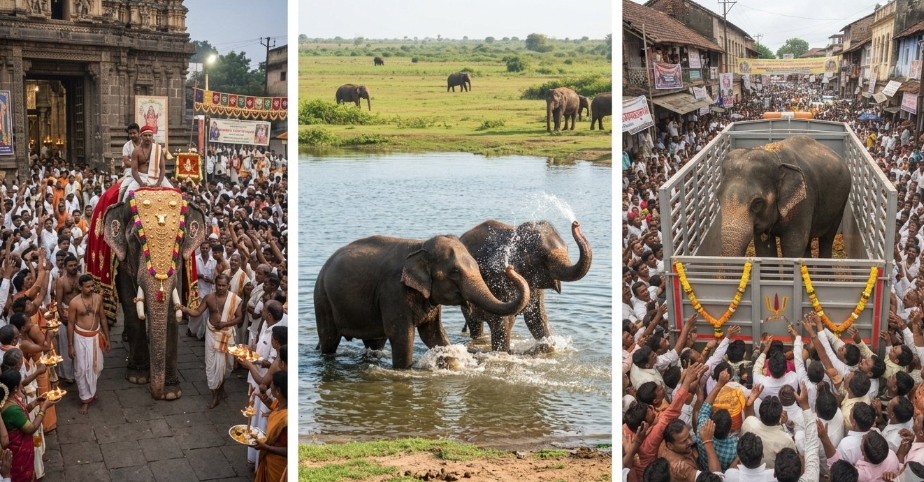
For thirty-six years, an elephant named Madhuri, also known as Mahadevi, lived a life defined by heavy iron shackles, unyielding concrete floors, and absolute isolation at the Shri Jinsen Bhattarak Pattacharya Mahaswami Jain Math in Nandani village, Kolhapur. Brought to the monastery as a mere three-year-old calf, she grew up fulfilling human demands instead of roaming the vast forests she belonged to. Decades of forced participation in loud, chaotic religious processions took an unbearable toll. Starved of companionship and suffering from severe chronic arthritis, foot rot, and overgrown nails, her psychological distress became deeply rooted. Her inner trauma manifested in tragedies, including a fatal attack on the math’s chief priest in 2017 and a bystander in 2022.
The turning point arrived on July 28, 2025. Following an intense legal battle championed by animal rights activists, the Bombay High Court issued a landmark directive, later firmly upheld by the Supreme Court. The legal bodies rejected the monastery's arguments that religious rituals took precedence over animal welfare, asserting that "animal dignity overrides ritual rights, and no religious custom justifies the physical torture of a captive elephant." The court ordered her immediate relocation to the advanced Vantara Wildlife Welfare Centre in Jamnagar, Gujarat. PETA India celebrated the moment, stating, "This court order gives Madhuri a new lease on life after thirty-three years of living in isolation and on unyielding concrete. She needs a quiet space to roam freely, a water body to ease her pain, and advanced veterinary equipment to heal."
For thirteen months, Madhuri experienced true relief. At Vantara, her feet finally touched soft, lush grass. She spent her afternoons wading, swimming, and playing in expansive hydrotherapy ponds that eased the aching joints of her arthritic legs. Crucially, the lonely elephant found companionship, forging a profound, gentle friendship with a fellow rescued elephant named Shanti. It was a brief glimpse of the peaceful retirement she had earned after a lifetime of labour.
However, back in Kolhapur, a fierce storm was brewing. The local community, viewing Madhuri not as a wild animal but as a deeply revered member of their sacred tradition, felt broken by her departure. Devotees organised massive public outcries, including a staggering forty-kilometre silent march. Her former mahout, Ismail Nidgun, captured the local grief, stating, "It feels like I have lost my own daughter. My days are empty, just like her empty enclosure at the temple." The local unrest rapidly escalated into a targeted economic and political campaign, including boycotts against corporate products linked to Vantara's parent organisation. Under immense electoral and social pressure, Maharashtra state leaders intervened, with local representatives declaring, "The government will fully support the legal efforts of the devotees to bring our revered deity back to her rightful home."
Faced with severe hostility and boycotts, Vantara altered its stance. The facility released a statement clarifying its position: "Vantara does not seek permanent custody of the elephant and merely cared for her under judicial orders. We will extend full support to any application filed by the Jain Math and the Government of Maharashtra before the Honourable Court requesting Madhuri's return." To satisfy welfare concerns, the monastery rapidly renovated its facilities, proclaiming, "We have modernised our infrastructure to include laser therapy rooms and open spaces to ensure her absolute well-being."
The devastating blow to Madhuri’s sanctuary life came on September 9, 2026. The Supreme Court-appointed High-Powered Committee issued an official clearance permitting her return to Kolhapur after a total of four hundred and nine days in paradise. The committee imposed strict, legally binding conditions: Madhuri must never be used in public processions again, she must receive round-the-clock care, and she must undergo mandatory medical examinations every fifteen days by visiting veterinarians.
On the auspicious occasion of Ganesh Chaturthi in September 2026, Madhuri was driven back into Kolhapur inside a specialised animal ambulance. Thousands of jubilant villagers lined the streets, showering the vehicle with flowers and bursting into triumphant celebrations to welcome their living deity home. But away from the cheering crowds, the contrast was stark. PETA India expressed deep dismay over the outcome, publicly declaring, "This decision is a tragic betrayal of an animal that had finally tasted freedom. She is being sent back to the exact same environment where her profound mental and physical suffering originated."
Today, the celebrations have quieted down, and Madhuri is back in Nandani. While the monastery promises to adhere strictly to the veterinary mandates, the psychological reality for Madhuri remains bleak. The expansive fields are gone, replaced by a confined enclosure where the trees are painted on walls rather than rooted in the earth. Miles away in Gujarat, her friend Shanti stands by the water, waiting for a companion who will never return.
International bodies and organisations like PETA cannot simply step in to override this return, as domestic legal remedies were exhausted when the highest court sanctioned the move. Because of this, many fear her freedom is gone for good. Yet, animal rights groups refuse to view this court-ordered return as the final chapter. Activists have firmly stated, "If the temple fails to meet even one of the mandated medical or environmental standards, we stand ready to immediately present that evidence to the judiciary to demand her permanent relocation back to a sanctuary." While her immediate freedom is severely restricted, the legal apparatus to protect her remains heavily active.
There is strong precedent to believe this ongoing vigilance can succeed, as seen in the historic victories of other captive elephants in India who won their permanent freedom after prolonged battles. Sunder, a young elephant kept in chains at a temple in Kolhapur, was permanently relocated to the Bannerghatta Biological Park sanctuary following a massive legal campaign and intense public pressure. Similarly, Gajraj was released to a specialised conservation centre after spending over fifty years in chains in Satara, while Lakshmi was permanently retired to a natural jungle sanctuary after being rescued from illegal captivity on the chaotic streets of Mumbai.
These landmark cases prove that persistent monitoring and strategic legal action can eventually reopen the doors to a life of dignity. Madhuri’s journey remains a painful, ongoing testament to the heartbreaking clash between human sentimentality and an animal's basic right to freedom, but the battle for her future is far from over.
The Legal and Emotional Statements
The high-stakes battle over the custody and welfare of the 36-year-old elephant Madhuri, also known as Mahadevi, involved distinct perspectives from animal welfare organisations, the temple trust, corporate rescue entities, the judiciary, and the public. Below are the documented positions and official statements charting her movement from the Nandani Jain Math in Kolhapur to the Vantara facility in Gujarat, and her eventual return.
The Animal Welfare Perspective: PETA India
People for the Ethical Treatment of Animals (PETA) India spearheaded the legal campaign to remove Madhuri from the temple, citing deep physical and psychological deterioration. Following the decision of the High-Powered Committee to allow her return to the math, PETA India issued a sharp public rebuke:
"This decision is a tragic betrayal of an animal that had finally tasted freedom. Madhuri is being sent back to the exact same environment where her profound mental and physical suffering originated. For the first time in decades, she could finally live as an elephant should at Vantara. Breaking the deep elephant bonds she has formed during rehabilitation is a massive setback.
Our legal team remains vigilant. The High-Powered Committee has set clear parameters. If the temple fails to meet even one of the mandated medical or environmental standards, we stand ready to immediately present that evidence to the judiciary to demand her permanent relocation back to a sanctuary. The legal battle to protect her from returning to her past suffering is far from over."
The Custodian and Sanctuary Perspective: Vantara Wildlife Welfare Centre
Vantara, based in Jamnagar, Gujarat, handled Madhuri’s medical care and rehabilitation for over a year. Placed under immense community pressure and localised boycotts, Vantara released a formal statement clarifying its neutral stance regarding permanent custody, prioritising community harmony while offering continued support:
"Vantara does not seek permanent custody of the elephant and merely cared for her under judicial orders. We respect the deep-rooted cultural sentiments of the local community. To support a peaceful transition, Vantara will extend full support to any application filed by the Jain Math and the Government of Maharashtra before the Honourable Court requesting Madhuri's return. We remain committed to helping provide technical and veterinary assistance to ensure she is kept in optimal health under the monastery's care."
Religious & Local Authority Perspective: Shri Jinsen Bhattarak Pattacharya Mahaswami Jain Math
The trust managing the Nandani Jain Math defended their right to house Madhuri based on decades of cultural integration and local faith. Temple representatives and regional political leaders emphasised their 33-year bond with the elephant and noted that full infrastructure modernisations have been completed to ensure her well-being:
"Madhuri has been an integral part of our daily spiritual lives and sacred heritage for over three decades. Her sudden removal caused immense pain to the entire community, who revere her as a living deity. We have addressed all prior welfare concerns by completely modernising our infrastructure. The newly built facilities now include laser therapy rooms, dust-free open spaces, and modern veterinary equipment to ensure her absolute well-being in her rightful home."
The Caretaker's “Grief”: Former Mahout Ismail Nidgun
Madhuri’s longtime handler expressed deep emotional attachment, capturing the local grief following her departure:
"It feels like I have lost my own daughter. My days are completely empty, just like her empty enclosure at the temple. Madhuri belongs here with the people who loved her for decades, and her empty stable has left a massive void in our village."
The Judicial Mandate: The Bombay High Court and the High-Powered Committee
The legal framework prioritised animal welfare over institutional ownership, with the Bombay High Court noting that animal dignity overrides ritual rights in cases of systemic neglect:
"Animal dignity overrides ritual rights, and no religious custom or traditional practice justifies the physical torture or long-term neglect of a captive elephant."
The Supreme Court-appointed High-Powered Committee cleared her return subject to strict conditions—banning her from public processions and mandating round-the-clock professional care and bi-monthly medical exams:
"The return of the elephant Madhuri to Kolhapur is approved subject to absolute compliance with welfare regulations. The elephant must never be used in public processions or loud festivals again, must receive round-the-clock professional care, and must undergo mandatory medical examinations every fifteen days by visiting veterinarians."
The Devotees and Public Sentiment
The local populace viewed Madhuri's removal as a blow to their civic and religious identity, culminating in a 40-kilometre silent protest march where local organiser Anand Narde highlighted the community's generational bond with the elephant:
"This is not just about ownership; it is about our deep, generational faith and spiritual bond with a sacred animal. The entire village is united in this struggle, and we will continue our peaceful protests until our revered elephant is brought back to her home."



Leave a comment