

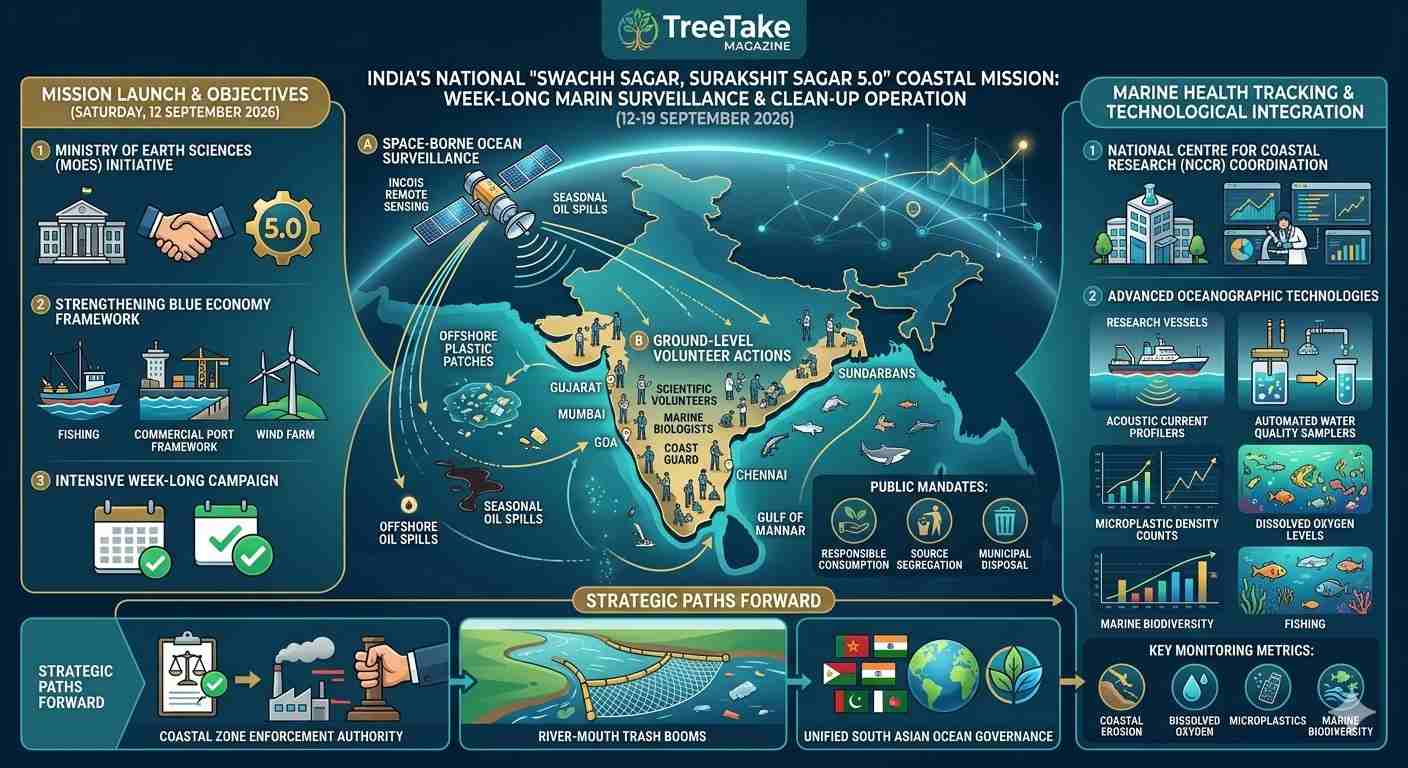
As rapid industrialisation and unchecked plastic disposal push the marine ecosystems of the Indian peninsula to the brink of collapse, the Union Government has initiated a major defensive intervention. Officially designated as Swachh Sagar, Surakshit Sagar 5.0, this high-stakes maritime campaign targets the escalating crisis of coastal degradation. TreeTake provides a detailed analysis of this federal deployment, evaluating the advanced remote sensing technologies being deployed, the critical data baselines being gathered, and the geopolitical necessity of safeguarding India's expansive blue economy framework.
A Federal Deployment on the Coastline
On Saturday, 12 September 2026, the Union Ministry of Earth Sciences officially launched the fifth edition of the Swachh Sagar, Surakshit Sagar national campaign from New Delhi. The intensive week-long coastal health initiative, running from 12 September to 19 September 2026, is coordinated by the National Centre for Coastal Research in Chennai. The mission deploys thousands of scientific volunteers, marine biologists, and coast guard personnel across dozens of critical beach sites spanning the eastern and western maritime corridors.
The campaign enters its fifth year facing an unprecedented surge in marine microplastic contamination and toxic industrial run-offs. Driven by the overarching objectives of the national blue economy framework, the initiative marks a transition from simple public beach cleaning drives to an institutional, data-driven maritime surveillance operation. The Ministry has anchored the mission around three core public mandates: consuming responsibly, segregating waste at source, and disposing of non-biodegradable materials through certified municipal channels.
Deploying the Technological Dragnet
The defining feature of this edition is the integration of advanced space-borne and oceanographic technologies to map the degradation of India's coastal shelf. The National Centre for Coastal Research has deployed specialised marine research vessels equipped with high-precision acoustic Doppler current profilers and automated water quality samplers. Simultaneously, the Indian National Centre for Ocean Information Services is utilising satellite imagery to track the movement of massive offshore plastic patches and seasonal oil spills.
"Our oceans are our shared heritage, and protecting them is our collective responsibility," stated Dr Srinivasa Kumar Tummala, Director of the Indian National Centre for Ocean Information Services, during the campaign's inaugural rollout. He emphasised that the initiative has successfully transformed into a powerful grassroots movement based on the spirit of collective community action. "Through the Swachh Sagar, Surakshit Sagar 5.0 framework, we are building a comprehensive digital repository of coastal health metrics. By combining real-time satellite remote sensing with extensive ground-level sampling, we are establishing the predictive models necessary to mitigate severe coastal erosion and protect our marine biodiversity centres from irreversible pollution."
The Rising Toll on Marine Ecosystems
The scientific urgency underlying this mobilisation is supported by alarming data gathered by oceanographic institutes over the past year. Run-off from rapid coastal urbanisation has significantly altered the dissolved oxygen levels across key fishing zones, creating temporary hypoxic zones that threaten traditional fishing communities. Furthermore, microplastic counts within commercial fish species sampled off major ports have registered a steady rise, posing a direct threat to public health and seafood export standards.
Independent marine ecologists have highlighted the scale of the challenge, emphasising that weekend clean-ups cannot counter structural industrial failures. The accumulation of synthetic debris along the delicate mangrove ecosystems of the Sundarbans and the coral reefs of the Gulf of Mannar continues to choke critical marine nurseries, altering local species distributions.
"The health of our oceans shapes the health of our planet, making this collective movement essential for building cleaner coasts," observed Dr Mrutyunjay Mohapatra, Director General of the India Meteorological Department, in a statement supporting the mission's data-gathering objectives. "The real battle for our oceans is fought at the mouths of our urban rivers and industrial canals. Until we enforce zero-liquid-discharge mandates on chemical manufacturing units located near the coast and eliminate single-use plastics from the municipal waste streams of coastal mega-cities, our marine monitoring systems will simply continue to document the slow death of our blue frontier."
Strategic Paths Forward
Reversing the degradation of India's marine territories requires transforming temporary conservation drives into strict statutory regulations. The central government must establish an independent coastal zone enforcement authority empowered to penalise maritime polluters using real-time satellite evidence. Technologically, local administrations must install automated trash booms at river mouths to intercept plastic debris before it enters the marine environment. Finally, India must collaborate with its regional maritime neighbours to develop a unified South Asian ocean governance policy, ensuring that plastic pollution and industrial spills are checked collectively across shared international waters.



Leave a comment