

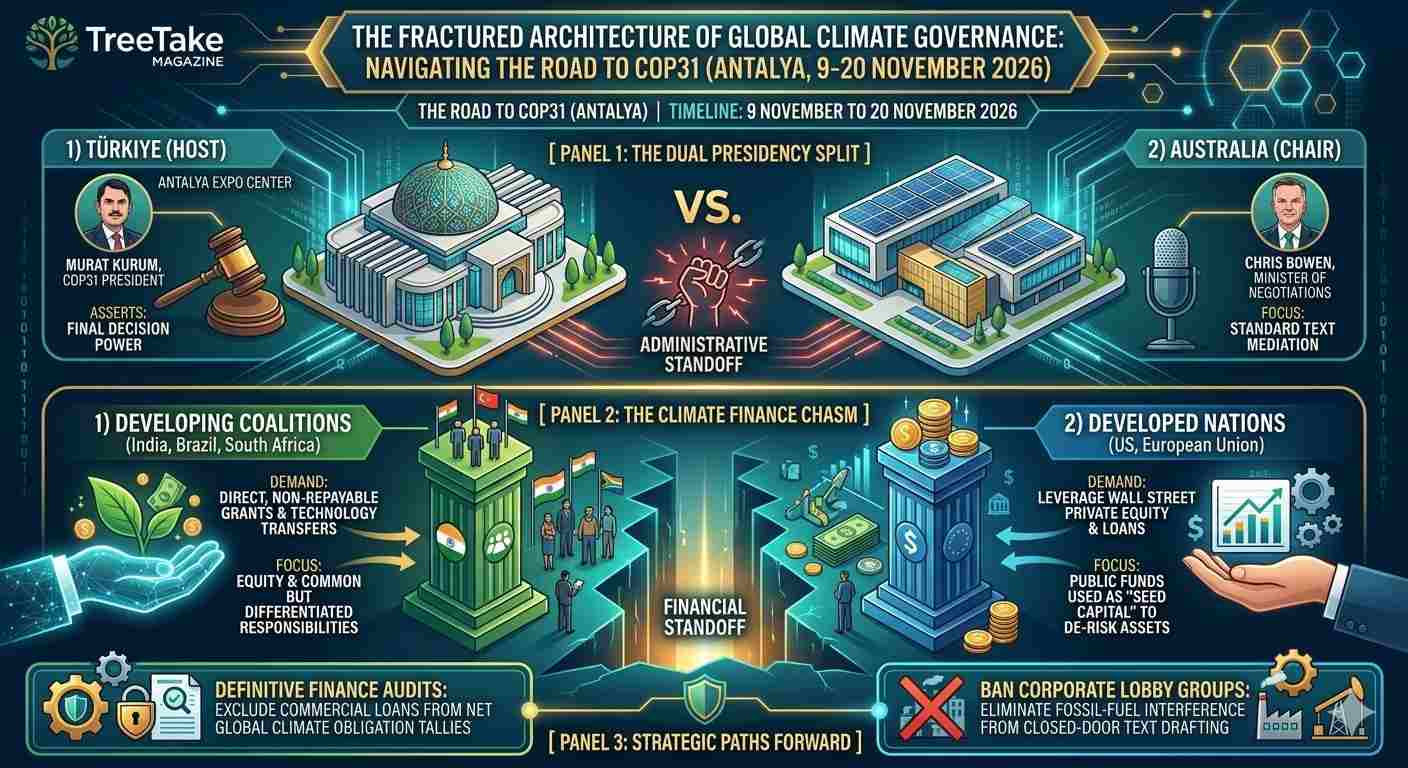
Global climate governance is rapidly heading toward a major diplomatic showdown as the United Nations framework faces severe institutional fractures. For the first time, a unique shared leadership structure defines the upcoming 31st session of the Conference of the Parties (COP31), scheduled to run from 9 November to 20 November 2026. While the resort city of Antalya, Türkiye, serves as the physical host location, Australia has been designated as the operational chair of negotiations. TreeTake presents a high-level briefing on this fractured layout, analysing the intense power struggles over executive authority, the shifting policy demands of developing coalitions, and the fierce global counterviews surrounding corporate greenwashing.
The Antalya-Canberra Executive Standoff
The formal scheduling of COP31 from 9 November to 20 November 2026 in Antalya, Türkiye, was intended to stabilise the United Nations Framework Convention on Climate Change (UNFCCC) pipeline following the highly contentious, forest-centric debates of the preceding COP30 summit in Belém, Brazil. To resolve an intense, deadlocked bidding war between Europe and Oceania, a unique compromise was brokered: Türkiye would provide the physical infrastructure and venue at its Expo Centre, with its Environment Minister Murat Kurum serving as the official COP31 President, while Australian Climate Change Minister Chris Bowen would take the helm as the President of Negotiations.
However, this unprecedented dual-presidency model has immediately cracked under intense geopolitical strain, threatening the administrative stability of the conference. Rather than operating as a smooth, collaborative partnership, a fierce territorial dispute has erupted over who maintains ultimate executive decision-making power during high-stakes text arbitrations. The diplomatic friction spilt directly into the public sphere when the Turkish Environment Ministry explicitly asserted that while Australia handles standard negotiation procedures, Türkiye retains absolute, final decision authority over the summit’s concluding ministerial declarations. This structural ambiguity has triggered severe anxieties among international observer groups, who warn that a divided leadership could completely paralyse negotiations on fast-evolving carbon-accounting rules.
The Global South's Financing Ultimatum
Beneath the administrative squabbling lies a fundamental, high-stakes battle over global capital distribution. Led by a powerful coalition of developing nations and major emerging economies including India, Brazil, and South Africa, the Global South is approaching the Antalya summit with a unified, aggressive financial ultimatum. Emerging economies are demanding a complete overhaul of how the New Collective Quantified Goal (NCQG) on climate finance is structured, insisting that historical Western polluters shift their focus away from commercial, interest-bearing loans and toward direct, non-repayable grants and highly concessional financing.
The position of the developing bloc is anchored in immediate economic reality: rising capital costs and volatile currency fluctuations mean that forcing vulnerable nations to borrow at market rates for climate adaptation accelerates domestic debt defaults. In an official ministerial address laying out the core priorities of developing economies, Union Environment Minister Bhupender Yadav stated that international climate cooperation must be guided by equity and the foundational principle of Common but Differentiated Responsibilities. He emphasised that the global transition cannot be achieved unless developed countries fulfil their historic commitments by providing affordable, unencumbered financial resources and seamless technology transfers to the Global South.
The Western Pivot to Private Capital and the Market Counterview
In stark contrast, a powerful counterview has solidified across the Global North, with negotiators from the United States, the European Union, and the United Kingdom pushing an entirely different financial narrative. Developed nations argue that public taxpayers' funds are fiscally insufficient to cover the multi-trillion-dollar global transition deficit. Consequently, the Western strategy focuses on utilising public funds strictly as "seed capital" to de-risk green projects, thereby leveraging vast networks of private institutional capital and commercial banking sectors to drive clean energy expansion.
This market-driven approach has drawn immediate, blistering pushback from grassroots climate networks and independent policy analysts, who condemn it as a dangerous abdication of historical accountability. Activists argue that relying on Wall Street or private equity to fund vital adaptation infrastructure—such as building coastal sea walls or restoring degraded topsoil—is a structural impossibility, as these essential public survival projects do not yield the short-term commercial profits required by private investors. Critics contend that the West’s continuous push to expand global carbon markets and private offsets serves as a regulatory smoke-screen designed to allow industrial conglomerates to buy their way out of raw domestic emission reductions, effectively transforming a planetary survival mechanism into a corporate greenwashing marketplace.
Strategic Paths Forward
Resolving the deep divisions gridlocking global climate diplomacy requires an immediate, structural rewrite of the UNFCCC negotiating framework. First, the United Nations must establish a strict, legally binding definition of climate finance that explicitly excludes standard commercial loans, ensuring that only genuine grants and highly concessional funds are counted toward historic Western obligations. Second, future COP presidencies must ban corporate fossil-fuel lobbying blocks from participating in closed-door policy arbitrations, preventing commercial interests from watering down emission-reduction timelines. Finally, the international community must formalise independent, regional tracking networks to verify that green technology transfers are executed seamlessly, allowing the Global South to deploy clean manufacturing infrastructure without incurring devastating national debt.



Leave a comment