

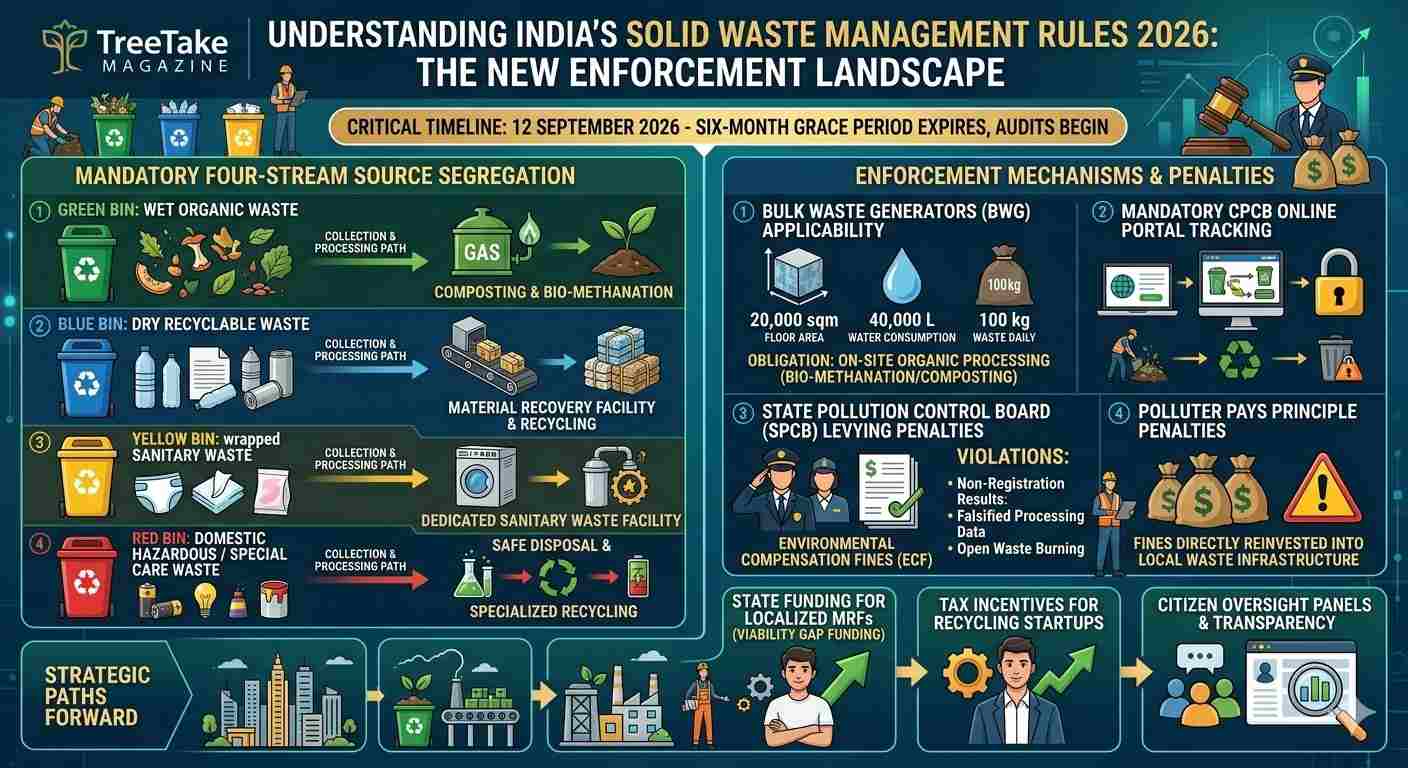
For a decade, India’s solid waste management has been hamstrung by weak local bylaws and a lack of financial accountability for polluters. The formal implementation of the Solid Waste Management Rules 2026 marks a major shift in urban environmental governance. By explicitly replacing the outdated 2016 framework and introducing mandatory four-stream source segregation alongside strict environmental compensation fines under the Polluter Pays Principle, the new central mandate targets institutional laxity. TreeTake examines the regulatory mechanisms, enforcement bottlenecks, and the immediate operational impact on bulk waste generators across the subcontinent.
A New Legislative Order for Urban Waste
On Wednesday, 1 April 2026, the revised Solid Waste Management Rules 2026 officially came into force across India, completely superseding the older regulations enacted in 2016. Notified by the Union Ministry of Environment, Forest and Climate Change under the foundational powers of the Environment Protection Act 1986, this updated framework marks a comprehensive restructuring of the country's municipal sanitation laws. The enforcement dragnet has hit a critical milestone today, Saturday, 12 September 2026, as the official six-month grace period granted to urban local bodies and commercial entities to transition their waste systems has drawn to a close, prompting the Central Pollution Control Board to initiate the first wave of national compliance audits and heavy penalty actions.
The operational focus of the new policy is the mandatory transition to a strict four-stream waste segregation model at the exact point of generation. Moving away from the basic dry-versus-wet separation of the past decade, all waste generators are now legally required to separate their refuse into four distinct, non-interchangeable streams: wet organic waste, dry recyclable waste, wrapped sanitary waste, and domestic hazardous or special care waste. Local authorities are empowered to completely halt the collection of unsegregated waste and levy escalating spot fines on non-compliant households and commercial entities.
Targeting the Bulk Waste Generators
The primary focus of the enforcement dragnet is the category defined as Bulk Waste Generators. The revised rules have tightened these criteria, defining a bulk generator as any institutional, commercial, or residential entity that occupies a total floor area of 20,000 square metres or more, consumes more than 40,000 litres of water per day, or generates over 100 kilogrammes of solid waste daily. This definition encompasses all central and state government departments, gated residential complexes, public sector undertakings, and major commercial shopping centres.
"The implementation of the Solid Waste Management Rules 2026 introduces strict, non-negotiable financial accountability for the entities driving urban consumption," stated Ravi Agrawal, Additional Secretary for Environmental Quality at the Central Pollution Control Board. "Bulk waste generators alone account for nearly 30 per cent of the total municipal solid waste load generated across our major cities. By introducing Extended Bulk Waste Generator Responsibility, the law forces these large entities to process their organic waste on-site through bio-methanation or composting facilities, significantly reducing the logistical and spatial pressure on our rapidly filling landfill sites."
The Economics of Non-Compliance and Counterviews
To ensure enforcement, the Central Pollution Control Board has established a centralised online portal to track the entire life cycle of solid waste from collection to final recycling or scientific disposal. Under the revised rules, State Pollution Control Boards are legally mandated to levy heavy environmental compensation penalties against any local body or private enterprise found operating without valid registration, submitting falsified processing data, or burning waste in the open.
However, the aggressive penalty structure has drawn strong criticism from municipal administrators and urban planners, who argue that the law penalises local bodies for structural issues beyond their immediate control. Transitioning millions of urban households to a complex four-stream segregation model requires a total overhaul of secondary transport vehicles and processing plants, an investment that many smaller municipal corporations cannot currently afford without capital grants from the central government.
"The new guidelines represent excellent environmental policy on paper, but they risk hitting a wall during local execution," noted Dr Smita Banerjee, an urban governance specialist and advisor on circular economy transitions. "We have mandated four-stream separation, yet fewer than twenty per cent of tier-two and tier-three Indian cities possess the localised Material Recovery Facilities necessary to process sanitary or special care waste separately. Without massive, immediate federal investments in decentralised segregation infrastructure, the fines collected under the Polluter Pays Principle will simply accumulate as unspent revenue while the waste continues to mix at regional dump sites."
Strategic Paths Forward
Transforming the new waste guidelines into a successful circular economy requires a rapid expansion of urban sorting infrastructure and commercial incentives. State governments must immediately provide targeted viability gap funding to municipal bodies to establish decentralised Material Recovery Facilities capable of managing all four distinct waste streams. Additionally, the central government should offer corporate tax incentives to recycling startups that integrate informal waste-pickers into the formal green economy. Finally, local bodies must enforce strict transparency by linking their public waste-tracking portals with independent citizen oversight panels, preventing the falsification of recycling metrics and ensuring that environmental penalties are directly reinvested into community composting systems.



Leave a comment