

TreeTake Network
A prominent pan-European coalition comprising over 1,200 ecological restoration scientists, conservation biologists, and climate economists has issued an urgent joint declaration to the European Commission. The policy text, delivered directly to the Directorate-General for Environment, demands a radical, legally binding shift in how upcoming National Restoration Plans are evaluated under European Union fiscal rules. The scientific consensus argues that municipal and state financial allocations targeted at river, urban, and marine ecosystem recovery must be rigidly classified as mandatory structural resilience investments rather than optional budgetary costs, blocking member states from scaling back critical environmental restoration projects during periods of economic austerity.
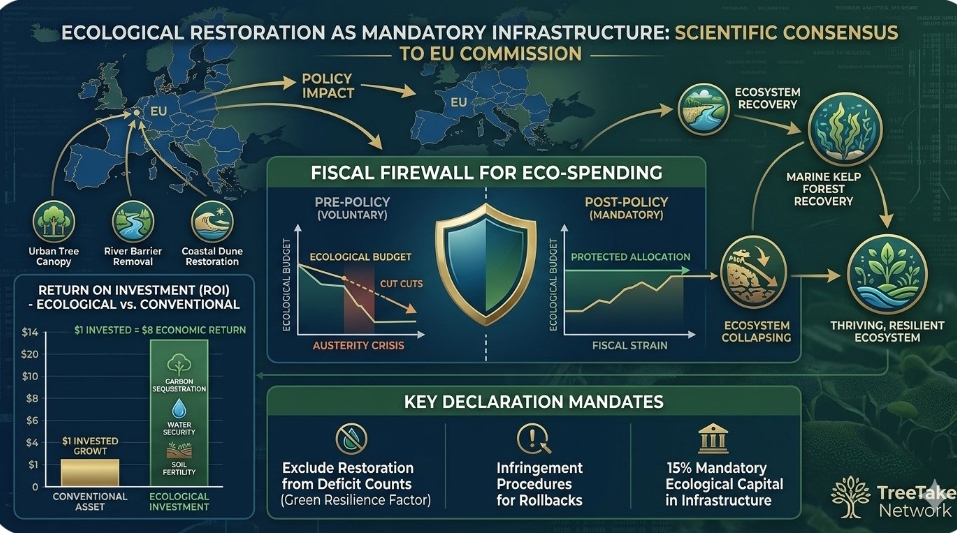
The scientific mobilisation occurs at a highly volatile moment for European climate policy, as several member states draft their compliance strategies for the European Union Nature Restoration Law. Under the current economic guidelines, funding earmarked for complex environmental interventions—such as removing obsolete river barriers, re-establishing urban tree canopies, and restoring degraded marine kelp forests—is lumped together with general public spending. The scientist coalition presents extensive econometric data proving that this accounting classification leaves vital ecological infrastructure highly vulnerable to local budget cuts, delaying essential pan-European biodiversity recoveries.
Dr Anke Vermeulen, Director of the European Institute for Ecosystem Resilience, delivered a sharp critique of the current fiscal treatment of environmental programs during a policy briefing in Brussels. According to Dr Vermeulen, treating ecosystem restoration as a financial luxury or an optional cost item is an outdated and dangerous economic misunderstanding. Investing in restoring wet floodplains and rebuilding damaged coastal dunes provides direct, multi-billion euro protections against catastrophic flooding and extreme heatwaves. Vermeulen stressed that the European Commission must establish an immediate fiscal firewall around these allocations, ensuring that state-level restoration budgets are legally protected from short-term political changes or macro-economic pressures.
The formal joint declaration outlines three core regulatory adaptations that the European Commission must incorporate into its structural evaluation framework. First, it requires the introduction of a standardised "Green Resilience Factor" in member state accounting, which excludes verified ecosystem restoration expenditures from national deficit calculations. Second, it demands that any state-level rollback of an approved National Restoration Plan due to fiscal constraints must trigger immediate infringement procedures and the suspension of European Union infrastructure subsidies. Third, it mandates that all future public infrastructure projects across Europe must allocate a non-negotiable 15 per cent of their total capital budget to localised habitat connectivity and ecological restoration.
The policy push has exposed deep divisions within the European Parliament, with conservative fiscal blocs and agricultural lobbies warning that imposing mandatory spending targets could strain the sovereign budgets of smaller member economies. Responding to these concerns, Dr Mateusz Kowalski, Lead Coordinator of the European Biodiversity Economics Network, emphasised that the long-term cost of ecological neglect vastly outweighs the immediate price of restoration. Kowalski pointed out that every single euro spent on restoring degraded European forests and peatlands yields an estimated eight euros in economic returns through improved soil fertility, reliable water security, and active carbon sequestration. The joint text serves as a historic ultimatum from the scientific community, forcing European policymakers to decide whether they will treat planetary survival as a luxury asset or a fundamental structural necessity.
Editor's Note
The joint scientist declaration to the European Commission exposes a critical flaw in global environmental governance: the tendency to separate economic rules from ecological realities. Passing historic conservation laws is entirely futile if national treasury departments are permitted to dismantle those programs at the first sign of an economic downturn. The European Commission must heed this scientific warning and legally classify ecosystem restoration as a mandatory infrastructure investment. True economic stability is impossible on a dying planet, and establishing a protective fiscal firewall around biodiversity spending is the only way to ensure that the European Union's green targets are realised in the real world.



Leave a comment