

TreeTake Network
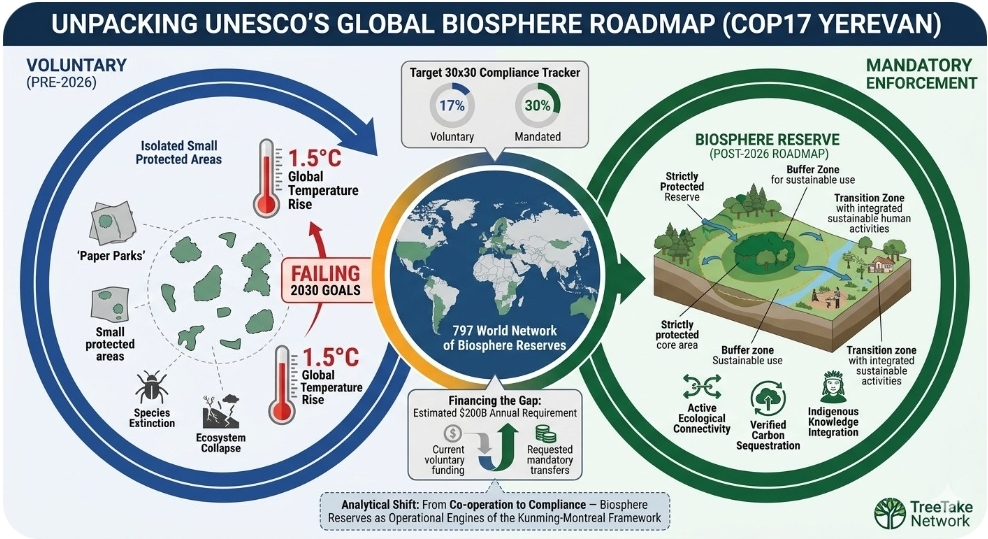
In a decisive institutional intervention aimed at rescuing the stalling Kunming-Montreal Global Biodiversity Framework, UNESCO has formally launched its highly anticipated Global Biosphere Roadmap at the ongoing United Nations COP17 Biodiversity Conference. Speaking before delegates from over 190 nations gathered at the Karen Demirchyan Complex, senior conservation officials unveiled a sweeping, legally rigorous enforcement architecture designed to fundamentally transform how protected ecosystems are managed. The new roadmap introduces binding conservation milestones across UNESCO’s expansive World Network of Biosphere Reserves, which currently encompasses 797 protected reserves across 134 countries, explicitly linking international status with strict national environmental accountability.
The launch comes amidst growing frustration among climate scientists and international policy advisors over the slow implementation of the "30 by 30" biodiversity goal—the global pledge to protect 30 per cent of the planet's terrestrial and marine ecosystems by 2030. According to technical compliance data presented ahead of the announcement, nearly 43 per cent of the designated biosphere reserves worldwide are experiencing severe ecological degradation due to unauthorised agricultural expansion, resource extraction, and weak domestic legislative protections. The newly established roadmap seeks to correct this by shifting UNESCO's role from a passive designation body to an active regulatory enforcement authority.
Dr Eliane Gautreau, Director of the Division of Ecological and Earth Sciences at UNESCO, delivered an impassioned address detailing the structural changes of the roadmap. According to Dr Gautreau, the global community can no longer afford to treat biosphere reserves as mere paper parks that exist only on maps without real-world protections. The Global Biosphere Roadmap introduces a rigid, dual-layered compliance system under which member states must submit standardised, satellite-verified biodiversity density audits every 24 months. Dr Gautreau explicitly warned that nations failing to curb industrial encroachment or infrastructure development within their core sanctuary zones will face immediate, public de-listing of their reserves, effectively cutting off vital international conservation funding and technical support mechanisms.
The core architecture of the roadmap introduces three mandatory, non-negotiable operational directives for all participating governments. First, it mandates the legal establishment of completely undisturbed "absolute protection zones" comprising at least 40 per cent of each biosphere reserve's total land area, barring all forms of commercial activity. Second, it establishes a unified Global Ecological Surveillance Network utilising high-resolution synthetic aperture radar imaging to track real-time canopy loss, illegal mining, and river pollution across cross-border sanctuaries. Third, it binds international development banks to restrict all green-finance loan disbursements to countries that violate their domestic biosphere preservation commitments.
The announcement has triggered intense debates within the plenary halls, particularly among developing nations who argue that the stringent enforcement metrics fail to account for local socio-economic realities and the livelihood dependencies of indigenous forest communities. Responding to these concerns during a high-level panel discussion, Dr Armen Vardanyan, Chairperson of the COP17 Organising Committee and Senior Biodiversity Advisor to the Armenian Ministry of Environment, emphasised that conservation cannot succeed in isolation from human development. Dr Vardanyan stated that the roadmap is deliberately designed not as a punitive tool, but as a robust mechanism to channel specialised international investments into local green economies. By safeguarding these 797 critical biospheres, governments can create sustainable buffer zones that empower local populations through eco-tourism and carbon-credit sharing, effectively proving that biodiversity preservation is a primary economic driver rather than a financial strain.
The implementation phase of the roadmap is scheduled to commence on January 1, 2027, with an initial focus on 84 critical cross-border biosphere reserves located across Latin America, Central Africa, and Southeast Asia. As negotiation teams split into working groups to hammer out the final funding allocations and technical sharing protocols, the UNESCO text stands out as the most concrete, actionable policy framework to emerge from Yerevan, setting a sharp precedent for international conservation governance in the final years of the decade.
Editor's Note
The UNESCO Global Biosphere Roadmap represents a long-overdue transition from toothless environmental diplomacy to targeted, metric-driven ecological governance. For decades, international biodiversity treaties have suffered from a chronic lack of accountability, allowing member states to win public praise for declaring protected zones while quietly permitting destructive commercial exploitation within them. By tying the prestigious biosphere status to strict, satellite-verified performance metrics and international green financing, UNESCO has created genuine leverage. The path forward requires an uncompromising refusal to compromise on these benchmarks, ensuring that global biosphere reserves finally function as true sanctuaries for the planet's most vulnerable species.



Leave a comment