

TreeTake Network
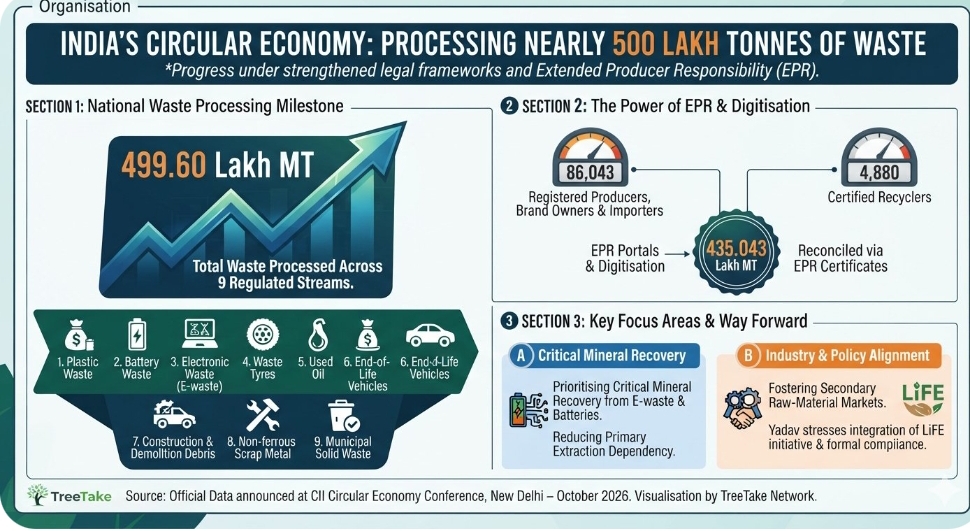
Addressing the flagship Circular Economy Conference organised by the Confederation of Indian Industry (CII) in New Delhi, Union Minister for Environment, Forest and Climate Change Bhupender Yadav announced that India has scaled its ecological transition by successfully processing nearly 499.60 lakh metric tonnes of waste. The sweeping progress highlights the country’s modern paradigm shift from a linear "take-make-use-dispose" roadmap toward comprehensive resource circularity. The federal government has adopted a structural approach to institutionalise waste tracking, building operational guidelines that explicitly span nine specific, highly regulated waste streams.
These nine regulated categories—including plastic, battery, e-waste, tyres, used oil, vehicles, construction debris, non-ferrous scrap, and solid waste—aim to manage entire product lifecycles through reuse and recovery.
Operational Scaling and Market Traceability
Digitisation through Extended Producer Responsibility (EPR) portals anchors this growth. Registry records show 86,043 producers, importers, and brand owners alongside 4,880 recyclers, with over 435 lakh metric tonnes reconciled via EPR certificates.
Union Minister Bhupender Yadav highlighted that strengthened legal frameworks translate policy into action, noting that EPR certificate trading financially incentivises recyclers and drives job creation. However, he stressed that regulation requires backing from the Lifestyle for Environment (LiFE) initiative to curb destructive consumption.
Critical Mineral Strategy and Supply Chains
The ministry prioritises recovering critical minerals from electronics and batteries to lower primary extraction needs, while urging coordination between producers and recyclers regarding plastic recycling capacity. Authorities continue fostering secondary raw-material markets and remain open to resolving stakeholder concerns regarding digital compliance.
Editor's Note
Processing nearly 500 lakh metric tonnes reflects India's industrial execution. Utilising EPR converts scrap into value chains, though integrating informal sectors remains vital for sustainability.



Leave a comment