

TreeTake Network
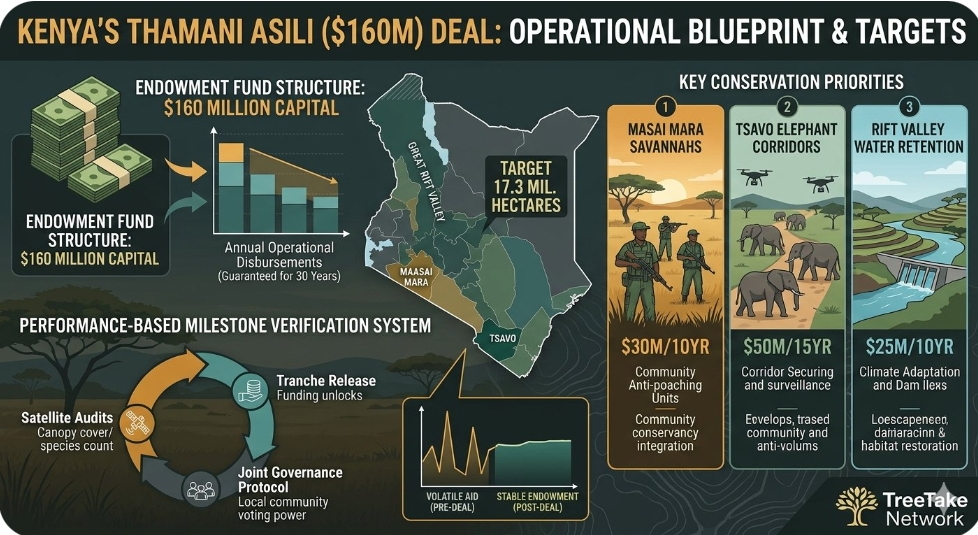
In one of the largest single conservation finance transactions in East African history, the Kenyan government, alongside an international coalition of sovereign donors and private philanthropic funds, has finalised a milestone 160-million-dollar funding mechanism. The innovative project, officially designated as the Thamani Asili (Value of Nature) initiative, establishes a permanent Project Finance for Permanence structure to ensure the long-term ecological integrity of 17.3 million hectares of highly volatile ecosystems. The targeted conservation territory stretches across an unbroken biological landscape, extending from the volcanic terrains of the Great Rift Valley to the savanna grassland ecosystems of the Maasai Mara and the dense forests of the Tsavo ecosystem.
The massive funding deployment arrives at a critical juncture for Kenya’s globally celebrated wildlife networks. Over the past decade, these wildlife corridors have faced severe disruption from climate-induced droughts, uncontrolled infrastructural expansion, and escalating land-use conflicts along park boundaries. Rather than relying on unpredictable, short-term annual charity grants that frequently dry up during global economic downturns, the Thamani Asili framework functions as an institutional endowment. The capital is legally bound to a rigid disbursement matrix that guarantees stable, multi-decade operational funding for anti-poaching patrol logistics, community-led conservancy payrolls, and large-scale habitat restoration projects.
Rebecca Miano, Cabinet Secretary for Tourism, Wildlife and Heritage, announced the completion of the treaty at a formal assembly in Tsavo West National Park, highlighting the revolutionary nature of the funding model. According to Cabinet Secretary Miano, this 160-million-dollar intervention fundamentally changes the economics of conservation across the Global South. For the first time, Kenya is moving away from reactive anti-poaching measures towards a proactive, fully capitalised ecosystem management strategy. Miano emphasised that the funds are explicitly locked into a joint governance protocol where local indigenous communities hold direct voting rights on capital distribution, ensuring that those who live alongside these apex predators are the primary financial beneficiaries of their survival.
The operational blueprint of the initiative outlines three immediate priority deployments across the targeted 17.3 million hectares. The first phase mandates the immediate, legal demarcation and physical securing of critical migratory corridors used by the continent's largest remaining tusker elephant populations moving between Tsavo and Amboseli. The second phase establishes a centralised, high-tech wildlife crime intelligence facility in Nairobi, integrating satellite monitoring and thermal imaging drones to intercept illegal ivory networks before they leave regional borders. The third phase expands the community conservancy model by funding sustainable water-retention infrastructure to mitigate the catastrophic impacts of climate-induced dry spells on wild ungulate populations.
Dr Philip Muruthi, Senior Vice President for Conservation Species at the African Wildlife Foundation, praised the structural safeguards embedded within the package. Dr Muruthi noted that the true genius of the Thamani Asili package lies in its strict performance-based milestones. The international donor coalition, which includes the German Development Bank and the Global Environment Facility, will release the tranches sequentially only upon the verification of strict ecological benchmarks, such as stable predator-prey ratios and zero net forest loss within the conservancies. Muruthi stated that this framework provides a highly replicable global model, proving that long-term financial security is the single most effective tool to combat species extinction and empower rural communities simultaneously.
The immediate execution of the project is scheduled to begin across the Maasai Mara buffer zones by the end of the current quarter. As field teams prepare to deploy new tracking assets and establish community patrol units, the Kenyan initiative stands out as a monumental victory for global conservation finance, providing a reliable, fully funded defensive shield for the continent's most celebrated biodiversity strongholds.
Editor's Note
The Thamani Asili initiative provides a profound lesson in the evolution of global conservation strategy by demonstrating that preserving biodiversity requires structural financial engineering, not just goodwill. For too long, magnificent ecosystems like the Maasai Mara have been left vulnerable to the whims of volatile tourism cycles and erratic foreign aid. By establishing a legally binding, performance-incentivised endowment that directly integrates indigenous land rights, Kenya has created a resilient economic wall around its natural heritage. The global community must look to this model as the standard for financing climate adaptation and species preservation across developing economies.



Leave a comment