

TreeTake Network
In a breakthrough for subterranean biology and tropical botany, the northeast region of India has recorded a simultaneous double discovery. Wildlife biology teams evaluating the groundwater table and fractured aquifer systems in the Goalpara district of lower Assam have formally identified two entirely new species of blind, troglobitic fish. Parallel to this subterranean discovery, a joint botanical expedition in the adjacent pristine forest tracts has successfully located living populations of a critically endangered, elusive plant species that had remained completely unrecorded by global botanists for 204 years. The dual breakthroughs underscore the massive, unexplored biological wealth trapped within the unique geomorphology of the Brahmaputra River basin drainage networks.
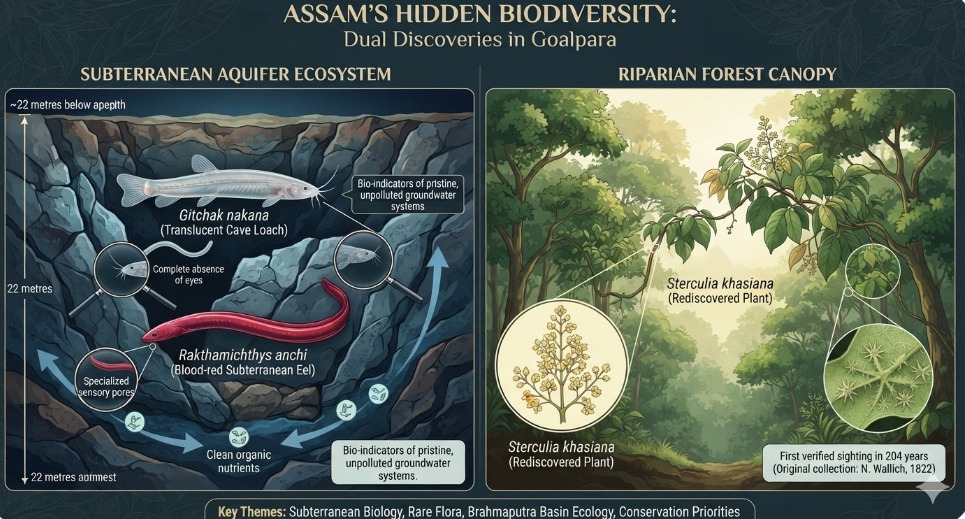
The subterranean biological discovery was made during an intensive three-month groundwater cave and deep-well biodiversity assessment led by the Northeast Frontier Institute of Science and Technology. Researchers extracting samples from deep artesian aquifers and open agricultural wells at a depth of 22 metres discovered small, pigmentless, sightless teleost fish. Taxonomic and genetic sequencing protocols conducted at the regional laboratory confirmed them as two distinct, previously undocumented species. The first, taxonomically named Gitchak nakana, is a highly adapted subterranean loach characterised by an elongated, translucent body, completely absent ocular structures, and specialised sensory barbels optimised for low-flow, pitch-black aquifer environments. The second species, Rakthamichthys anchi, is a subterranean swamp eel distinguished by its bright crimson, blood-red colouration, which is caused by subcutaneous capillary blood flow visible through its unpigmented skin.
Dr Himadri Sekhar Das, Lead Ichthyologist at the conservation collective Biodiversity Assam, noted the immense ecological value of these cave-dwelling organisms. According to Dr Das, subterranean fish function as critical bio-indicators for the structural health of deep-groundwater networks. The presence of Gitchak nakana and Rakthamichthys anchi confirms that these deep, fractured rock aquifers are receiving clean, unpolluted organic nutrient inputs from the surface. However, Dr Das warned that unmonitored chemical fertiliser leaching and unregulated groundwater extraction across Goalpara pose an immediate, existential threat to these highly fragile micro-habitats before they can even be fully mapped by science.
Simultaneously, a botanical team led by the State Forest Department's Research Wing announced the rediscovery of an ultra-rare woody climber, Sterculia khasiana, in a remote, low-altitude evergreen pocket near the Assam-Meghalaya border. The plant was originally collected only once in British India by botanist Dr Nathaniel Wallich in October 1822 and was widely presumed extinct by the international scientific community. The living specimen, a mature flowering vine growing in an undisturbed riparian canopy, was identified by its distinct stellate pubescence and pale yellow axillary panicles. State taxonomists verified its identity against archival herbarium sheets, marking the first verified sighting of the species in over two centuries.
The convergence of these discoveries has prompted urgent calls for localised habitat protection from regional environmental bodies. The Goalpara aquifer systems are closely linked to the seasonal floodplains of the Brahmaputra, meaning any localised industrial development or heavy open-cast stone quarrying nearby could cause catastrophic siltation or chemical contamination within the underground caves. The Assam State Biodiversity Board has initiated preliminary paperwork to declare the specific well clusters and adjacent riparian forest patches as Biodiversity Heritage Sites under the Biological Diversity Act to enforce strict legal protections.
Editor's Note
The simultaneous discovery of unique subterranean fish species and the resurrection of a plant lost to science for two centuries highlight the immense, hidden resilience of India's northeastern frontier ecosystems. Moving forward, the Ministry of Environment, Forest and Climate Change must mandate comprehensive subterranean environmental impact assessments before clearing any major infrastructure, mining, or heavy groundwater-extraction projects in the region. Protecting surface forests is no longer enough; policy frameworks must expand to safeguard the invisible, interconnected underground aquifers that harbour the planet's most specialised and vulnerable biodiversity.



Leave a comment