

TreeTake Network
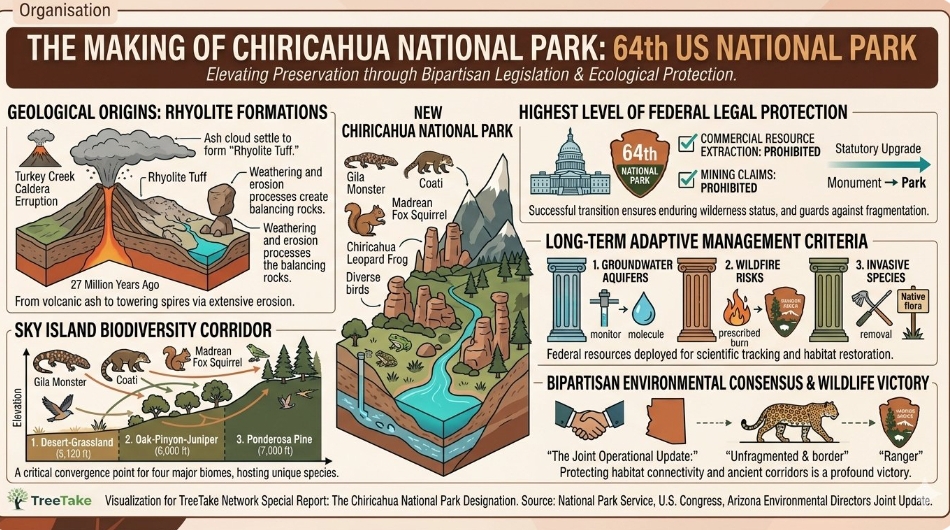
Following a successful legislative push through both houses of Congress, bipartisan environmental protection frameworks have culminated in the official designation of Chiricahua in southeastern Arizona as the sixty-fourth national park in the United Sations. The landmark environmental status upgrades more than twelve thousand acres of contiguous wilderness area, ensuring the highest level of federal legal protection against commercial resource extraction, mining claims, and unchecked landscape fragmentation. The conservation milestone transitions the former national monument into a premier protected category, anchoring regional preservation strategies amid intensifying climate disruptions.
The newly elevated zone is internationally renowned for its dramatic geological formations, consisting of an extensive network of balancing rocks, towering volcanic rock spires, and deep rhyolite canyons formed over twenty-seven million years ago. Beyond its stark geological features, the park serves as a critical evolutionary corridor where diverse ecosystems—including the Sonoran and Chihuahuan deserts, alongside the Rocky Mountains and Sierra Madre ranges—converge to host unique species.
Ecological Protection and Adaptive Management
The structural transition to full national park status introduces a series of mandatory long-term ecological evaluation criteria. Under the newly implemented guidelines, park authorities are required to develop comprehensive climate adaptation roadmaps aimed at preserving regional groundwater aquifers, mitigating wildfire risks, and countering invasive plant species that threaten native flora. The federal classification guarantees robust financial resources for scientific tracking, habitat restoration, and the deployment of specialised wilderness rangers trained in high-altitude desert resource management.
Celebrating the completion of the legislative transition, regional environmental directors and park administrators released a joint operational update detailing the long-term conservation targets:
"Elevating this wilderness to national park status formally recognises the irreplaceable ecological value of our southwestern 'sky islands'. This statutory upgrade provides our teams with the enduring legal authority and federal resources needed to defend fragile desert-grassland crossover zones from accelerating climate stresses."
Echoing the sentiment, leading wilderness preservation advocates highlighted the systemic benefits of the designation, stating:
"Securing this highest tier of federal preservation represents a profound victory for habitat connectivity across the continent. By establishing permanent safeguards for these ancient volcanic corridors, we ensure that vulnerable migratory wildlife can navigate diverse altitudinal gradients without encountering industrial or commercial encroachments."
Balancing Biodiversity Tracking with Regulated Tourism
The historic designation has ignited detailed policy discussions among conservation scientists regarding how best to balance rising visitor foot traffic with strict environmental preservation. The new park framework authorises structural funding to upgrade peripheral visitor facilities while enforcing strict limits on back-country entry to minimise soil compaction and human disruptions within critical wildlife zones. Conservationists emphasis that the expansion must serve as a blueprint for protective connectivity, demonstrating how targeted legislative action can actively insulate core biodiversity strongholds from broader macroeconomic pressures.
Editor's Note
The designation of Chiricahua as the sixty-fourth national park reflects a highly commendable, rare instance of bipartisan environmental consensus. However, assigning prestigious status updates to isolated ecological pockets remains insufficient without a unified national policy that actively addresses regional water scarcity and heating anomalies across surrounding state lands.



Leave a comment