

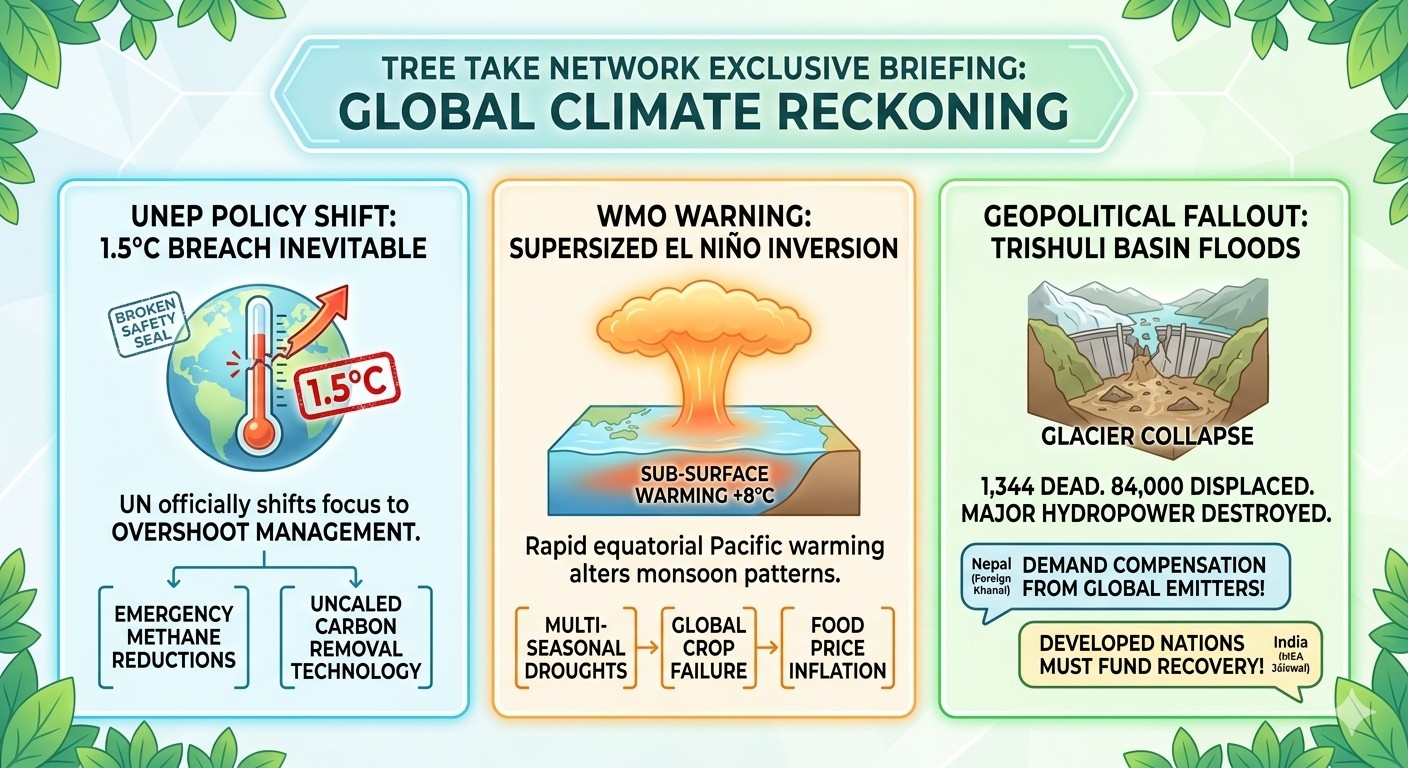
The Overshoot Reality: How a shifting UN policy framework matches real-time atmospheric inversions and escalating climate accountability rows in South Asia.
TreeTake Network
The global climate architecture has reached a critical inflexion point where scientific projections, atmospheric crises, and geopolitical friction have converged into a singular narrative of planetary strain. As international oversight bodies formally concede that established warming limits will be breached, the real-world consequences are manifesting through rapid ocean warming and severe infrastructural collapses in vulnerable mountain ecosystems. This unified briefing maps the direct cause-and-effect chain connecting global policy shifts to the escalating cross-border tensions in the Indian subcontinent.
The Macro Policy Shift: UNEP Declares 1.5°C Breach Inevitable
The foundational framework of international climate mitigation has fundamentally altered following a landmark assessment by the United Nations Environment Programme (UNEP). In its newly published global assessment, the UN body has officially shifted its operational stance from containment to emergency overshoot management.
The data confirms that temporarily exceeding the 1.5°C global warming threshold established under the Paris Agreement is no longer a preventable scenario; it is now a mathematical certainty within the current decade. For the first time, international planners have outlined a radical "overshoot, peak, and decline" pathway. This strategy acknowledges that global temperatures will peak well above safety margins before they can be systematically brought back down.
The policy shift forces an immediate transition away from purely defensive emissions reductions toward the aggressive deployment of unscaled carbon-dioxide removal technologies and emergency methane suppression. The UN has issued a stark warning that every fraction of a degree of prolonged overshoot risks permanently activating catastrophic planetary tipping points, altering oceanic and atmospheric circulation permanently.
The Atmospheric Engine: WMO Warns of Supersized El Niño Inversion
The practical mechanisms driving this rapid thermal acceleration have been identified in equatorial waters. The World Meteorological Organisation (WMO) has issued an authoritative climate alert confirming that the current Pacific El Niño pattern has mutated into a super-heated atmospheric inversion.
Forensic satellite mapping and marine buoy arrays show that subsurface ocean temperatures in the equatorial Pacific have spiked to an extraordinary 8°C above historical baseline averages. This extraordinary thermal accumulation is already destabilising global jet streams, creating a massive atmospheric engine that alters seasonal monsoons and precipitation corridors worldwide.
Meteorologists have warned that this intensified phenomenon will trigger prolonged multi-seasonal droughts across critical agricultural zones, severe crop moisture failures, and unpredictable, highly concentrated rainstorms. The WMO has cautioned governments that the resulting disruption to global agricultural supply chains will systematically drive severe food price inflation well into next year, transforming an atmospheric event into a profound socio-economic crisis.
The Regional Fallout: Trishuli Basin Devastation and the India-Nepal Standoff
The abstract warnings issued by global agencies found a destructive, real-time expression in the high-altitude valleys of the Himalayas. A catastrophic border glacier collapse triggered a massive sequence of flash floods and dense debris flows down a 72-kilometre stretch of the Trishuli River basin, resulting in massive human and economic loss.
The official death toll from the Trishuli catastrophe has climbed to 1,344 individuals, with emergency search and rescue teams continuing to extract remains from heavily silted ruins. Illustrating the immense physical force of the sudden debris torrent, police command centres confirmed that 501 of the recovered victims consisted of amputated bodies pulled directly from the deep mud. More than 84,000 residents have been severely displaced across the Nuwakot and Rasuwa districts, prompting the United Nations to launch an urgent 49.6 million dollar flash appeal for emergency survival relief.
The flood wave instantaneously compromised or entirely destroyed 2 major hydropower stations, wiping out more than 10% of Nepal's total domestic electricity generation capacity. While joint military operations successfully rescued trapped subterranean tunnel workers—including a Chinese national at the Upper Trishuli-1 site—the loss of infrastructure has plunged regional energy policy into absolute chaos.
This localised ecological collapse has rapidly ignited an intense cross-border geopolitical standoff regarding financial liability and climate accountability. Pointing directly to the macro-scientific data, Nepal Foreign Minister Shisir Khanal launched a formal diplomatic push targeting the world's largest historic and current greenhouse gas emitters.
"The catastrophic losses we are witnessing in the Trishuli basin are the direct result of climate disruptions driven by heavy industrial emissions beyond our borders," Foreign Minister Shisir Khanal stated during an emergency briefing. "Nepal is bearing the lethal cost of a crisis it did not create. We are formally demanding that major emitting nations, including our immediate neighbours and global industrial powers, provide direct financial compensation for infrastructure rehabilitation and loss and damage."
The demand for cross-border climate compensation was met with a swift, firm rebuttal from New Delhi. Indian Ministry of External Affairs Spokesperson Randhir Jaiswal addressed the compensation claims directly during a press briefing, outlining India's clear position on regional climate liability.
"Climate change is an undeniable, collective common challenge that requires deep regional cooperation and mutual support," MEA Spokesperson Randhir Jaiswal stated. "However, the framework for loss, damage, and financial accountability is clearly defined within international climate negotiations. It is the developed nations, with their vast historical emissions footprint, that must lead the process of funding global mitigation and compensation mechanisms. Placing the structural financial burden on developing regional neighbours is neither a sustainable nor a recognised solution under global climate pacts."
As Indian security forces finalise the evacuation of 169 Indian nationals from the flood-ravaged Trishuli Bazaar zone while actively tracking 275 others who remain missing, the geopolitical standoff underscores the grim reality of the UNEP's overshoot declaration. The destruction of the Trishuli basin stands as living proof that abstract planetary warming models have translated into hard, national security challenges and bitter diplomatic rifts over who pays for the wreckage of a changing world.
Editor's Note
The escalating diplomatic friction between New Delhi and Kathmandu, occurring in lockstep with the shifting policy frameworks of the United Nations, underscores a grim transition in global environmental governance from proactive containment to reactive crisis management. As the tangible impacts of atmospheric inversions and glacial degradation rapidly outpace international diplomatic protocols, vulnerable populations and developing regional economies are left to absorb the immediate structural and financial shocks. TreeTake Network remains committed to providing independent, rigorous field journalism from the front lines of this developing planetary crisis. Our editorial teams will continue to monitor the engineering assessments in the Trishuli basin and the unfolding climate liability negotiations across South Asia as verified updates are synthesised by our global network.



Leave a comment