

TreeTake Network
The Turag River, an essential riparian artery skirting the northern periphery of the Dhaka region in Bangladesh, is experiencing an unprecedented double-pronged ecological crisis. Independent water quality assessments and aquatic biology surveys conducted along the river basin confirm that a severe breakdown in regulatory enforcement has allowed rampant, untreated industrial effluents to reduce the river’s dissolved oxygen levels to near-zero across multiple critical stretches. Compounding this toxic chemical load, field researchers have documented a massive population explosion of the highly invasive Amazonian suckermouth catfish (Pterygoplichthys pardalis), which has successfully outcompeted and systematically crowded out native fish populations, effectively driving the river’s historical biodiversity to absolute collapse.
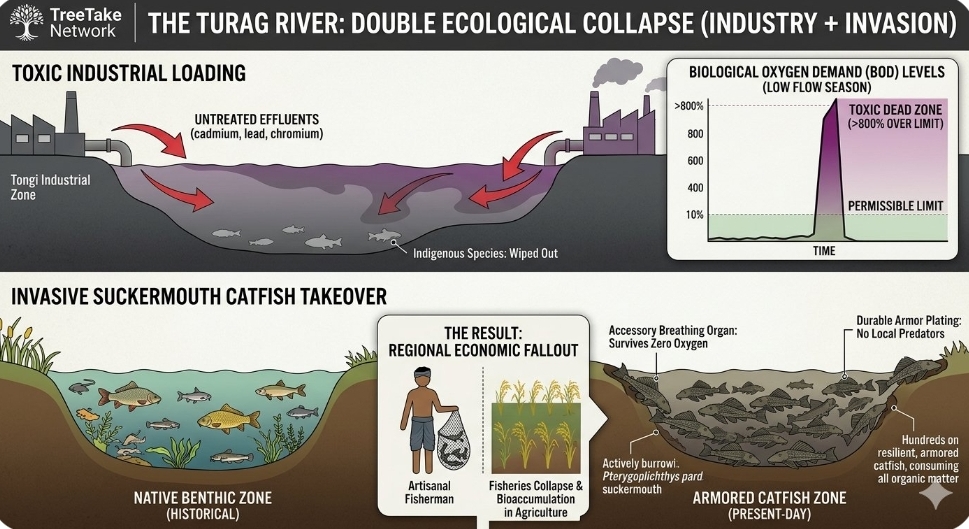
The physical state of the Turag River has reached a level of toxicity that threatens not just the river's internal ecosystem but the entire regional food web. Dozens of textile dyeing installations, chemical manufacturing facilities, and heavy tanneries operating along the banks in the Tongi and Gazipur industrial zones continue to discharge toxic heavy metals—including high concentrations of cadmium, chromium, and lead—directly into the main channel. During the current low-flow season, the water has transformed into a thick, black, foul-smelling sludge. Laboratory tests indicate that biological oxygen demand (BOD) values are regularly exceeding permissible national thresholds by over 800 per cent, creating vast, subterranean "dead zones" where no indigenous gill-breathing species can survive.
Dr Sharmin Akter, Lead Hydro-Biologist at the Centre for Aquatic Resource Management, delivered a grim evaluation of the river's current state. According to Dr Akter, the Turag is undergoing a complete and potentially irreversible biological transformation. Chemical toxicity has wiped out native carps, catfish, and other minor riverine species, while the invasive suckermouth catfish is thriving under these conditions. Equipped with a highly resilient accessory breathing organ that allows it to survive in virtually anoxic, oxygen-depleted waters, the armoured catfish is multiplying exponentially. Dr Akter noted that these pests are aggressively consuming the remaining benthic organic matter, destroying native spawning nests, and physically eroding the clay riverbanks with their burrowing habits, leaving the river completely hollowed out of its natural identity.
The economic fallout of this ecological collapse is devastating the surrounding rural and semi-urban communities that have historically depended on the Turag for their sustenance. Local artisanal fishermen report that their daily catches now consist exclusively of the inedible, armour-plated invasive catfish, forcing hundreds of traditional fishing families into sudden financial ruin. Furthermore, agriculturalists pumping the river’s contaminated water to irrigate adjacent paddy fields are reporting alarming drops in crop yields, alongside growing medical concerns over heavy metal bioaccumulation entering the localized food supply chain through harvested rice grains.
Despite a milestone high court verdict that previously declared the Turag River a "living entity" with distinct legal rights, local enforcement bodies have failed to curb the daily dumping of waste or launch a cohesive eradication drive against the invasive catfish. As environmental advocates demand an immediate, militarised enforcement corridor to seal off illegal industrial discharge pipes, the Turag stands as a tragic monument to the cost of unmonitored industrialisation, requiring massive, immediate state intervention to restore its basic biological functions.
Editor's Note
The biological degradation of the Turag River exposes the profound limitations of purely symbolic environmental legislation. Declaring a river a "living entity" is entirely meaningless if municipal authorities and industrial regulatory bodies fail to police the corporate entities treating the water as a free dumping ground for hazardous chemicals. Moving forward, the state must implement a dual-action survival plan: first, enforce immediate criminal closure orders on any factory operating without a fully functional effluent treatment plant; second, launch a state-funded, community-incentivised eradication bounty to physically clear the channel of invasive suckermouth catfish for future native species reintroduction.



Leave a comment