

TreeTake Network —
The commercial development of the Gomti River basin has escalated into a confrontation between urban planners and environmental oversight bodies. The Lucknow Development Authority (LDA) has officially sanctioned a 266-crore development package to install high-yield tourist infrastructure, including a 25-crore water laser show, a 700-metre nature trail, and a commercial cruise line.
However, the rapid commercialisation push has triggered a severe administrative crisis following the formal resignation of senior environmental scientist Prof. Venkatesh Dutta from the District Ganga Committee on 30 August 2026.
The Environmental Standoff
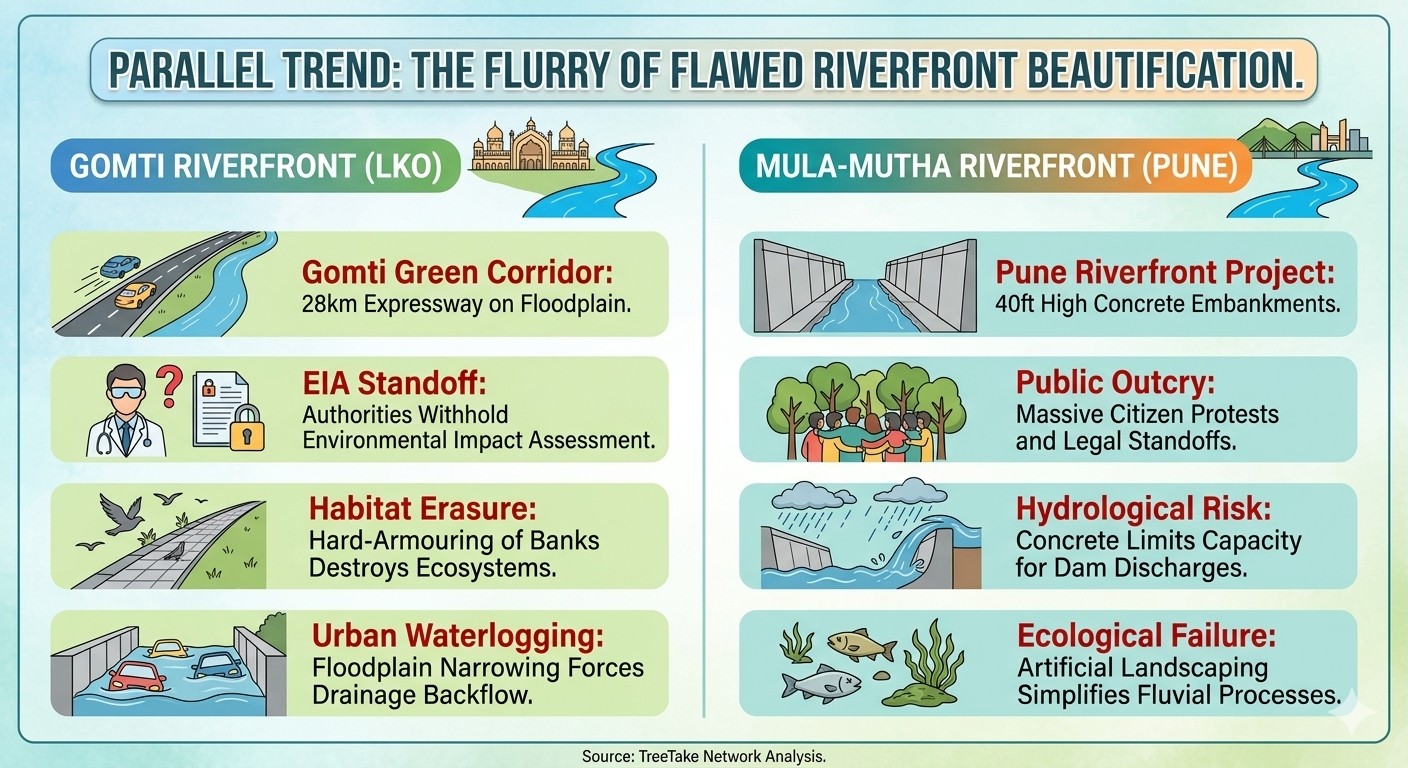
The latest escalation centres on a complete lack of transparency regarding the environmental impact of the ongoing 28-kilometre Green Corridor expressway being built directly across the river's active floodplains.
- Withheld Assessments: In his formal exit statement submitted to the committee, Prof. Dutta revealed that project authorities have repeatedly refused to provide the Detailed Project Report (DPR) and Environmental Impact Assessment (EIA) copies to the statutory committee.
- The Compliance Breach: Environmental watchdogs assert that executing massive concrete piling, utility shifting, and riverbank narrowing without sharing these mandatory ecological evaluations violates established riparian preservation laws.
- Habitat Erasure Concerns: Scientists warn that the hard-armouring of the banks, combined with the new construction zones for the tourist trail and pedestrian landmarks, permanently alters the hydrological resilience of the Gomti, simplifying critical habitats and trapping heavy urban pollution.
Statutory Powers of the District Ganga Committee
The high-profile resignation has cast a harsh spotlight on the exact legal authority wielded by the District Ganga Committee (DGC) under Indian environmental law. Established under the River Ganga Authorities Order, the DGC functions as a statutory watchdog at the municipal level rather than a mere advisory panel.
- Monitoring Mandate: The committee is legally empowered to monitor all activities threatening the health of the Ganga and its tributaries, which includes the Gomti. It possesses the authority to flag unlawful encroachment and demand the suspension of projects that alter riparian ecosystems.
- The Enforcement Gap: While the DGC has the power to report non-compliance directly to the National Mission for Clean Ganga (NMCG) and invoke provisions under the Environment (Protection) Act, state infrastructure projects frequently exploit bureaucratic delays. By withholding mandatory documents like the EIA and DPR from the committee, executing agencies effectively bypass local scrutiny. This leaves the DGC with the power to expose violations but dependent on federal intervention to enforce a definitive halt on state-backed construction.
In his official resignation correspondence sent to DGC Chairman Vishak G., Prof Dutta expressed his professional objections clearly. "If the observations and recommendations of river ecologists and scientists are not being given due consideration and if project-related documents such as the DPR and EIA are not made available to committee members for informed deliberation, I find it difficult to justify my continued association with the committee," Prof. Dutta stated, vocally opposing what he termed "mindless" construction of embankments and highways in eco-sensitive zones.
Hydrological Brief: Floodplain Narrowing and Urban Waterlogging
The ongoing construction of the Green Corridor represents a significant structural narrowing of the Gomti’s active floodplain, a move that directly exacerbates seasonal urban waterlogging risks across Lucknow. Floodplains act as natural sponges, absorbing excess surface runoff during periods of intense monsoon rainfall.
- The Absorption Deficit: Hard-armouring the riverbanks with concrete piling and utility infrastructure eliminates the natural porous earth required for groundwater recharge. When the river channel is artificially constricted, its carrying capacity drops sharply.
- The Backflow Backlash: During peak seasonal rainfall, the river’s elevated water level prevents city drains from discharging efficiently into the main channel. Instead of draining away, urban stormwater is forced backwards into low-lying residential sectors. This structural bottleneck transforms standard monsoon downpours into prolonged urban waterlogging crises, trapped by the very riverside embankments designed to modernise the city's waterfront.
The Infrastructure Push
Despite the brewing legal and administrative backlash, municipal authorities are fast-tracking the commercial layout to meet strict seasonal deadlines, citing critical improvements to city mobility. LDA Vice-Chairperson Prathamesh Kumar strongly defended the necessity of the infrastructure corridor.
"The corridor will reduce congestion in central areas," Prathamesh Kumar noted during a recent review. "Travel time on routes like Gomti Nagar to Daliganj is expected to come down to 10 to 15 minutes."
To maintain momentum, the LDA has confirmed that utility shifting along the riverbanks is being funded via a fresh 15-crore allocation, while engineering teams prepare to launch the third phase connecting Pipraghat to Shaheed Path. The approved water laser and sound show is designed to run along the Hanuman Setu stretch, explicitly utilising the waterfront as a commercial entertainment hub to draw higher consumer traffic to adjacent real estate zones.
While state planning officials maintain that the Green Corridor and riverfront upgrades are essential mobility and tourism enhancements for the city's expanding population, environmental legal coalitions are currently reviewing the withheld documents to determine if a formal injunction can be filed to halt construction on the ecologically sensitive floodplains.
Parallel Ribbons of Ruin: The National Trend of Flawed Waterway Beautification
The ongoing crisis in Lucknow mirrors a dangerous "copy-paste" trend of urban riverfront development dominating cities across India, where complex, living river systems are aggressively channelled into narrow concrete canals. Rather than rejuvenating dying streams, these heavy engineering schemes consistently replace natural fluvial processes with artificial landscaping, resulting in predictable ecological failure and increased waterlogging risks.
- The Pune Mula-Mutha Project Standoff: Designed as a multi-crore urban renewal scheme, the Mula-Mutha Riverfront Development in Maharashtra has drawn massive civil protests, including mass tree-hugging demonstrations. Much like the Gomti project, architects and activists have flagged severe discrepancies between the Detailed Project Report (DPR) and local environmental safety guidelines, proving that building 40-foot-high concrete embankments explicitly reduces cross-sectional carrying capacity and invites devastating horizontal water spread during seasonal dam discharges.
- The Sabarmati Blueprint Backlash: Frequently cited by municipal bodies as the ultimate success story, the Sabarmati Riverfront in Ahmedabad achieved its year-round waterfront aesthetic by completely narrowing the natural riverbed and heavily armouring 11 kilometres of the bank with concrete diaphragm walls. Independent ecological studies reveal that this structural confinement has fundamentally decimated local riverine biodiversity and compromised downstream flow, effectively transforming a natural river process into an engineered reservoir that forces lower-lying peripheral sectors to bear the brunt of unexpected flood surges.
Editor's Note:
The aggressive infrastructure drive spearheaded by the Lucknow Development Authority stands as a stark testament to how municipal planning continues to blindly defy the fundamental laws of nature and environmental preservation. By constricting the active floodplains of the Gomti and systematically withholding vital ecological assessments, authorities are courting unprecedented hydrological havoc that will inevitably rebound upon the city's residents. This corporate obsession with concrete modernisation over ecological survival reflects a deeply concerning, almost hopeless pattern of urban development observed throughout Lucknow. As natural drainage paths are choked and riparian habitats permanently erased, the state's insistence on fast-tracking these commercial ventures demonstrates a reckless disregard for the very natural systems that protect the urban landscape from catastrophic seasonal collapse.


Leave a comment