

TreeTake Network
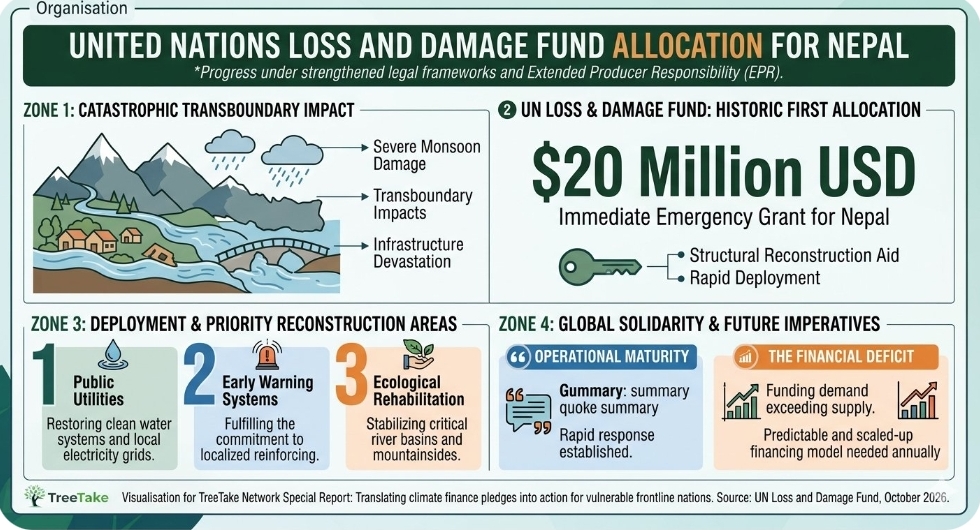
Following intensive extraordinary technical deliberations behind closed doors, the Board of the United Nations Loss and Damage Fund has formally authorised its first-ever emergency financial package, allocating 20 million dollars in immediate structural aid to Nepal. The breakthrough international decision aims to jumpstart recovery and adaptive rebuilding operations across vulnerable border communities devastated by catastrophic transboundary flash floods. The specialised funding represents a pivotal operational milestone for the global mechanism, demonstrating a rapid response capability to climate-induced losses that outpace traditional local insurance and municipal emergency reserves.
The deployment focuses on severely impacted mountain districts and river basins where intense regional downpours triggered major landslides, swept away critical bridge networks, and completely inundated vital low-lying agricultural zones. International evaluation teams note that the scale of structural destruction has heavily strained local governance resources, leaving vulnerable populations exposed to secondary economic displacement.
Operational Mobilisation and Targeted Reconstruction
Unlike conventional international development loans that accumulate long-term national debt, this direct emergency grant is strictly ring-fenced for immediate public utility restoration, localised early warning reinforcement, and community-led ecological rehabilitation. The fund administrators are collaborating with regional implementing agencies to ensure that structural reconstruction projects prioritise long-term climate resilience, preventing future vulnerabilities during subsequent monsoon seasons.
Announcing the historic allocation, the Co-Chairpersons of the Loss and Damage Fund Board issued a joint statement highlighting the framework's operational maturity:
"This initial deployment of twenty million dollars directly honours our international commitment to rapidly support frontline nations experiencing extreme climate emergencies. By cutting through traditional bureaucratic delays, the fund is ensuring that critical resources reach affected communities when they are most urgently required to rebuild damaged infrastructure."
Expressing gratitude for the international support, Nepal's Ministry of Environment officials emphasised the pressing need for broader systemic scaling, stating:
"While we welcome this historic and timely allocation from the United Nations Board, the absolute scale of our transboundary infrastructure damage remains vastly greater than current global allocations. This grant marks an essential first step, but continuous international solidarity and scaled-up adaptation financing are absolutely vital to safeguard our mountainous communities from worsening weather patterns."
Long-Term Financing Deficits and Structural Overhauls
The landmark decision has intensified broader debate within the United Nations Framework Convention on Climate Change regarding the capitalisation velocity of global climate funds. While major industrialised nations have pledged initial support, total active capital within the Loss and Damage Fund remains significantly below the hundreds of billions of dollars required annually to offset global climate disruptions. International policy experts are calling for structured, non-arbitrary allocation rules to guarantee that highly vulnerable, landlocked developing nations receive consistent institutional back-stopping during extreme environmental crises.
Editor's Note
The twenty million dollar allocation to Nepal represents a commendable transition from political rhetoric to tangible climate finance execution. However, treating such emergency funds as isolated gestures fails to resolve the systemic deficit facing vulnerable nations, demanding a predictable, legally binding global funding model to counter escalating transboundary disasters effectively.



Leave a comment