

TreeTake Network
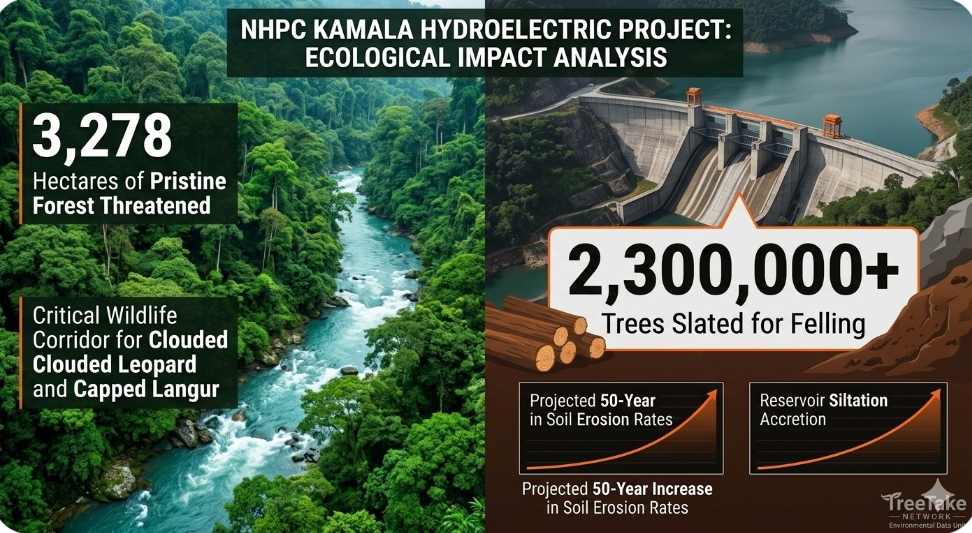
The National Hydroelectric Power Corporation (NHPC) has officially submitted an expansive proposal to the Union Ministry of Environment, Forest and Climate Change seeking critical clearance for its ambitious 1,720-megawatt Kamala hydroelectric project. The multi-billion rupee infrastructure undertaking, planned across the pristine waters of the Kamala River in the Subansiri basin of Arunachal Pradesh, demands the diversion of 3,278 hectares of dense, old-growth forest land. Most alarmingly, ecological impact assessments indicate that the execution of this massive engineering feat will require the clear-felling of over 23 lakh mature trees, sparking intense resistance from regional conservation networks and wildlife biologists who warn of irreversible habitat fragmentation.
The proposed dam project sits within one of the world's most sensitive macro-biodiversity hotspots. The vast forest tracts slated for submersion and construction clearance consist of primary sub-tropical and wet temperate evergreen forests that serve as an unbroken, contiguous wildlife corridor between established protected sanctuaries. According to the structural project files submitted to the environmental appraisal committee, the reservoir's catchment zone will completely engulf critical low-altitude riparian habitats, permanently altering the hydrology of the Kamala River and drowning vital nesting grounds for several critically endangered avian and mammalian species.
Chowna Namchoom, a senior field researcher associated with the Eastern Himalayan Wildlife Consortium, expressed deep concern over the staggering scale of the environmental sacrifice being demanded. Namchoom noted that felling 23 lakh trees in this geologically volatile terrain would fundamentally destabilise the steep hill slopes of the Subansiri basin. The removal of extensive root networks is highly likely to trigger catastrophic landslides and unprecedented soil erosion during the heavy monsoon cycles, which will drastically accelerate the siltation rates of the riverbed downstream. Furthermore, Namchoom emphasised that the displacement of large-mammal populations, including the elusive clouded leopard and the endemic capped langur, will inevitably escalate human-wildlife conflict to unmanageable levels across the surrounding community-managed forests.
Engineers from the NHPC defend the project as a critical pillar for India's green energy transition, arguing that the 1,720-megawatt installation will provide stable, emission-free peak power to the national grid while aiding regional economic development through localised employment and infrastructure. The corporation has promised a comprehensive compensatory afforestation framework, pledging to plant double the number of lost trees on degraded forest lands in lower-altitude districts. However, independent botanical experts argue that monoculture plantations can never replicate the complex ecological functions, carbon sequestration capacity, or rich biodiversity of an ancient, multi-tiered primary rainforest canopy.
Public hearings and community consultations in the affected valleys are exposing deep-seated anxieties among indigenous groups who depend on the river and adjacent forests for their traditional livelihoods. As the Union Environment Ministry's Forest Advisory Committee prepares to conduct a high-level site inspection next month, regional environmental collectives are expanding their campaign to demand a downscaling of the dam's design to minimise the catastrophic ecological footprint on the state’s natural heritage.
Editor's Note
The sheer volume of forest diversion requested for the Kamala hydroelectric project brings India's clean energy ambitions into direct, violent conflict with its national biodiversity conservation mandates. While expanding renewable energy infrastructure is a geopolitical necessity, doing so at the cost of felling 23 lakh primary rainforest trees in a globally recognised biodiversity hotspot is fundamentally counterproductive. Moving forward, the government must prioritise low-impact, run-of-the-river designs or decentralised solar grids rather than relying on massive, destructive reservoirs that permanently scar fragile Himalayan ecosystems.



Leave a comment