

TreeTake Network
A severe institutional conflict has erupted over the future of ethical scientific research standards in India following a major regulatory overhaul proposed by the Central Government. The Ministry of Fisheries, Animal Husbandry and Dairying officially published the draft Prevention of Cruelty to Animals (Control and Supervision of Experiment, Breeding and Trading of Laboratory Animals) Rules, 2026 in the Gazette of India on October 6, 2026. This newly introduced framework, which seeks to completely replace the long-standing Breeding of and Experiments on Animals (Control and Supervision) Rules, 1998, has drawn intense condemnation from animal welfare legislators, international organisations, and legal experts who allege that the proposed shifts systematically dismantle decades of independent oversight to appease commercial pharmaceutical networks.
The deployment of the draft has initiated a mandatory thirty-day public consultation window, providing citizens, scientists, and non-governmental organisations until November 5, 2026, to file formal objections and recommendations with the national regulatory panel. At the centre of the escalating dispute is a fundamental transformation in how animal trials are authorised. While government officials defend the changes as a strategic measures to eliminate bureaucratic red tape and synchronise Indian laboratories with global trends, critics argue the rules create an environment of self-policing that directly jeopardises the lives of companion animals, stray populations, and protected wildlife.
The Shift from Central Control to Self-Policing
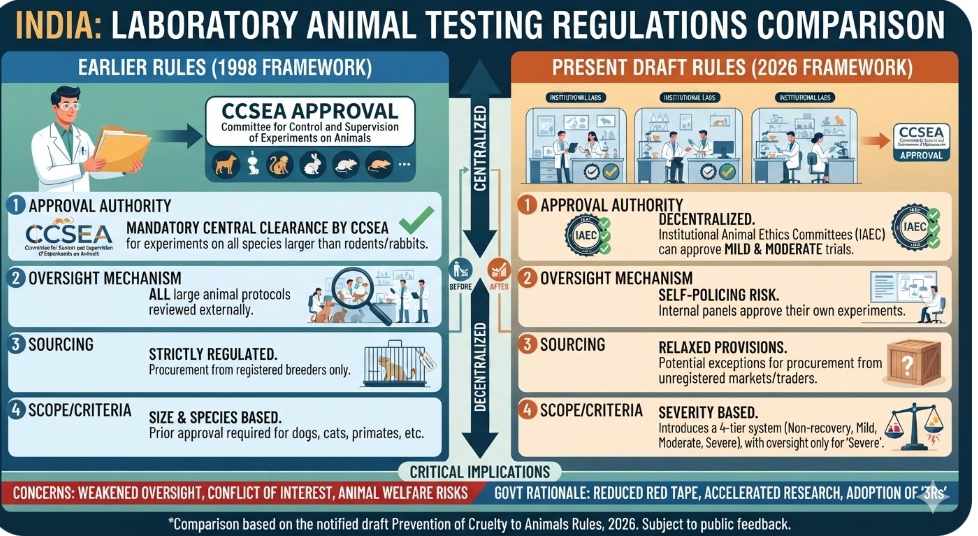
The primary structural divergence between the 1998 rules and the newly drafted 2026 guidelines lies in the elimination of mandatory central scrutiny for large-animal experimentation. Under the established 1998 regulatory protocol, any researcher or pharmaceutical conglomerate intending to conduct testing on animals larger than rodents and rabbits—specifically dogs, cats, pigs, horses, cattle, and non-human primates—was legally obligated to obtain explicit, prior clearance from the central regulatory body, the Committee for Control and Supervision of Experiments on Animals (CCSEA).
The draft rules completely upend this system by introducing a modern four-tier classification matrix based on estimated pain levels rather than the physical size of the species. Experiments will now be categorised under non-recovery, mild, moderate, or severe benchmarks. Under Rule 11 of the 2026 draft, any experimentation determined by an institution to fall within the mild or moderate threshold can be greenlit autonomously by that specific facility's internal Institutional Animal Ethics Committee (IAEC). This administrative decentralisation grants internal panels the final authority to sanction trials across any animal species without ever referring the project details to the central CCSEA panel.
Furthermore, the structural composition of these internal ethics committees has triggered immense concern. The 2026 rules allow the parent research institution to directly select and appoint the committee's internal chairperson and member secretary. Welfare advocates emphasise that this arrangement effectively allows commercial entities and private academic laboratories to police their own operations, establishing an absolute conflict of interest where academic or financial advancement can easily overshadow animal protection metrics.
Maneka Gandhi Issues Starks Warnings on Accountability
Former Union Minister and seasoned animal rights champion Maneka Gandhi has led the opposition against the draft framework, releasing detailed arguments characterising the proposal as a regressive step for Indian science. Gandhi questioned the logical and moral foundation of the decentralisation policy, pointing out the inherent dangers of removing external checks from highly profitable corporate entities.
In her formal statements, Gandhi noted that an institution cannot be asked to police itself when the lives of animals are at stake. She questioned who will protect the animals if independent, external oversight is systematically weakened. She emphasised that while the global scientific community is aggressively transitioning to phase out live animal usage entirely, India's new draft appears explicitly structured to make the containment and exploitation of large mammals easier for commercial operators. Gandhi also pointed out that even India's own Health Ministry has historically updated its regulatory frameworks—such as the New Drugs and Clinical Trials Rules—to acknowledge that new chemical entities can be verified using advanced, non-animal testing methodologies. She concluded that the draft does not serve true science, but rather serves the convenience of private entities seeking to bypass ethical accountability.
Animal Protection Organisations Highlight Sourcing Risks
The backlash has been forcefully amplified by major welfare bodies, including People for the Ethical Treatment of Animals (PETA) India and People for Animals (PFA), both of which have launched nationwide coordination campaigns demanding the immediate and total withdrawal of the 2026 draft. Activists and veterinary policy advisors have meticulously analysed the fine print of the text, discovering highly problematic updates concerning how laboratories procure their living research subjects.
According to technical reviews published by PETA India, the draft framework introduces broad exceptions to traditional animal-sourcing mandates, potentially permitting establishments to source experimental animals from open markets, unregistered commercial traders, and unstructured environments. Activists warn that these loopholes significantly raise the risk of community dogs, abandoned pets, and captured free-ranging street cats being funnelled directly into commercial research projects.
Furthermore, welfare organisations have exposed the problematic parameters used to define pain levels within the new draft. Under the proposed severity scale, techniques involving prolonged social isolation, food deprivation, starvation, and the application of inescapable psychological or physical stimuli are classified merely as mild or moderate interventions. Because of this classification, such procedures would escape central CCSEA scrutiny entirely, leaving internal institutional panels to clear them without public visibility.
Dr Anjana Aggarwal, a prominent scientist and research policy advisor, noted that these protocols run completely counter to modern biosecurity frameworks. Welfare experts also point out that the draft explicitly expands the permissible operating definitions of a laboratory site to include non-enclosed structures and mobile facilities, which could lead to severe biosecurity failures, improper waste management, and the local transmission of experimental pathogens near human habitats.
Government Rationale and the Animal Husbandry Board Position
In stark contrast to the warnings issued by welfare advocates, administrative representatives from the Ministry of Fisheries, Animal Husbandry and Dairying, alongside proponents within the Department of Animal Husbandry, maintain that the draft rules represent a progressive, globally attuned update. Government officials emphasize that the 1998 guidelines have become structurally outdated, creating severe administrative backlogs that delay vital biomedical breakthroughs, vaccine development projects, and national pharmaceutical trials.
The official stance highlights that the draft formally institutionalises the internationally recognised "3Rs" principle of animal research—specifically Replacement, Reduction, and Refinement—directly into the statutory text. Proponents argue that the implementation of local mixed panels, combined with the four-tier pain assessment framework, forces institutions to actively design experiments that minimise distress.
According to departmental spokespersons, centralizing every single large-animal approval within the CCSEA has historically slowed down imperative academic research. By shifting the evaluation of mild and moderate procedures to registered internal ethics committees, the central CCSEA can concentrate its specialized resources on inspecting laboratory facilities and strictly auditing top-tier severe-pain protocols and non-recovery procedures. The government insists that the draft balances scientific acceleration with animal care by requiring all breeders and traders to maintain basic registrations, thereby establishing a formal audit trail while removing unnecessary administrative barriers.
Editor's Note
The draft Prevention of Cruelty to Animals Rules, 2026, presents a significant risk to independent animal welfare monitoring in India under the guise of scientific modernization. While fast-tracking research timelines is an understandable administrative goal for the pharmaceutical sector, decoupling the evaluation of large-animal trials from centralized CCSEA oversight is a deeply flawed strategy. Allowing individual research facilities to appoint their own internal ethics chairs to approve mild and moderate protocols creates an undeniable conflict of interest that effectively eliminates transparency.
Moreover, the relaxed sourcing provisions that open the door to unregistered traders are highly alarming, creating a direct threat to community animals and stray populations. It is also deeply concerning that the underlying legal mechanism for deterrence remains tied to Section 20 of the parent Prevention of Cruelty to Animals Act of 1960, which caps fines for experimental violations at an completely obsolete maximum of two hundred rupees.
The true path forward for Indian research does not lie in easing laboratory trial approvals or lowering compliance bars for large-animal testing. The ministry must instead formalize a mandatory transition toward human-relevant, non-animal testing methodologies, such as organs-on-chips, advanced computational simulations, and human cell-based assays. The Central Government should withdraw the current draft, preserve the absolute requirement for prior centralized clearance for all non-rodent species, and ensure that independent welfare observers maintain unhindered oversight over every laboratory floor in the country.



Leave a comment