

TreeTake Network
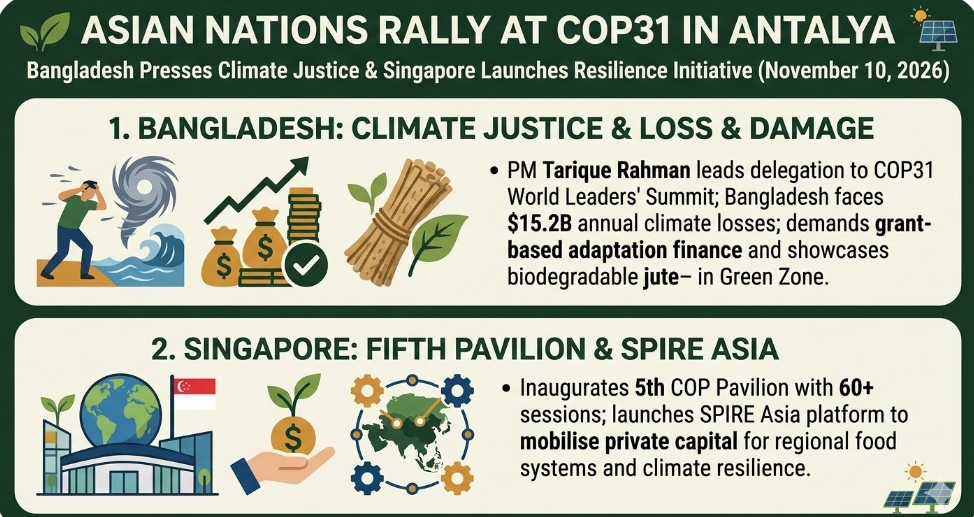
Asian nations stepped up their diplomatic and practical engagement at the 31st Conference of the Parties (COP31) to the United Nations Framework Convention on Climate Change (UNFCCC) in Antalya, Türkiye, on November 10, 2026, as Bangladesh Prime Minister Tarique Rahman arrived to champion climate justice and loss and damage compensation ahead of the World Leaders' Summit, while Singapore inaugurated its fifth consecutive climate pavilion with a new regional adaptation investment platform.
Together, the parallel developments highlight how South and Southeast Asian economies are advancing both high-level financial equity demands and concrete public-private resilience mechanisms during the 12-day global climate summit running from November 9 to November 20, 2026.
Bangladesh Presses for Grant-Based Finance and Loss and Damage Compensation
Departing Dhaka on the morning of November 10, 2026 and arriving in Antalya ahead of the November 11 and November 12, 2026 World Leaders' Summit, Prime Minister Tarique Rahman is leading Bangladesh's high-level delegation to place climate justice, technology transfer, and accessible grant-based adaptation finance at the forefront of negotiations. Despite contributing less than 0.5 per cent of global greenhouse gas emissions, Bangladesh ranks among the nations most severely affected by intensifying cyclones, riverbank erosion, salinity intrusion, and sea-level rise.
Outlining Dhaka's core demands ahead of the summit, Bangladesh Minister of Environment, Forest and Climate Change Abdul Awal Mintoo confirmed that climate-induced disasters cost Bangladesh roughly 15.2 billion US dollars annually. "Climate change is no longer a future threat for Bangladesh; it is an existential reality costing our economy billions of dollars every year, and developed nations must deliver grant-based adaptation and loss and damage finance rather than burdening vulnerable countries with high-interest loans," Abdul Awal Mintoo stated.
Bangladesh has also established a prominent presence across both the Blue Zone and Green Zone at the EXPO Antalya venue to showcase its updated Nationally Determined Contributions (NDC 3.0), community-led adaptation innovations, and biodegradable jute products as sustainable alternatives to single-use plastics. Commenting on the role of jute in global circular-economy solutions, Bangladesh Jute Diversification Promotion Centre Executive Director Zeenat Ara observed, "As nations gather at COP31 to curb plastic pollution and carbon emissions, Bangladeshi golden fibre offers an immediate, biodegradable industrial alternative that supports rural livelihoods while protecting ecosystems." Alongside multilateral sessions, Prime Minister Tarique Rahman is scheduled to hold bilateral discussions with Turkish President Recep Tayyip Erdoğan and other world leaders to strengthen climate and economic cooperation.
Singapore Opens Fifth COP Pavilion and Unveils SPIRE Asia
Across the EXPO Antalya complex on November 10, 2026, Singapore officially inaugurated its fifth consecutive COP Pavilion under the theme of driving climate action and strengthening community resilience through international partnership. Hosting more than 60 panel discussions, roundtables, and technical showcases across the two-week conference, the pavilion serves as a hub for governments, multilateral development banks, researchers, and private sector leaders.
Delivering the keynote address at the pavilion opening, Singapore Minister for Sustainability and the Environment Grace Fu unveiled Scaling Projects and Investments for Resilience in Asia (SPIRE Asia), a new regional multi-stakeholder platform designed to mobilise private capital into bankable adaptation projects across Asia, with an initial focus on sustainable food systems and water security. "Adaptation across Asia cannot rely on public budgets alone; through SPIRE Asia, we aim to bridge the financing gap by unlocking catalytic capital and scaling practical resilience projects that protect vulnerable communities and supply chains," Grace Fu stated.
Singapore Ambassador for Climate Action Ravi Menon emphasised that sustained multilateral cooperation remains indispensable even amid global economic and geopolitical headwinds. "At a time when geopolitical tensions and fiscal pressures threaten to slow the clean energy transition, practical partnerships across borders are essential to turn climate pledges into measurable emissions reductions and resilient infrastructure," Ravi Menon remarked.
The inauguration ceremony was attended by senior international climate figures, including COP31 President of Negotiations and Australian Climate Change and Energy Minister Chris Bowen, alongside United Kingdom Climate Envoy Rachel Kyte. Welcoming regional collaboration on the floor of the Antalya summit, Chris Bowen noted, "Real progress at COP31 depends on turning ambition into implementation, and initiatives that connect capital, technology, and regional resilience across Asia demonstrate the spirit of practical delivery this summit requires."
Editor's Note
The parallel diplomatic and institutional interventions by Bangladesh and Singapore at COP31 illustrate the dual imperative confronting Asia on the front lines of climate change. While climate-vulnerable nations like Bangladesh rightly demand predictable, grant-based loss and damage restitution from historical emitters to safeguard millions of lives, regional hubs like Singapore are demonstrating how blended finance platforms can accelerate private investment in adaptation and food security. Moving forward, negotiators in Antalya must ensure that both tracks advance in tandem so that global climate finance reaches the communities most exposed to climate shocks while scaling resilient infrastructure across the developing world.



Leave a comment