

TreeTake Network
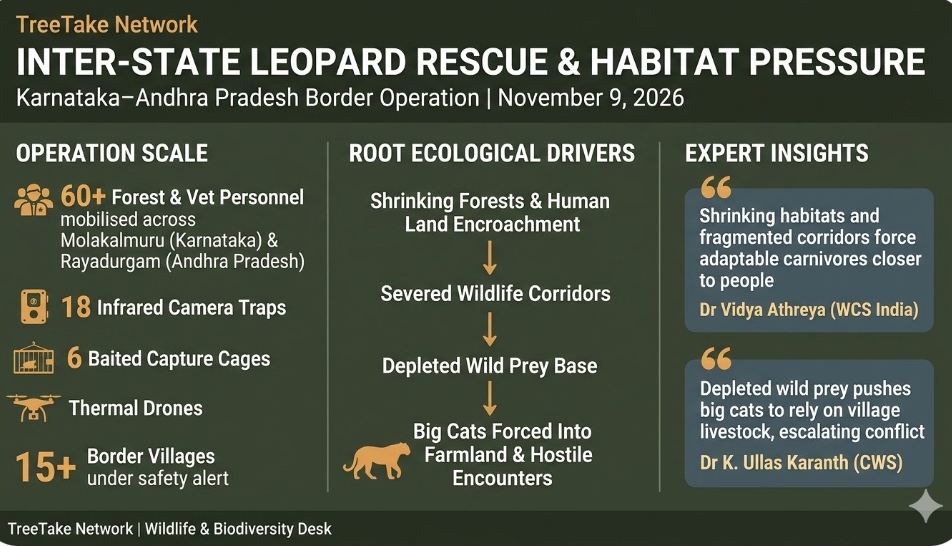
A coordinated inter-state wildlife tracking and capture operation involving forest department personnel from Karnataka and Andhra Pradesh continued at full intensity on November 9, 2026, along the rocky border corridor near Chitradurga district following a fatal leopard attack on a local farmer. More than 60 frontline forest guards, veterinary tranquilisation specialists, and wildlife trackers have been mobilised across scrubland and agricultural fringes bordering Molakalmuru taluk in Karnataka and Rayadurgam mandal in Andhra Pradesh to locate and safely capture the big cat.
Fatal Attack Triggers High-Alert Inter-State Response
The emergency operation was launched after a 52-year-old farmer tending his groundnut and maize fields near the inter-state boundary succumbed to severe injuries sustained in a sudden leopard attack late on November 7, 2026. Field inspections conducted by senior range forest officers on November 8, 2026, confirmed fresh pugmarks, drag trails, and claw markings consistent with an adult Indian leopard (Panthera pardus fusca) moving between rocky hillocks on the Karnataka side and adjoining dry deciduous scrub forests in Andhra Pradesh's Anantapur district.
Because the territory straddles administrative jurisdictions with minimal physical barriers, senior conservators from both states established a unified field command centre on November 8, 2026, ensuring seamless real-time intelligence sharing, joint patrolling, and synchronised trap placement across the border belt.
Camera Traps, Cages, and Thermal Drones Deployed
By the morning of November 9, 2026, joint task force teams had installed 18 motion-triggered infrared camera traps along identified wildlife movement corridors, waterholes, and rocky outcrops, alongside six heavy-duty iron capture cages baited under strict veterinary supervision. Thermal imaging drones are also being flown during dusk and early dawn hours to scan dense prosopis thickets and boulder crevices where leopards typically shelter during daylight.
Chitradurga Deputy Conservator of Forests (DCF) T Rajanna confirmed that capturing the animal alive without endangering local villagers or field staff remains the foremost priority. "We have established a coordinated inter-state grid with our counterparts from the Andhra Pradesh Forest Department to monitor every movement corridor along the border hillocks," Rajanna stated. "Eighteen camera traps and six cages have been positioned at strategic points, and our tranquilisation teams are on standby round the clock until the leopard is safely rescued."
Anantapur District Forest Officer (DFO) G Satish Kumar emphasised the operational importance of cross-border collaboration in semi-arid Deccan habitats. "Wildlife does not recognise state boundaries, especially in contiguous rocky landscapes connecting Rayadurgam and Molakalmuru," Kumar noted. "Joint patrolling and shared camera-trap data allow us to track the animal's movement pattern accurately and prevent any further human-wildlife conflict."
Shrinking Forests, Vanishing Corridors, and Depleted Prey Drive Hostile Encounters
Conservation biologists and wildlife ecologists stress that behind every emergency capture operation lies a deeper ecological crisis driven by relentless human encroachment. Across the Deccan Plateau, expanding agricultural boundaries, quarrying, linear infrastructure, and rural settlements have steadily encroached upon traditional wildlands—causing natural forest cover to shrink and severing vital wildlife corridors that once allowed big cats to disperse safely.
As natural habitats contract, wild herbivores such as spotted deer, four-horned antelope, and wild hare decline sharply. Deprived of their natural prey base and squeezed into fragmented pockets of scrubland, leopards face acute survival stress that pushes them into human-dominated fields in search of domestic livestock and dogs, turning defensive or hunger-driven encounters into hostile confrontations that ultimately trigger intensive capture hunts.
Dr Vidya Athreya, wildlife biologist and Director of the Wildlife Conservation Society (WCS) India, who has extensively researched human-leopard interactions across agricultural landscapes, highlighted how landscape transformation alters animal behaviour. "Leopards are highly adaptable carnivores that routinely inhabit human-dominated agricultural mosaics across peninsular India, yet shrinking natural habitats and fragmented corridors constantly force them into closer proximity with people," Dr Athreya explained. "Preventing tragic encounters requires immediate village-level early warning systems, avoiding solitary movement near dense crop edges after dusk, and ensuring livestock enclosures are securely fenced."
Dr K Ullas Karanth, renowned wildlife scientist and Emeritus Director of the Centre for Wildlife Studies (CWS), underscored the fundamental link between intact ecosystems, wild prey, and human safety. "When wild habitats are degraded and natural prey populations are depleted through human pressures, large carnivores are forced to rely on domestic animals near villages, which inevitably escalates conflict," Dr Karanth noted. "Lasting solutions depend on protecting contiguous forest patches, restoring natural prey bases, and preventing unplanned encroachment into critical wildlife corridors."
Safety Advisories Issued Across Border Villages
District administrations in both Chitradurga and Anantapur issued urgent public safety advisories on November 9, 2026, instructing residents in more than 15 border villages to avoid venturing into fields alone between sunset and sunrise, keep children indoors after dark, and report any fresh pugmarks or livestock sightings immediately to dedicated forest helpline numbers.
Editor's Note
The swift inter-state coordination between Karnataka and Andhra Pradesh forest authorities demonstrates an essential operational model for managing human-wildlife conflict across porous ecological boundaries. However, emergency capture operations address only the immediate symptom of a far deeper crisis. As human expansion shrinks forests, severs migration corridors, and depletes natural prey bases, wild carnivores are pushed toward hostile survival behaviours that invariably result in tragedies for both villagers and wildlife. Long-term coexistence across the Deccan scrublands depends on safeguarding intact habitats, restoring wild prey populations, and maintaining vigilant community-level early warning networks.



Leave a comment