

TreeTake Network
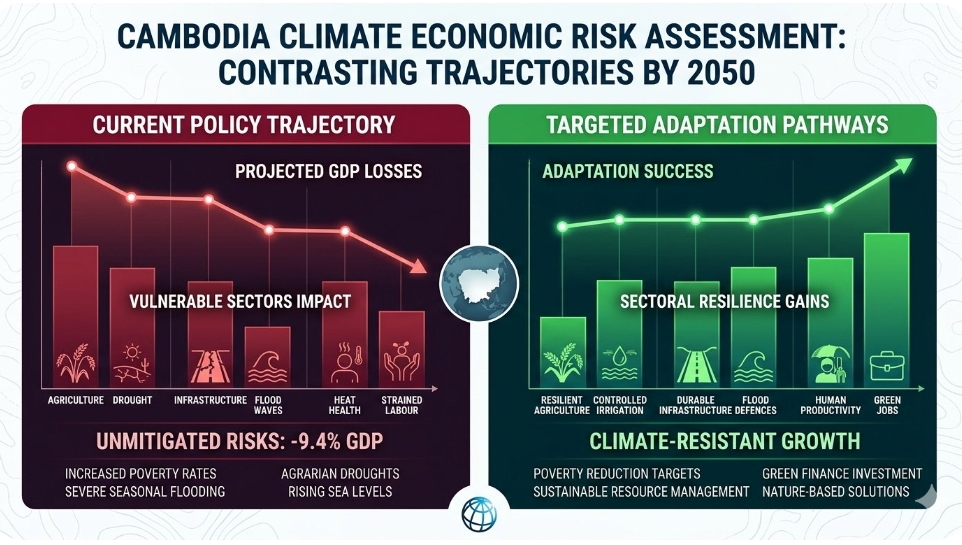
Unmitigated climate change and escalating environmental volatility present an acute threat to the long-term economic development of Cambodia, potentially reducing the nation's Gross Domestic Product by up to 9.4% by the year 2050. The latest Country Climate and Development Report published by the World Bank explicitly details that the combination of severe seasonal floods, prolonged agrarian droughts, rising sea levels, and intense heat stress will disproportionately penalise low-income communities and accelerate domestic poverty rates unless proactive, systemic interventions are deployed immediately.
Cambodia has registered strong macroeconomic expansion over the past two decades, maintaining an ambition to graduate to an upper-middle-income status by 2030. However, the report highlights that the country's geographical vulnerability, ranked fourth globally for flood exposure under international risk indices, risks stunting this transition. Key climate-sensitive sectors, including traditional agriculture, inland fisheries, rural infrastructure, and human manufacturing productivity, face systemic vulnerabilities under severe emissions scenarios, which could add up to six percentage points to the national poverty rate by 2040.
Mariam Sherman, World Bank Country Director for Cambodia, Myanmar, and Lao PDR, highlighted the acute risks facing impoverished regions, noting that Cambodia is among the nations with the highest vulnerability to floods and extreme heat, and unfortunately, the most vulnerable regions and communities tend to be the poorest. Sherman added that proactive adaptation options exist to curb these impacts on growth and livelihoods.
To address these vulnerabilities, the report details a strategic path aimed at reducing asset exposure, realigning emissions, and reorienting the economy toward the global green transition.
Manuela V Ferro, World Bank Vice President for East Asia and Pacific, emphasised the scale of the challenge, stating that in order to recover the lost ground due to the pandemic and high food and energy prices, the country must implement targeted adaptation measures that can effectively halve potential GDP losses.
Editor's Note
The report underscores that climate adaptation is vital for Cambodia's macroeconomic stability. Shifting investments toward resilient infrastructure, forest conservation, and green finance is critical to breaking the unsustainable cycle of post-disaster reconstruction.



Leave a comment