

Thinking Point
TreeTake Network
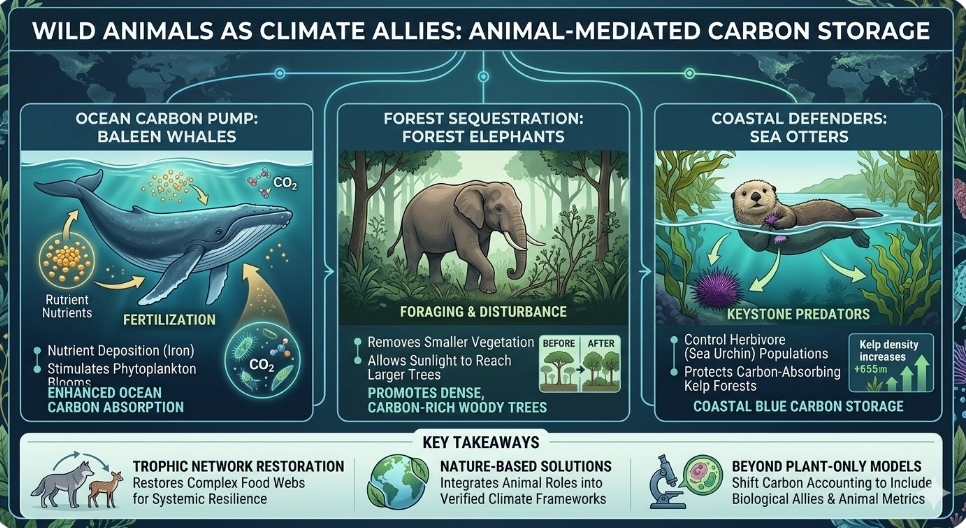
Over 260 international scientists, conservation biologists, and climate researchers from leading global institutions have co-signed a breakthrough policy paper urging international bodies to formally recognise wild animals as active biological allies in the fight against climate change. The multi-disciplinary assessment proves that restoring depleted populations of key species—ranging from open-ocean baleen whales and sea otters to forest elephants and grey wolves—can significantly accelerate natural carbon storage, providing an indispensable, nature-based mechanism to stabilize upper atmosphere emissions.
The collective paper details how wild fauna function as "ecosystem engineers" that actively alter carbon cycles through their daily foraging, nutrient deposition, and seed dispersal habits. For example, large forest herbivores encourage the growth of dense, woody trees that hold far higher volumes of carbon, whilst marine mammals distribute vital iron compounds that stimulate carbon-absorbing phytoplankton blooms across open-ocean corridors. Marine and terrestrial ecosystems risk losing their baseline carbon buffering capacity unless global frameworks pivot away from static, plant-only accounting models.
Dr Angela Oswald, lead ecologist at the Interdisciplinary Centre for Biosphere Research, analysed the biological mechanics behind the report. "For decades, international climate frameworks have treated carbon sequestration as a purely botanical process, focusing exclusively on planting trees," Dr Oswald stated. "Our combined research proves that a forest or ocean devoid of its native animal cohorts is drastically less efficient at processing carbon. Restoring wildlife is a fundamental prerequisite if we are to optimise the planet's natural carbon sinks."
The unified scientific group is lobbying for animal-mediated carbon metrics to be integrated directly into national biodiversity action plans ahead of upcoming international environmental treaties.
Dr Christian Rutz, a senior research fellow in wildlife conservation tracking systems, emphasised the strategic urgency of shifting policy models. "We must expand our climate strategies to value the functional roles of animals within their natural habitats," Dr Rutz remarked. "Protecting trophic networks is not just an ethical duty for wildlife preservation; it is a highly viable macroeconomic strategy to stabilise global temperatures and secure systemic ecological resilience."
Editor's Note
The international scientific consensus shifts the paradigm of wildlife conservation from a passive ethical pursuit to a core pillar of global climate mitigation strategy. To operationalise these findings, international climate funds must expand their investment criteria, allowing countries to secure verified carbon credits directly linked to the verifiable recovery of keystone animal populations. True ecological balance requires moving past simplified tree-planting metrics, ensuring that the living, breathing networks that sustain the biosphere are fully restored.



Leave a comment