

Talking Point
TreeTake Network
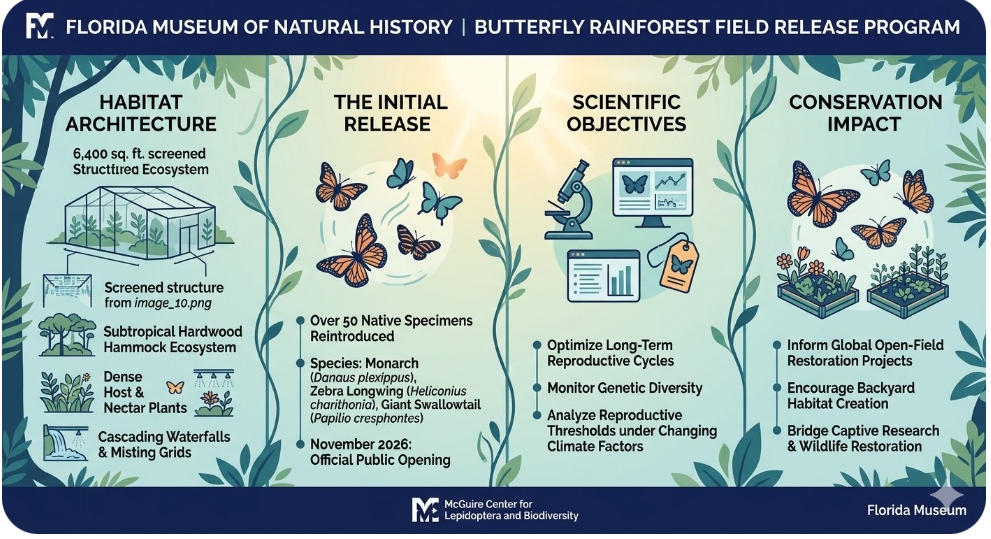
Conservation biologists and lepidopterists at the Florida Museum of Natural History have marked a significant milestone after successfully completing the inaugural field release of multiple native butterfly cohorts into the newly curated Butterfly Rainforest pavilion in Gainesville, Florida. The carefully orchestrated reintroduction program serves as the final biological implementation phase ahead of the state-of-the-art facility opening its doors to the public on November 20, 2026. The expansive 6,400-square-foot screened structure now contains an entirely self-sustaining ecosystem built to replicate a subtropical hardwood hammock.
The dynamic habitat contains a dense assortment of tropical and native flora, cascading water features, and specialised microclimate misting grids designed to maintain exact humidity parameters. By creating an enclosed environment that minimises natural predators, scientists are seeking to optimise long-term reproductive cycles for several threatened species. The initial release phase successfully reintroduced over 50 specimens, prioritising the iconic monarch, the vibrant zebra longwing, and the giant swallowtail, each sourced from certified, disease-free regional breeding laboratories.
Dr Jaret Daniels, the lead curator and director of the museum's McGuire Centre for Lepidoptera and Biodiversity, highlighted the technical precision behind the habitat design. "Our team spent over 18 months customising the plant architecture within this structure to ensure that specific larval host plants align organically with adult nectar sources," Dr Daniels explained. "By modernising the traditional greenhouse layout into a fully integrated rainforest, we are not simply building a public exhibition, but providing a living laboratory where we can analyse reproductive thresholds under changing climate factors."
The museum administration intends to continuously monitor genetic diversity within the pavilion, introducing supplementary wild strains throughout the winter season to minimise the risks of inbreeding depression. The data gathered from these closed tracking cohorts will directly inform global open-field restoration projects across the Southeastern United States.
Dr Thomas Emmel, a senior research specialist in invertebrate conservation ecology, emphasised the critical educational framework of the release. "Allowing visitors to visualise the entire lifecycle of these animals up close is a highly effective way to encourage community-driven backyard habitat restoration," Dr Emmel stated. "If we are to reverse the steep declines tracked in wild pollinator populations, we must humanise conservation science, transforming abstract global biodiversity goals into tangible, localised experiences."
Editor's Note
The completion of the Gainesville butterfly release highlights the growing value of controlled ecological facilities in modern conservation science. While large-scale wilderness preservation remains the ultimate goal, enclosed sanctuaries provide invaluable safe zones for vulnerable species to breed without immediate predatory pressures. Moving forward, academic institutions must secure steady funding pathways to bridge the gap between captive research and open-field wildlife restoration.



Leave a comment