

TreeTake Network
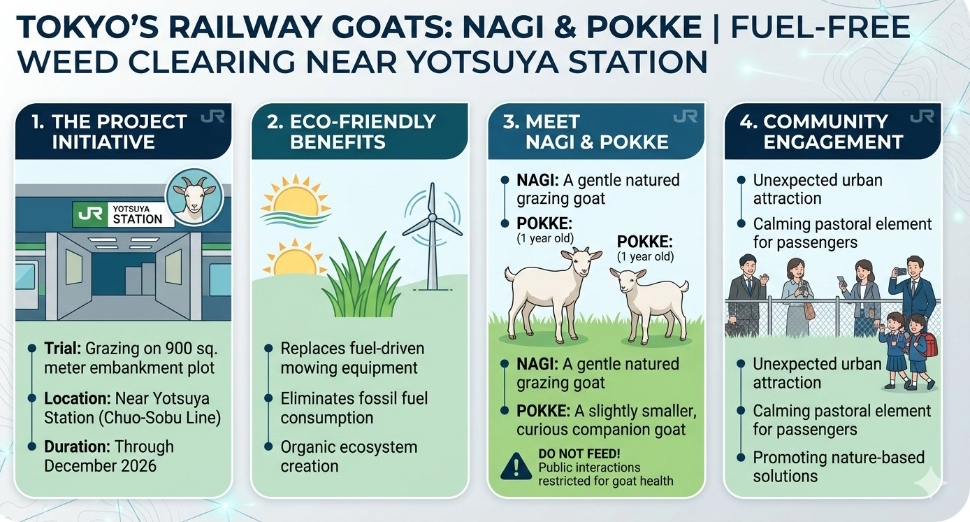
A pastoral experiment has captured global attention in the dense urban core of Tokyo, where rail operators are utilising an innovative approach to vegetative maintenance. East Japan Railway Company has officially deployed two young goats, named Nagi and Pokke, to manage overgrown grass along a 900-square-metre plot of steep embankment property near Yotsuya Station. The trial marks the first time the network has integrated live grazing livestock for eco-friendly grounds management within Tokyo's central Yamanote Line loop, successfully replacing mechanical, fuel-driven mowing equipment.
The initiative, originally proposed by a local station worker seeking low-carbon landscape strategies, has transformed the rail property near the Akasaka exit into an unexpected public attraction. Passers-by, daily commuters, and local school cohorts frequently gather above the sunken grassy zone to watch the animals graze. To safeguard the health of the four-legged workers, the station administration has established a secure perimeter, complete with an overnight weather shelter, whilst explicitly prohibiting the public from offering outside food items.
Takashi Suzuki, a senior operations director at East Japan Railway Company's metropolitan asset management division, detailed the mechanical transition of the project. "The traditional methods of clearing steep railway embankments require significant fossil fuel consumption and complex mechanical harness rigs to ensure worker safety," Suzuki explained. "By customising this trial with natural biological grazing, we completely eliminate fuel expenditure for this sector whilst fostering an organic ecosystem that brings a calming, pastoral element to our passengers."
The project is scheduled to run until December 2026, or until the immediate vegetation runs out, with potential plans to reintroduce the grazing rotation between March and May 2027. Environmental economists are tracking the trial to calculate the scalability of animal-assisted landscape care across expansive suburban track corridors.
Dr Naomi Tanaka, an urban ecology research fellow at the Tokyo Institute for Environmental Sustainability, emphasised the broader educational and societal value of the system. "Deploying grazing goats within one of the densest transit hubs in the world is a brilliant method to popularise nature-based solutions," Tanaka remarked. "It forces modern urban planners to visualise cities not as sterile concrete containers, but as fluid spaces where natural systems can minimise traditional carbon burdens."
Editor's Note
The Yotsuya Station initiative demonstrates that decarbonisation does not always require capital-intensive technological investments; rather, it often relies on realigning existing natural workflows with urban demands. Moving forward, global transit corporations must expand their definition of green infrastructure to systematically incorporate biological maintenance strategies. Realising a zero-emission transit network requires creativity at every tier, ensuring that localised field solutions actively complement large-scale fleet electrification.



Leave a comment