

Talking Point
TreeTake Network
Multi-agency enforcement squads deployed by the Delhi municipal apparatus have launched sweeping punitive action against major infrastructure firms, penalising 47 distinct operations within a 24-hour window for violating localised dust-control parameters. The aggressive legal sweep comes as local authorities struggle to secure systemic industrial compliance amidst the rapid deterioration of the regional winter air baseline. Compliance inspectors equipped with laser-based particulate monitors carried out unannounced physical audits across 11 high-density transit and construction corridors, identifying widespread failures in basic atmospheric mitigation protocols.
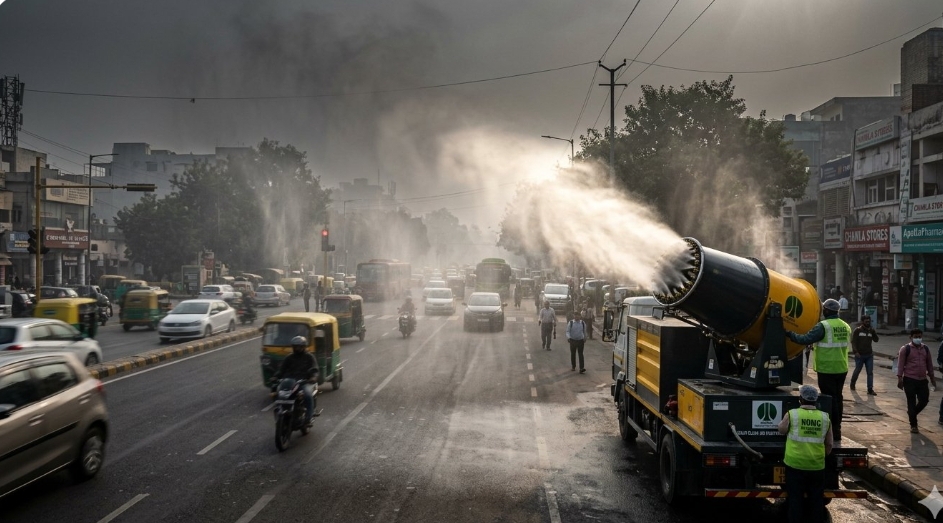
The targeted administrative intervention follows the enforcement of Stage III emergency curbs under the Graded Response Action Plan, which mandates absolute dust suppression protocols across all permissible municipal and utilities works. Under existing statutory frameworks, commercial entities found failing to deploy continuous water-sprinkling systems, high-altitude anti-smog guns, or wind-breaking perimeter sheets face immediate operational suspension alongside severe fiscal penalties. The municipal squads confirmed that the penalised projects spanned several major public utility extensions, commercial hubs, and private residential developments.
Regulatory directors emphasise that localised dust from unpaved transit corridors and unregulated construction bypasses remains a primary catalyst for the dangerous elevation of the regional PM2.5 baseline.
"Our physical inspections have revealed a pattern of structural negligence among major project managers who treat environmental safeguards as optional overheads," stated Viren Shah, Deputy Commissioner of the Capital Air Taskforce. "Firms must understand that we will no longer tolerate localised dust clouds bypassing our public health safeguards. We have finalised a streamlined tracking mechanism that allows our squads to issue instant, legally binding halt-work orders alongside the 47 punitive fines executed during this shift."
Environmental scientists warn that the current meteorological inversion layer traps dense industrial and ground-level particulates close to the surface, transforming minor local compliance lapses into regional public health threats.
"The atmospheric conditions we encounter in November mean that any unmitigated dust source has an amplified biological impact on the surrounding urban population," observed Dr Meera Chawla, Principal Atmospheric Researcher at the Clean Air Institute. "When an infrastructure firm fails to internalise regularised water-misting or leaves vast piles of soil uncovered, they are directly contributing to the toxic inversion layer. Our continuous modelling demonstrates that localised enforcement must achieve absolute consistency if we are to prevent these early-winter pollution spikes from overwhelming our medical infrastructure."
Editor's Note
The sudden surge in municipal penalties against infrastructure firms exposes the severe limits of voluntary corporate compliance within the northern Indian airshed. While high-volume punitive sweeps provide immediate administrative accountability, they function as reactive checks rather than preventive solutions to an annual public health crisis. The optimal way forward requires shifting from periodic physical inspections to an automated, sensor-driven compliance framework, in which all large-scale construction sites are legally required to integrate real-time PM10 telemetry links that trigger automatic regulatory lockdowns the moment a developer's localised dust emission baseline is breached.



Leave a comment