

TreeTake Network
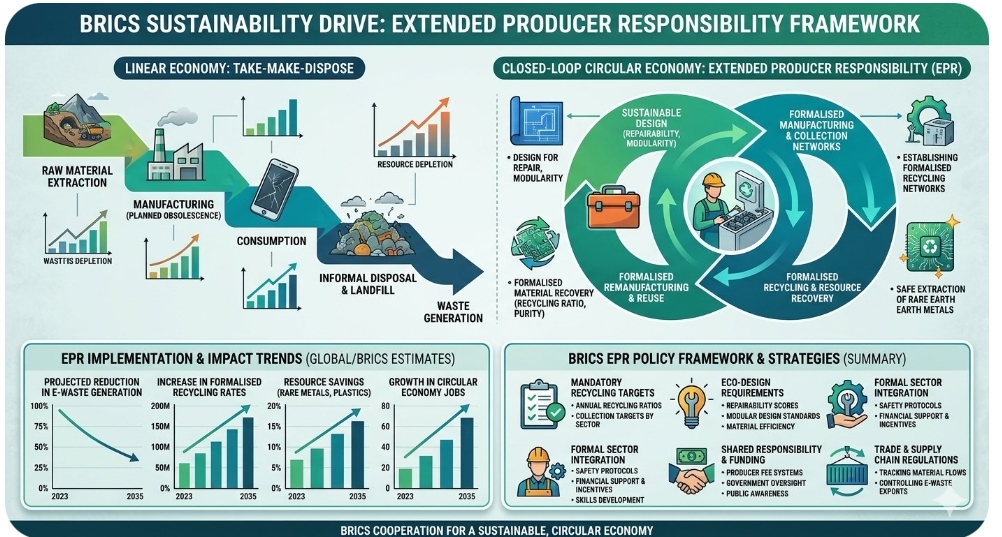
India firmly advocated for the international standardisation of mandatory Extended Producer Responsibility frameworks to curb the global surge in electronic waste on Friday, November 6, 2026. Speaking at the official plenary sessions of the BRICS Sustainable Lifestyle Week, the Indian delegation presented a comprehensive circular-economy blueprint designed to modernise resource recovery across industrial sectors. With global e-waste generation expanding at an alarming rate, the proposal insists that manufacturing corporations must remain legally and financially responsible for the entire life cycle of consumer electronics. The strategic initiative seeks to harmonise waste-management programmes across Brazil, Russia, India, China, and South Africa, establishing unified guidelines to prevent developed markets from using transnational corridors as informal dumping grounds.
The structural transition toward closed-loop industrial ecosystems requires high-level coordination to balance commercial growth with resource conservation. Professor Alok Kumar, Director of the National Institute of Urban Affairs and Specialist in circular economics, stated: "Voluntary corporate recycling schemes have historically failed to deliver tangible ecological benefits, meaning that mandatory frameworks are the only viable mechanism to compel tech conglomerates to design products that naturally favour repairability." Detailing the collaborative technology sharing required under the new pact, Dr Sunita Narain, Director General of the Centre for Science and Environment, observed: "BRICS nations represent a massive share of global industrial consumption, and a unified policy on electrical components will decisively disrupt the traditional take-make-dispose economic paradigm."
Sovereign shifts toward sustainable manufacturing require substantial updates to regional supply chains and domestic informal recycling sectors. Professor Liu Jian, Chief Scientist at the United Nations Environment Programme, cautioned: "Transitioning to fully formalised circular supply chains will require considerable infrastructure financing to safely integrate informal waste pickers, who currently bear the dangerous chemical burden of primitive toxic extractions." Emphasising the strategic value of international waste regulation, Dr Carlos Nobre, Earth System Scientist, noted: "Establishing clear product lifecycle accountability across rapidly growing economies is a critical element in reducing the heavy carbon and ecological footprints associated with the mining of rare earth metals."
Editor's Note
India's strong push for enforceable responsibility models at the BRICS summit underscores the need to move beyond localised waste collection toward global corporate accountability. Moving forward, participating governments must create clear financial incentives for companies that design modular, easily recyclable consumer goods while imposing heavy penalties on planned obsolescence.



Leave a comment